Answering 4-Mark Questions (DP IB Economics: SL): Revision Note

How to answer IB Economics 4-mark questions
4-mark questions assess your ability to apply and analyse economic theory clearly and accurately
They often sit at the boundary between short factual responses and more developed analytical answers
These questions are most closely linked to AO2 (application and analysis) and sometimes AO4 when diagrams are required
What examiners are looking for
For 4 marks, examiners typically expect:
a clear explanation of an economic relationship, and
accurate use of theory, diagrams, or data where required
Marks are usually awarded for:
correct economic reasoning, and
clear development of the explanation
Always read the full question carefully to identify:
the variable being explained, and
whether a diagram is required
Common command terms
Explain – describe an economic relationship using theory
Explain using a diagram – support your explanation with a correctly labelled diagram
Explain how – focus on cause-and-effect relationships
How to structure your answer
A strong 4-mark answer usually includes:
one or two short, well-developed paragraphs, and
a diagram only if explicitly required
If a diagram is required:
draw it clearly and label all axes and curves
refer to it directly in your written explanation
Worked Example
Explanation without a diagram
Question
Explain how an increase in interest rates may affect investment. [4]
Sample response
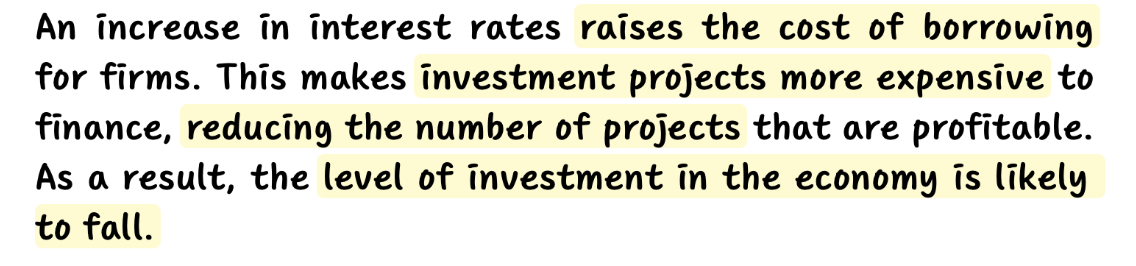
Why this scores 4/4
✅ Clear chain of economic reasoning
✅ Correct use of terminology
✅ Focuses directly on the variable in the question (investment)
Worked Example
Explanation using a diagram
Question
Explain using a diagram how a subsidy to producers may affect the price and quantity of a good. [4]
Sample response
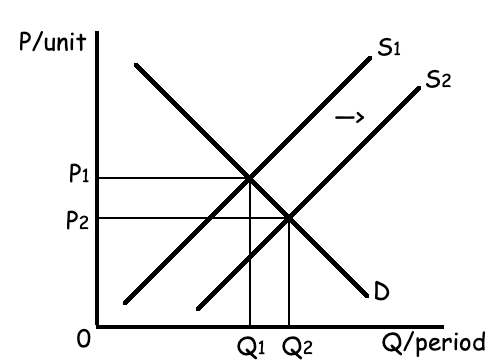
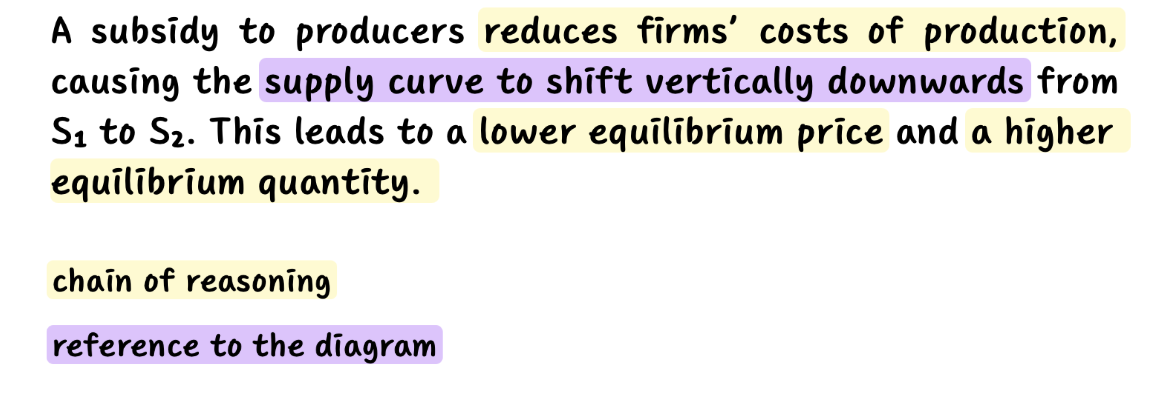
Why this scores 4/4
✅ The diagram is relevant and correctly labelled
✅ The explanation refers explicitly to the diagram
✅ Correct explanation of changes in price and quantity
✅ No unnecessary detail
Common mistakes to avoid
Adding evaluation or long conclusions
Drawing diagrams when not required
Forgetting to label axes or curves
Explaining the wrong variable
Examiner Tips and Tricks
If a diagram is required, an incorrect or poorly labelled diagram can cost up to half the marks, even if the written explanation is good
Keep diagrams simple, accurate, and relevant

Unlock more, it's free!
Join the 100,000+ Students that ❤️ Save My Exams
the (exam) results speak for themselves:

Was this revision note helpful?
