Answering Calculation Questions (DP IB Economics: SL): Revision Note

How to answer IB Economics calculation questions
Calculation questions appear mainly in Paper 2 and Paper 3 and are closely linked to AO4 (use and application of skills)
These questions reward method, accuracy, and interpretation, not speed.
Many students lose marks not because they do not understand the concept, but because they skip steps, omit units, or fail to interpret results correctly
What examiners are looking for
For calculation questions, examiners expect:
a clear and correct method
accurate numerical working
correct units and rounding
and, where required, economic interpretation of the result
Examiner Tips and Tricks
Even if the final answer is incorrect, marks may still be awarded for the correct method
General rules for calculations
Always show all workings
Write out formulas before substituting numbers
Include units in the final answer
Round final answers to two decimal places (unless instructed otherwise)
Use results from calculations in later questions when relevant
Worked Example
Percentage change
Question
Calculate the percentage change in the price of a good when it rises from $20 to $25. [2]
Sample response
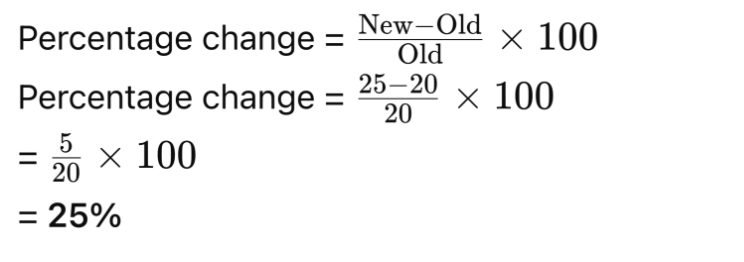
Why this scores full marks
✅ Correct formula shown
✅ Clear substitution and working
✅ Final answer clearly stated
Worked Example
Price elasticity of demand
Question
Calculate the price elasticity of demand (PED) when quantity demanded falls from 80 to 60 units following a price increase from $10 to $12. [4]
Sample response

Why this scores full marks
✅ Each step is clearly shown
✅ Correct use of the PED formula
✅ Correct sign and final value
Worked Example
Interpretation
Question
Using your answer to part (a), comment on the elasticity of demand. [2]
Sample response
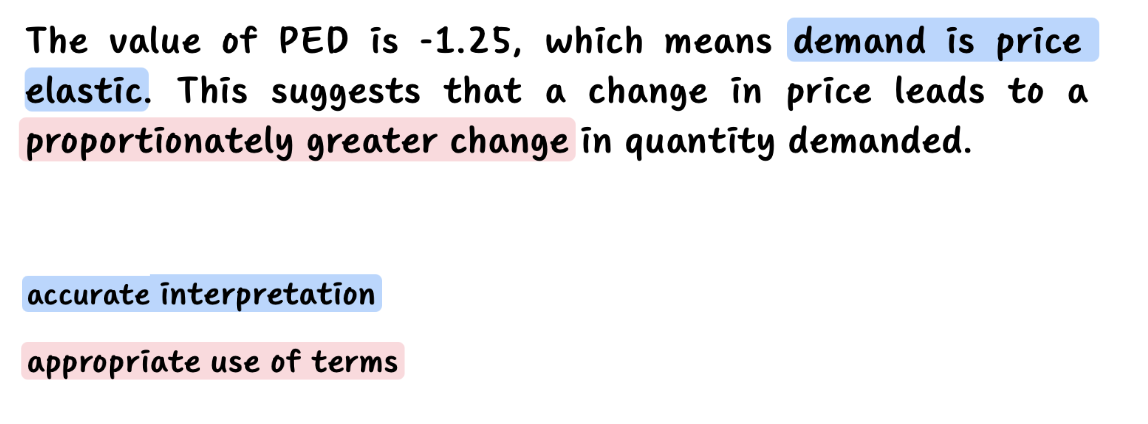
Why this scores full marks
✅ Refers explicitly to the calculated value
✅ Correct interpretation of elasticity
✅ Uses economic terminology accurately
Common mistakes to avoid
Writing only the final answer with no workings
Forgetting negative signs in elasticity values
Omitting units
Rounding too early
Failing to use calculation results in later evaluative questions
Examiner Tips and Tricks
Treat calculations as evidence, not isolated tasks. In Paper 2 and especially Paper 3, numerical results should support explanation and evaluation wherever possible

Unlock more, it's free!
Join the 100,000+ Students that ❤️ Save My Exams
the (exam) results speak for themselves:

Was this revision note helpful?