Answering the Paper 2 Essay (DP IB Economics: SL): Revision Note

How to answer IB Economics Paper 2 fifteen-mark question
Paper 2 part (g) is a 15-mark data-response evaluation question
Although it has the same mark allocation as a Paper 1 (b) essay, it assesses different skills and must be approached differently
In Paper 2, evaluation must be rooted in the stimulus material
Economic theory is essential, but it must always be applied directly to the data, text, and context provided
Answers that resemble Paper 1 essays are capped, even if the theory is accurate
What examiners are looking for in Paper 2 (g)
Paper 2 (g) primarily assesses:
AO2 (application) – effective and explicit use of the stimulus material
AO3 (evaluation) – balanced and context-specific judgment
supported by AO1 (knowledge) and AO4 (data interpretation)
To reach the top mark band, students must:
refer explicitly to figures, trends, or information in the stimulus
integrate data into analysis and evaluation
avoid generic or memorised responses
Structure of a strong Paper 2 essay
A high-scoring Paper 2 (g) response typically includes:
Introduction
Brief definitions of key terms
Clear identification of the economic issue in the given context
Analytical paragraphs
Relevant economic theory
Explicit reference to data from the stimulus
Clear cause-and-effect reasoning
Evaluation
Strengths and weaknesses of policies or outcomes
Short-run vs long-run effects
Distributional impacts
Limitations of data or policy effectiveness
Conclusion
A reasoned judgment directly linked to the evidence provided
Worked Example
Question
Evaluate the effectiveness of government policies in promoting economic growth in the Philippines. [15]
Sample response

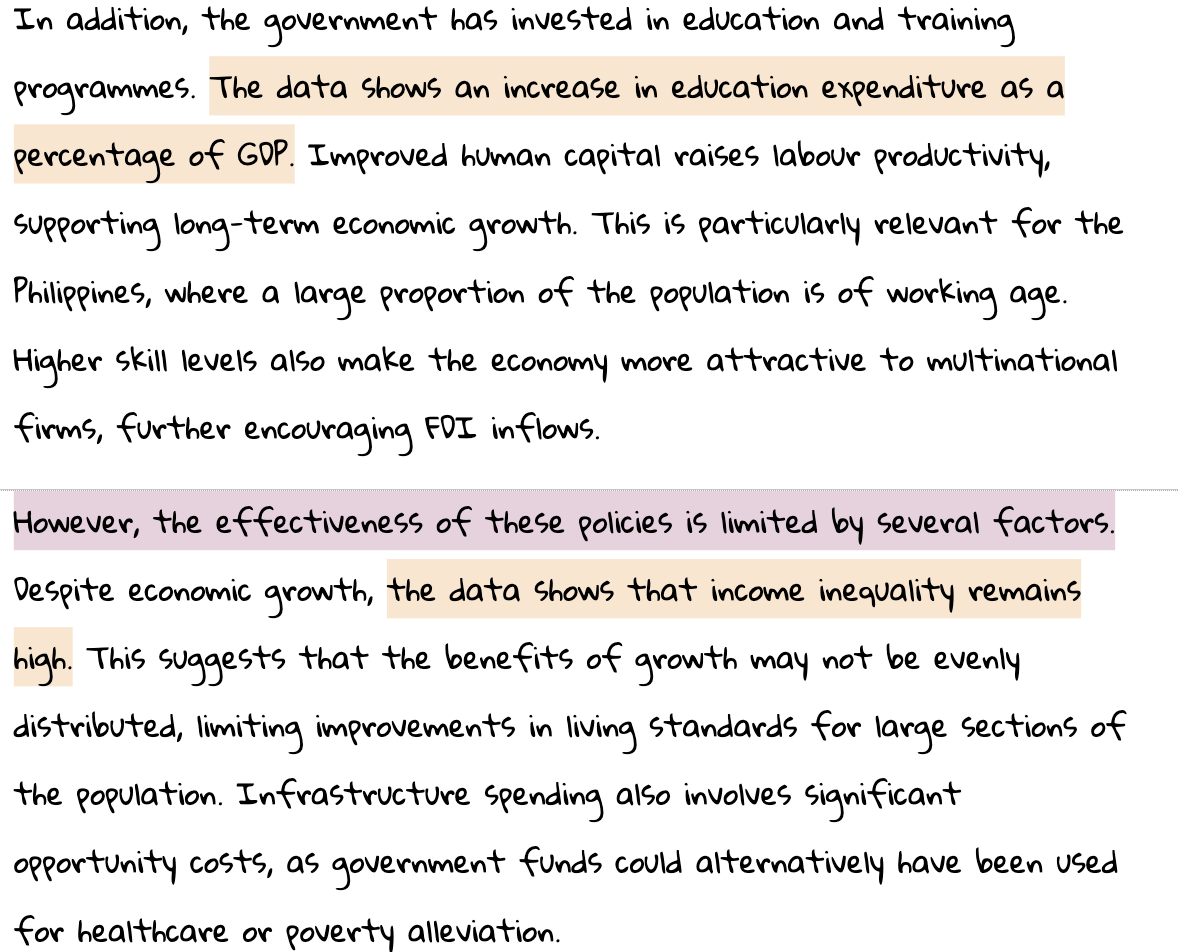
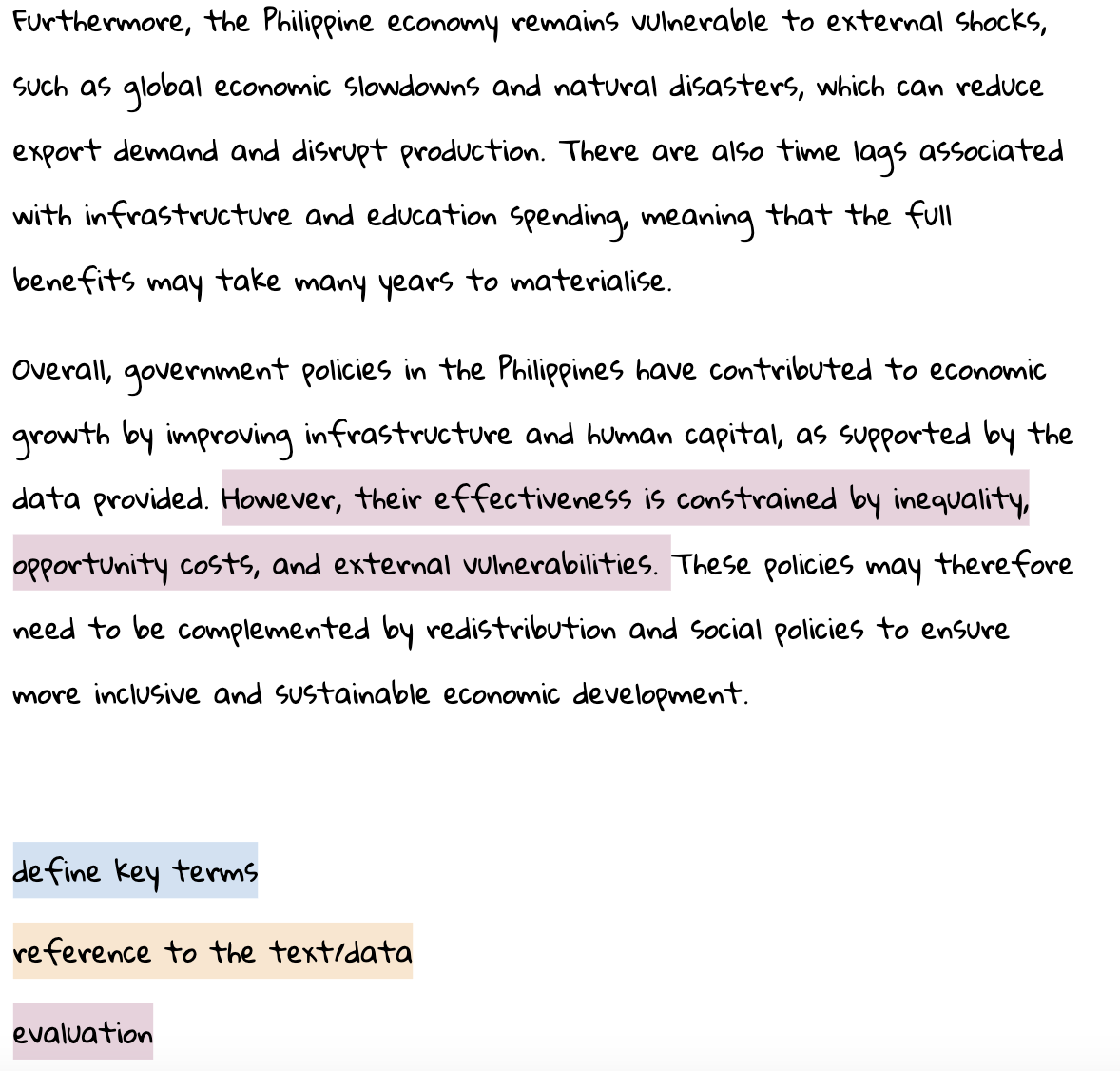
Why this scores in the top band
✅ Consistent and explicit use of stimulus data
✅ Clear application of theory to the Philippine context
✅ Evaluation is contextual, not generic
✅ A balanced and justified conclusion linked to evidence

Unlock more, it's free!
Join the 100,000+ Students that ❤️ Save My Exams
the (exam) results speak for themselves:

Was this revision note helpful?
