Business Management Toolkit: Ansoff Matrix (DP IB Business Management: SL): Revision Note

Ansoff matrix
Abraca could use the Ansoff matrix to determine suitable strategies to grow, depending on the level of risk it is willing to accept
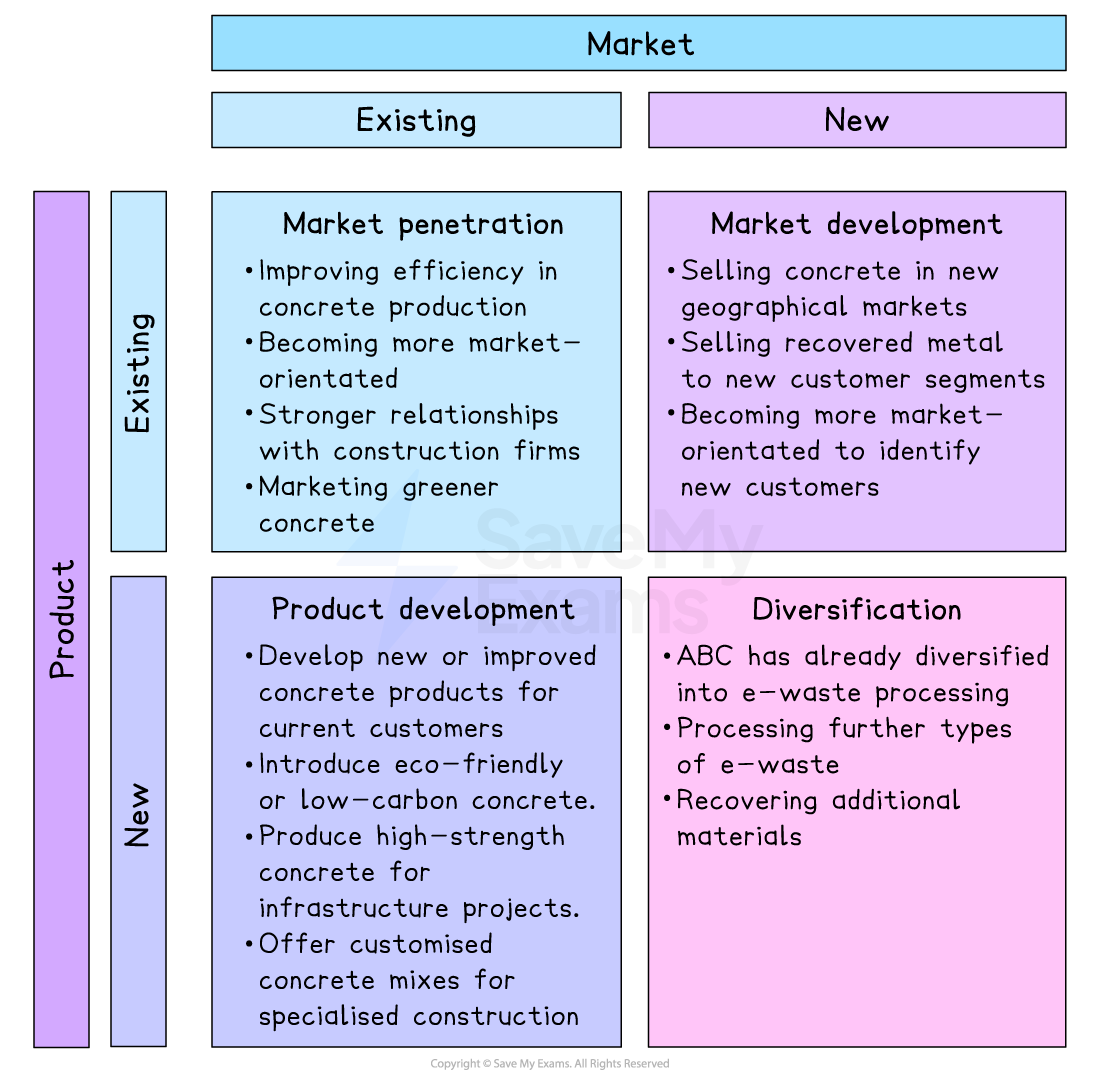
Worked Example
Market penetration
This strategy focuses on increasing sales of current products in current markets by improving efficiency, pricing or customer relationships
Application to Abraca (ABC)
Improving efficiency in concrete production
ABC is considering increasing efficiency in its existing concrete factories
Lower production costs could allow competitive pricing or higher profit margins in a B2B market where buyers are price-sensitive
Becoming more market-orientated
ABC could invest in better understanding what its construction industry customers need, rather than simply producing and selling
In a B2B market, this might mean tailoring concrete specifications to individual clients or offering better service
Stronger relationships with construction firms
ABC could secure long-term contracts with developers and governments
This increases repeat business and market share
Marketing greener concrete
ABC could promote its existing concrete as more sustainable
This may attract environmentally conscious construction companies
Challenges
Highly competitive industry
Concrete markets are often local and price-sensitive
Competitors may lower prices to protect their market share
ABC is already Country Z’s largest concrete producer
There may be a ceiling on how much more market share it can realistically capture through market penetration alone.
Environmental criticism
Cement production produces high CO₂ emissions
Improving image may be difficult without major investment
Potential impact | |
|---|---|
|
|
Worked Example
Product development
This strategy involves introducing new products to existing customers
Application to Abraca (ABC)
Low-carbon or “green” concrete products
ABC could develop concrete with lower emissions
Growing government sustainability targets in many countries make this increasingly attractive to B2B customers
Concrete using recycled aggregates
ABC is already researching using recycled products as aggregates in concrete
This would be a genuinely new product sold to ABC’s existing construction market
It directly supports ABC’s goal of reducing environmental impact and circular economy goals
Expanded e-waste recycling services
The pre-release terminology list includes plastic-shredding machinery and solar panels, suggesting ABC may expand beyond circuit boards into recycling other materials
Processing solar panel waste or shredding plastics from electronic devices would be new products within ABC’s existing (newly established) e-waste market
Challenges
ABC’s e-waste recovery process was discovered by chance during unrelated research
ABC does not appear to have a deliberate R&D track record in this field, which raises questions about whether it can develop further innovations intentionally
New concrete formulations using recycled aggregates would need to meet strict construction safety standards before customers would trust them in building projects
ABC’s core expertise is in concrete, not recycling technology
Developing new recycled products requires different skills and knowledge
Potential impact | |
|---|---|
|
|
Worked Example
Market development
This strategy involves selling current products in new geographical or customer markets
Application to Abraca (ABC)
Selling concrete in new geographical markets
ABC is currently described as Country Z’s largest concrete producer, suggesting it operates primarily in one country
Entering neighbouring countries or regions with growing infrastructure demand would be market development
The pre-release states that half of the world’s buildings are made from concrete, suggesting strong global demand
Selling recovered metals to new customer segments
ABC currently sells gold to jewellery makers and also recovers other precious metals
Targeting electronics manufacturers, industrial buyers, or other sectors that use precious metals would mean selling existing products to new markets
Becoming more market-orientated to identify new customers
ABC’s stated goal of becoming more market-orientated could lead it to identify customer groups it isn’t currently serving, in both concrete and e-waste recovery
Challenges
Concrete is heavy and expensive to transport over long distances
This naturally limits geographical expansion
Entering new countries would likely require building new factories, which demands significant capital investment
Different countries have different building regulations, environmental laws, and business practices
As a publicly held company, ABC would face scrutiny from shareholders over the risks of international expansion
ABC’s e-waste processing currently handles 100 tonnes per week from one factory
Scaling up to serve new markets would require substantial investment in additional capacity
Potential impact | |
|---|---|
|
|
Worked Example
Diversification
Diversification involves entering completely new industries or markets
Application to Abraca (ABC)
ABC has already diversified
The pre-release shows that ABC has moved from being purely a concrete producer into e-waste processing
In 2024, ABC opened a factory to process e-waste (line 12) — this is a completely different industry from concrete production, with different supply chains, customers, and expertise
ABC now sells recovered gold to jewellery makers (line 14) — a customer group entirely outside the construction industry
This diversification arose by chance from concrete research, not from a deliberate strategic plan
Where diversification could go next
Processing further types of e-waste
The terminology list includes solar panels and plastic-shredding machinery, hinting at diversification
If ABC sold these recycled outputs to customers outside its current concrete and jewellery markets, this would be further diversification
Recovering additional materials
If ABC expanded into recovering toxic metals (from the terminology list) for safe disposal rather than resale, it would be entering yet another market (environmental waste management)
Challenges
ABC’s move into e-waste was accidental, not strategic
Successfully diversifying further would require deliberate planning in an industry where ABC has limited experience
E-waste processing involves handling toxic metals (from the terminology list)
This carries health, safety, and environmental risks that are very different from concrete production
Gold and precious metal prices fluctuate on global commodity markets
ABC’s revenue from this diversification is therefore less predictable than concrete sales
ABC must manage two very different businesses simultaneously
This places demands on management, resources and expertise.
Potential impact | |
|---|---|
|
|
Which strategy is most appropriate?
This depends on ABC's risk appetite and available resources
Strategy | Suitability |
|---|---|
Market penetration |
|
Product development |
|
Diversification |
|
A key consideration is that ABC's concrete profits are likely fund its e-waste expansion
If market penetration or product development in concrete fails, it could undermine ABC's ability to grow its e-waste business
The strategies are therefore interdependent, not independent choices
Examiner Tips and Tricks
For further information on the Ansoff Matrix, check out these detailed revision notes

Unlock more, it's free!
Join the 100,000+ Students that ❤️ Save My Exams
the (exam) results speak for themselves:

Was this revision note helpful?