Industry Insights & Trends: The E-waste Industry (DP IB Business Management: SL): Revision Note

Market size and growth
E-waste means unwanted or discarded electronic products
Examples include old phones, computers, TVs, tablets, cables and game consoles
The amount of e-waste produced worldwide is very large and increasing quickly
Around 62 million tonnes of e-waste were produced globally in 2022
This is expected to increase to over 80 million tonnes by 2030
Only a small share of e-waste is recycled properly
Just over 20% is formally collected and recycled
The rest is often dumped in landfill or handled informally
This creates strong growth potential for the e-waste processing industry
Governments want higher recycling rates
Firms see opportunities to recover valuable materials
The global e-waste recycling industry is worth tens of billions of dollars and there is a large and fast-growing global market
Leading companies and brands
The industry includes two main types of big players
Electronics recyclers / IT asset disposal firms
Collect, sort, wipe data and pre-process devices
Metal smelters/refiners
Recover high-value metals (gold, silver, palladium, copper) from e-waste
Some companies operate globally, while others focus on one country or region
Examples of major international companies
These companies often work with governments, electronics manufacturers and large businesses replacing IT equipment
 |  |
|---|---|
Specialises in recycling copper and electronic materials | Operates recycling facilities in many countries |
 |  |
Recovers precious metals such as gold and silver from electronic waste | Runs large facilities that recycle circuit boards and electronic parts |
Product types and consumption trends
E-waste processors do not usually sell finished products to consumers
Instead, they sell materials recovered from old electronics to other businesses
Main outputs from e-waste processing include:
Metals, such as copper, aluminium, gold and silver
Plastics, which may be reused or recycled
Reusable devices or parts, if products still work
Demand for e-waste processing is increasing for several reasons
People replace electronic devices more often
New technology becomes outdated quickly
There are more electronic devices per person than in the past
Governments and companies are also under pressure to:
Reduce landfill waste
Meet environmental targets
Show responsible behaviour (CSR)
Market challenges
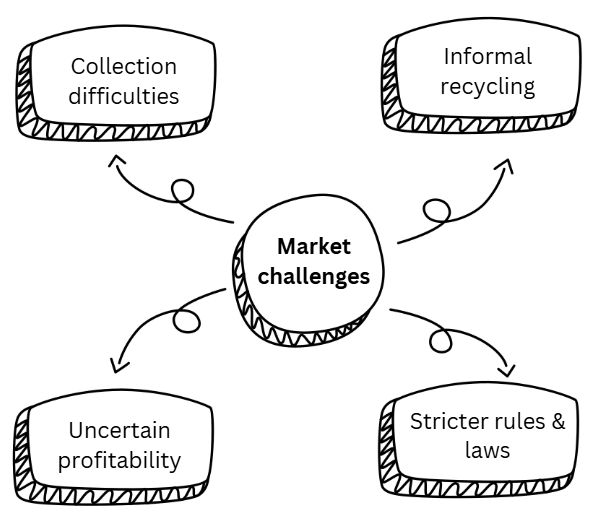
Collection is a major challenge
Even though lots of e-waste exists, much of it is not collected properly
In 2022, only 22.3% was formally collected and recycled globally
This limits how much material formal recycling firms can access
Informal recycling creates problems
In some countries, e-waste is recycled using unsafe methods
This can cause serious health and environmental damage
The World Health Organisation has warned that millions of children and adolescents may be at risk from exposure linked to informal e-waste recycling
Research in Ghana found significant lead exposure risks among people working/living near informal recycling facilities
Informal recyclers often have lower costs, creating unfair competition
Profitability can be uncertain
Recycling profits depend on prices of metals like copper and gold
If metal prices fall, profits may decrease even if recycling volumes rise
Rules and laws are becoming stricter
Governments are tightening controls on exporting e-waste
The EU's Basel Convention entries for shipments affects how e-waste moves internationally.
Firms must meet higher environmental and safety standards
This can increase costs but also protect responsible businesses
Emerging markets and regional insights
Asia produces the largest amount of e-waste worldwide
Nearly half of global e-waste comes from Asian countries
Recycling rates are relatively low, so growth potential is high
Europe has stronger recycling laws
Collection rates are higher than in many other regions
However, some countries still fail to meet official recycling targets
Southeast Asia faces serious challenges
Some countries receive illegal e-waste shipments
Governments are increasing enforcement and banning imports
Malaysia has recently moved to a full ban on e-waste imports and, alongside Thailand, has seized illegal shipments
Africa hosts major informal recycling areas
Recycling often takes place with limited safety equipment
This creates health risks, especially for children
There is growing international pressure to improve conditions

Unlock more, it's free!
Join the 100,000+ Students that ❤️ Save My Exams
the (exam) results speak for themselves:

Was this revision note helpful?