Cellular Control (OCR A Level Biology): Exam Questions

Exam code: H420

2 hours29 questions

Smart practice available on this topic

Answer questions with adaptive difficulty and personalised feedback

Start practising
1a
Sme Calculator
5 marks

The body plan of multicellular organisms is under genetic control.

Complete the passage below using the most appropriate words from the list.

analogous    archaea    development    DNA    domains

homeobox    homologous    homozygous    kingdoms    operon

phyla    plant    preserved    prokaryotes    regulator

ribosomes    transcription    translation

The development of body plan in eukaryotic organisms is controlled by ................................. genes. These genes code for proteins that are able to bind to ................................... and turn specific genes on and off and are known as ......................................... factors. These proteins contain a sequence of base pairs that varies little between species within the animal, ............................................. or fungus ..........................................

1b
Sme Calculator
4 marks

Investigations into the activity of genes that control body plan frequently use fruit flies and mice.

One reason fruit flies are used is that there are fewer public concerns about the ethics of using flies.

(i) Suggest two other reasons why fruit flies are chosen for research into genes controlling the development of body plan.

[2]

(ii) There are some public concerns about the ethics of using mice in these investigations.

Suggest two reasons why mice are chosen as a suitable species for investigation.

[2]

2a
Sme Calculator
2 marks

Marfan syndrome is a genetic disorder that affects the connective tissue. It is caused by mutations in a gene known as fibrillin 1 (FBN1).

Fig. 1 shows the effects of two different mutations that can occur in the FBN1 gene.

Mutations mRNA tRNA triplet code

Fig. 1

(i) Identify the type of gene mutation shown in mutation 2 in Fig. 1.

[1]

(ii) Table 1 shows the mRNA codons that code for four different amino acids.

Amino acid

mRNA codon

Methionine

AUG

Cysteine

UGU

UGC

Tyrosine

UAU

UAC

Phenylalanine

UUU

UUC

Table 1

Use the information in Table 1 to identify amino acid P from Fig. 1.

[1]

2b
Sme Calculator
4 marks

Use the information in Fig. 1 and Table 1 to explain the effects of the following on the fibrillin protein for which this section of DNA codes:

(i) Mutation 1

[2]

(ii) Mutation 2

[2]

2c
Sme Calculator
4 marks

Fig. 2 below shows a third possible mutation that could occur in the same section of the FBN1 gene.

mutation-3

Fig. 2

Explain how the type of mutation demonstrated by mutation 3 can have a greater impact on protein function than the mutations shown in Fig. 1.

2d
Sme Calculator
2 marks

New mutations have been discovered in the FBN1 gene, and it is thought that mutagens in the environment may have contributed to the occurrence of these mutations.

Suggest two examples of mutagens that could have caused these mutations.

3a
Sme Calculator
3 marks

Fig. 1 below shows the growth of an E. coli bacteria population that is cultured in a medium containing both glucose and lactose.

Between points P-Q in Fig. 1 the E. coli cells are using glucose, and between points R-S the cells are using lactose.

e-coli-cells

Fig. 1

Describe the growth of the E. coli population over 10 hours.

3b
Sme Calculator
4 marks

Suggest an explanation for the trend in bacterial growth seen between points Q-R in Fig. 1.

3c
Sme Calculator
4 marks

E. coli bacteria need to synthesise the amino acid tryptophan in order to build proteins inside their cells. Tryptophan synthesis requires enzymes that are coded for by five structural genes; trpA, trpB, trpC, trpD and trpE.

The synthesis of tryptophan is controlled by a region known as the trp operon, the action of which is shown in Fig. 2 below:

tryptophan

Fig. 2

(i) Suggest how the trp operon controls the synthesis of tryptophan.

[3]

(ii) Suggest the benefit to the E. coli of controlling tryptophan synthesis in this way.

[1]

4a
Sme Calculator
3 marks

The hormone oestrogen can diffuse into human body cells. Once inside a cell, oestrogen diffuses through the nuclear pores into the nucleus where it can influence the process of transcription.

Fig. 1 shows the action of oestrogen.

untitled-1

Fig. 1

Explain how ER acts as a transcription factor in Fig. 1.

4b
Sme Calculator
3 marks

In certain types of breast cancer the process described in part (a) may lead to the development of oestrogen-induced tumours. Tamoxifen was one of the first effective treatments for these types of cancers and is still used with great success.

Fig. 2 shows the action of tamoxifen.

untitled-2

Fig. 2

Suggest how tamoxifen is an effective treatment for breast cancer.

4c
Sme Calculator
2 marks

ER is said to act as an activator in the process of gene expression, but some transcription factors prevent genes from being expressed.

Suggest two ways in which transcription factors might prevent a gene from being expressed.

4d
Sme Calculator
4 marks

Transcription factors regulate gene expression at the transcription stage.

Describe two regulatory mechanisms that control gene expression at the post-transcriptional level.

5a
Sme Calculator
3 marks

A mutation in the HOXD13 gene has been associated in some studies with a limb condition known as syndactly.

(i) Define the term mutation.

[1]

(ii) Suggest a likely role of the gene HOXD13.

[2]

5b
Sme Calculator
3 marks

The gene HOXD13 codes for the protein HOXD13. HOXD13 protein can bind to the promoter of another gene, EPHA7, and inititate its expression.

Suggest how HOXD13 could initiate expression of EPHA7.

5c
Sme Calculator
3 marks

A mutation in the HOXD13 gene can lead to a non-functional HOXD13 protein.

Explain how a mutation can leads to the synthesis of a non-functional HOXD13 protein.

5d
Sme Calculator
3 marks

Fig. 1 below shows two possible manifestations of the syndactly condition that results from a mutation in the HOXD13 gene. Syndactyly involves either complete or partial fusion of the skin and soft tissue between fingers 2 and 3 of the hands.

hands

Fig. 1

(i) Use Fig. 1 and information provided in part (b) to identify the process that might be regulated by the EPHA7 gene.

[1]

(ii) Explain your answer to part (i).

[2]

6a
1 mark

Mosquitoes of the species Anopheles gambiae are often exposed to insecticides as part of malaria control measures. Carbamate insecticides target an enzyme called acetylcholinesterase, coded for by the gene ace-1.

Researchers suspected that exposure to a carbamate insecticide may be linked to a higher frequency of mutations in ace-1. They compared a short section of ace-1 DNA from mosquitoes collected in areas with little/no insecticide exposure with mosquitoes from areas using carbamates.

DNA from ace-1 allele of mosquito with little/no insecticide exposure:

… GAA CCG TTG ATA CTT …

DNA from ace-1 allele of mosquito with carbamate exposure:

… GAA TCG TTG ATA CTT …

Name the type of mutation shown in the DNA of the mosquito with carbamate exposure.

6b
1 mark

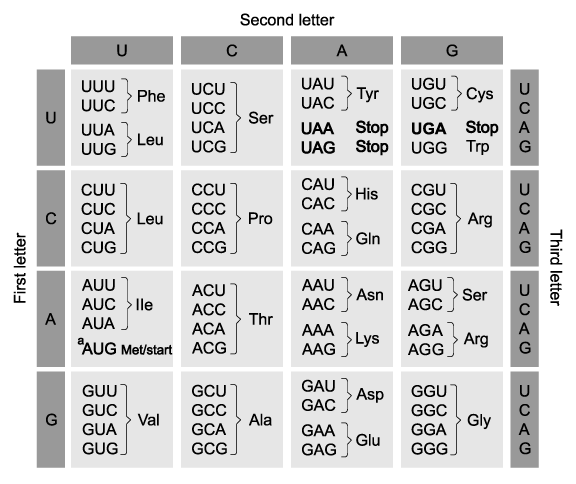
Fig. 1 below shows how the mRNA code converts to amino acids in a polypeptide during translation.

Fig. 1

Genetic code chart showing mRNA codons with corresponding amino acids and stop signals; codons are sorted by first, second, and third letter.

State how the mutation in the DNA code of the mosquito with carbamate exposure from part (a), would affect the primary structure of the acetylcholinesterase polypeptide.

Note that the DNA sequences shown in part (a) are from the template strand.

6c
3 marks

The mutation in the DNA of the mosquito with carbamate exposure reduces the function of the acetylcholinesterase enzyme.

Explain how the mutation shown in part (a) could reduce enzyme function.

6d
4 marks

Scientists investigated whether living in a region where carbamates are used is linked to a higher frequency of the ace-1 gene mutation.

They selected 10 regions. In 5 regions, carbamates had been used regularly in the previous 12 months. In the other 5 regions, carbamates had not been used in the previous 12 months.

In each region, adult mosquitoes were collected using the same trap type over the same number of nights. Mosquitoes were identified as Anopheles gambiae using an identification key. DNA was extracted from each mosquito and used to test whether the ace-1 mutation was present.

Each mosquito was recorded as either:

  • mutation present

  • mutation not present

Table 2 shows the percentage of mosquitoes with the mutation in each group of regions.

Table 2

Region type

Total mosquitoes tested

Mean percentage with mutation (%) ± SD

No carbamate use in previous 12 months

412

1.9 ± 1.4

Regular carbamate use in previous 12 months

168

40.6 ± 5.6

A student read the results of the study and concluded that carbamate caused mutations in the ace-1 gene of Anopheles gambiae mosquitoes.

Evaluate the student's conclusion.

7a
3 marks

Neuroblastoma is a cancer of the nervous system. A characteristic feature of neuroblastoma cells is the high expression of a surface antigen called GD2, which is present at much lower levels on normal cells.

Scientists investigated a combination therapy using 2 drugs:

  1. Anti-GD2 mAbs: specially designed monoclonal antibodies

  2. Vorinostat: an inhibitor of histone deacetylase (HDAC), an enzyme that normally reduces gene expression

Mice with neuroblastoma were divided into four groups:

  1. control

  2. treated with anti-GD2 mAbs only

  3. treated with Vorinostat only

  4. treated with Vorinostat + anti-GD2 mAbs

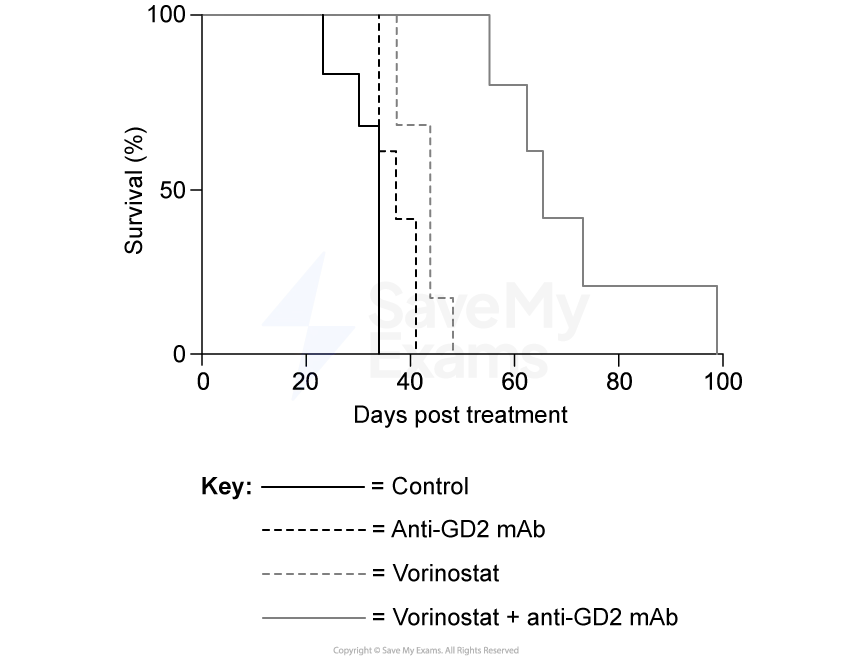
Survival of the mice was recorded over time and the results are shown in Figure 5.

Figure 5

Survival graph shows four lines comparing treatments: control, anti-GD2 mAb, Vorinostat, and Vorinostat with anti-GD2 mAb over 100 days.

Compare the effect of the different treatments on mouse survival.

7b
3 marks

Suggest how anti-GD2 mAbs can lead to the destruction of tumour cells.

7c
1 mark

Using Fig. 5, estimate the median survival time for mice treated with both anti-GD2 antibodies and Vorinostat.

7d
1 mark

Suggest one limitation of using this graph to determine median survival time.