1

1 mark
Which of the following organelles is involved in the modification and packaging of lipids and proteins?
Lysosomes
Golgi apparatus
Ribosomes
Mitochondria
Was this exam question helpful?
Exam code: H420
Which of the following organelles is involved in the modification and packaging of lipids and proteins?
Lysosomes
Golgi apparatus
Ribosomes
Mitochondria
Was this exam question helpful?
Which of the following is not a function of the cytoskeleton?
Cellular movement
Strengthening and support
Intracellular movement
Transport of substances in and out of the cell.
Was this exam question helpful?
Which of the following is not a feature of prokaryotic cells?
DNA associated with histones, formed into chromosomes.
Cell wall made of peptidoglycan and murein.
No membrane-bound organelles.
Cell division occurs by binary fission.
Was this exam question helpful?
Which of the following is a structure that is only found in animal cells?
Cellulose cell wall
Centriole
Endoplasmic reticulum
Large permanent vacuole
Was this exam question helpful?
The following are steps in a method of preparing a microscope slide using a solid specimen. Which of the following shows the correct order in which to carry out the steps?
1 | Peel away a very thin layer of cells from the tissue sample and place onto a slide. |
2 | Gently place a coverslip on top and press down to remove any air bubbles. |
3 | Apply a stain. |
4 | Use scissors to cut a small sample of the tissue. |
4, 1, 2, 3
4, 3, 1, 2
4, 1, 3, 2
3, 4, 1, 2
Was this exam question helpful?
Which of the following statements, A to D, about differential staining is not true?
Differential staining can distinguish between different organelles.
Differential staining can distinguish between types of cell.
Differential staining can distinguish between types of organism.
Differential staining is a common feature of electron microscopy.
Was this exam question helpful?
Refer to the following image of a human blood smear.

The cell labelled E shows a parasite called Trypanosoma.
Which of the following statements is/are evidence that Trypanosoma is a eukaryote?
1 a nucleus is present
2 it is a similar size to blood cells
3 the presence of flagella
1, 2 and 3
only 1 and 2
only 2 and 3
only 1
Was this exam question helpful?
Which of the following best describes a microscope with high resolution?
The microscope can distinguish structures that are very close together.
The microscope can view structures that are very small.
The microscope is capable of high magnification.
The microscope has an in-built eyepiece graticule.
Was this exam question helpful?
The image below shows a tardigrade, Echiniscus granulatus, viewed from the underneath. The magnification is × 110.

(For users viewing this question on-screen, the printed image of the tardigrade measures 95mm in length).
How long is the tardigrade in real life?
115μm
1.14 × 10⁻⁵ m
8.64 × 10 -4m
0.116mm
Was this exam question helpful?
A student counted stomata on a leaf using a light microscope. The image below, measuring 106 mm by 77 mm, shows the stomata that were visible.
The image magnification is ×60.

Which of the options, A to D, is the correct stomatal density of this leaf?
7.50 stomata mm-2
0.13 stomata mm-2
2428 stomata mm-2
0.21 stomata mm-2
Was this exam question helpful?
Which of the options, A to D, occurs in the nucleus of a cell?
synthesis of enzymes
synthesis of RNA
modification of polypeptides
synthesis of carbohydrates
Was this exam question helpful?
Which of the following statements describes an organelle which is not membrane bound?
contains cristae
modifies and packages proteins
contains digestive enzymes
is made of rRNA and protein
Was this exam question helpful?
Which of the following statements is/are true?
Statement 1: | Microtubules are part of the ‘9 + 2’ formation in bacterial flagella. |
Statement 2: | Microtubules can be prevented from functioning by a respiratory inhibitor. |
Statement 3: | Microtubules are involved in moving chromosomes from the equator to the poles of the cell during mitosis. |
1, 2 and 3
Only 1 and 2
Only 2 and 3
Only 1
Was this exam question helpful?
A student used an eyepiece graticule with 100 small divisions, and a stage micrometer with 40 divisions, each 0.05 mm apart.
Using a x40 objective lens, the whole length of the stage micrometer lined up with 20 divisions of the eyepiece graticule.
What is the actual length of a specimen that corresponds to the full 100-division scale of the eyepiece graticule when it is calibrated at this magnification?
500 µm
50 µm
10 mm
1.0 mm
Was this exam question helpful?
A scientist used thin layer chromatography (TLC) to identify an unknown contaminant in a sample of chlorophyll a. Lane X contains the contaminated sample and lane Y contains a pure sample of chlorophyll a.
The resulting chromatogram is shown below.
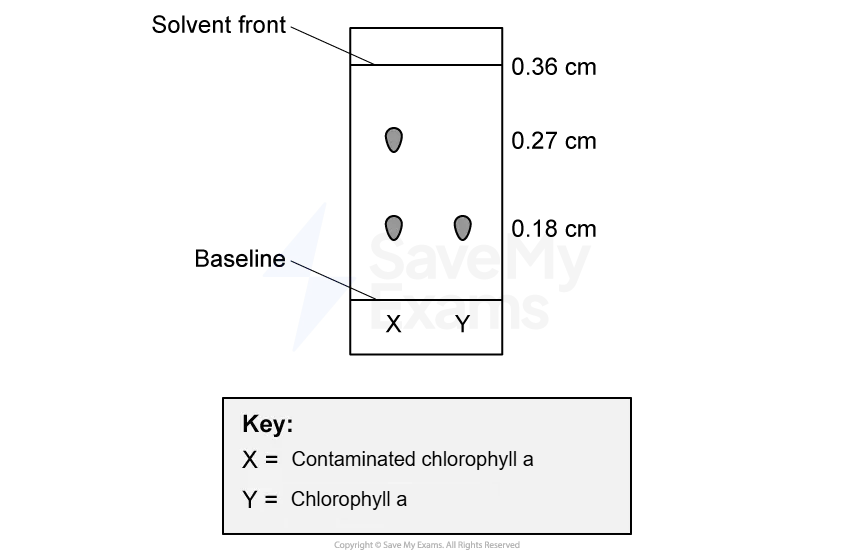
What is the Rf value of the contaminating pigment?
0.50
0.75
0.65
0.85
Was this exam question helpful?
A student placed potato cubes into a sucrose solution and recorded the change in total mass over 80 minutes.
One large cube (total mass 60 g) and eight smaller cubes (total mass 60 g) were used, each placed in identical sucrose solutions. The results are seen in the graph below.
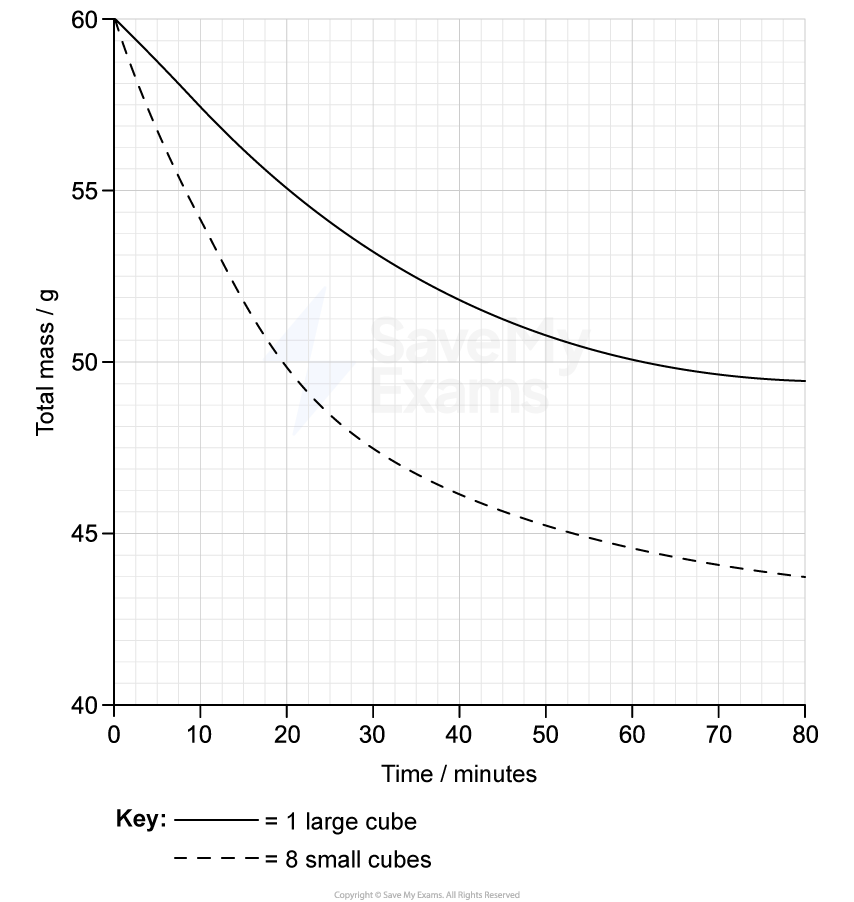
The student repeated the experiment using the same sized cubes but placed them in a more concentrated sucrose solution at a higher temperature.
Which of the following correctly describes the expected changes to the curves on the graph?
Both curves will have a steeper initial gradient and will plateau at a lower final mass.
Both curves will have a steeper initial gradient and will plateau at a higher final mass.
Both curves will have a shallower initial gradient and will plateau at a lower final mass.
The curve for the eight small cubes will plateau at a lower final mass, but the single large cube will plateau at the same final mass as the original experiment.
Was this exam question helpful?
The TEM micrograph below shows the mitochondria from an animal cell at a magnification of x 40 000. The image size of the mitochondria is 72 mm.

The cell that holds this mitochondria has an actual size of 14 μm, how much larger is the cell than the mitochondria?
77.8 x larger
19.4 x larger
2.5 x larger
7.8 x larger
Was this exam question helpful?
The theory of endosymbiosis states that eukaryotic cells evolved from cells that engulfed organelles such as mitochondria and chloroplasts, which were once free-living prokaryotes, as endosymbionts within host cells.
Which of the following statements provide evidence that support the endosymbiotic theory?
1 | Mitochondria and chloroplasts are approximately the same size as bacteria. |
2 | Mitochondria and chloroplasts contain DNA. |
3 | Mitochondria and chloroplasts have multiple membranes. |
4 | Mitochondria and chloroplasts both contain a fluid interior. |
All 4 statements.
1, 2 and 3
1, 3 and 4
2 and 3 only.
Was this exam question helpful?
Which of the following words fill the gaps in the statement below to describe the structure of the cytoskeleton?
The cytoskeleton has three components: Microfilaments are solid strands made of _______ that bring about cell movement, microtubules are formed from the ________ protein tubulin and form structures used both in the movement of _________ and vesicles and as spindle fibres in cell division, and __________ fibres give mechanical strength to cells.
Actin, fibrous, cells, intermediate
Actin, globular, organelles, intermediate
Myosin, fibrous, organelles, cellulose
Myosin, globular, cells, cellulose
Was this exam question helpful?
Which of the following does not describe the function of a membrane in or surrounding an organelle in a eukaryotic cell?
The site of the electron transport chain in respiration.
Preventing digestive enzymes from damaging the cell.
The site of the light-dependent stage of photosynthesis.
The site of protein synthesis in the cell.
Was this exam question helpful?
The images below show cells with cilia and flagella, organelles sometimes found on prokaryotic and eukaryotic cells.

Which of the statements below show a correct comparison between flagella and cilia in prokaryotic and eukaryotic cells?
1 | Cilia are not present in prokaryotes but flagella can be found in both prokaryotic and eukaryotic cells. |
2 | Cilia and flagella in eukaryotic cells are both made from microtubules. |
3 | Cilia allow for the movement of substances over the cell surface. |
4 | Flagella are used primarily for cell motility in prokaryotes whilst being used as a sensory organelle in eukaryotes. |
1 and 2 only.
1, 3 and 4.
1, 2 and 3.
All 4 statements.
Was this exam question helpful?