Simplex Algorithm (Edexcel A Level Further Maths: Decision 1): Exam Questions

Exam code: 9FM0

2 hours10 questions
1a
Sme Calculator
1 mark

A linear programming problem in x comma space y space and space z is described as follows.

Maximise       P space equals space 2 x space plus space 2 y space minus z

subject to       3 x space plus space y space plus space 2 z space less or equal than space 30

                       x minus y plus z greater or equal than 8

                       4 y space plus space 2 z space greater or equal than space 15

                        x comma space y comma space z space greater or equal than space 0

Explain why the Simplex algorithm cannot be used to solve this linear programming problem.

1b
Sme Calculator
7 marks

Write your answer in the Answer Booklet (opens in a new tab).

Set up the initial tableau for solving this linear programming problem using the big-M method.

1c
Sme Calculator
1 mark

After a first iteration of the big-M method, the tableau is

b.v.

x

space y

z

s subscript 1

s subscript 2

s subscript 3

a subscript 1

a subscript 2

Value

s subscript 1

3

0

1.5

1

0

0.25

0

-0.25

26.25

a subscript 1

1

0

1.5

0

-1

-0.25

1

0.25

11.75

space y

0

1

0.5

0

0

-0.25

0

0.25

3.75

P

negative left parenthesis 2 plus M right parenthesis

0

2 minus 1.5 M

0

M

negative 0.5 plus 0.25 M

0

0.5 plus 0.75 M

7.5 minus 11.75 M

State the value of each variable after the first iteration.

1d
Sme Calculator
1 mark

Explain why the solution given by the first iteration is not feasible.

1e
Sme Calculator
2 marks

Taking the most negative entry in the profit row to indicate the pivot column,

Obtain the most efficient pivot for a second iteration. You must give reasons for your answer.

2a
Sme Calculator
4 marks

A maximisation linear programming problem in x comma space y and z is to be solved using the two-stage simplex method.

The partially completed initial tableau is shown below.

Basic variable

x

y

z

S subscript 1

S subscript 2

S subscript 3

a subscript 1

a subscript 2

Value

S subscript 1

1

2

3

1

0

0

0

0

45

a subscript 1

3

2

0

0

–1

0

1

0

9

a subscript 2

–1

0

4

0

0

–1

0

1

4

P

–2

–1

–3

0

0

0

0

0

0

A


Using the information in the above tableau, formulate the linear programming problem. State the objective and list the constraints as inequalities.

2b
Sme Calculator
2 marks

Complete the bottom row of Table 1 in the answer book (opens in a new tab). You should make your method and working clear.

2c
Sme Calculator
3 marks

The following tableau is obtained after two iterations of the first stage of the two-stage simplex method.

Basic variable

x

y

z

S subscript 1

S subscript 2

S subscript 3

a subscript 1

a subscript 2

Value

S subscript 1

0

begin inline style 5 over 6 end style

0

1

begin inline style 7 over 12 end style

begin inline style 3 over 4 end style

negative begin inline style 7 over 12 end style

negative begin inline style 3 over 4 end style

begin inline style 147 over 4 end style

a subscript 1

1

begin inline style 2 over 3 end style

0

0

negative 1 third

0

1 third

0

3

a subscript 2

0

begin inline style 1 over 6 end style

1

0

negative begin inline style 1 over 12 end style

negative 1 fourth

1 over 12

1 fourth

begin inline style 7 over 4 end style

P

0

begin inline style 5 over 6 end style

0

0

negative 11 over 12

negative begin inline style 3 over 4 end style

begin inline style 11 over 12 end style

begin inline style 3 over 4 end style

45 over 4

A

0

0

0

0

0

0

1

1

0

(i) Explain how the above tableau shows that a basic feasible solution has been found for the original linear programming problem.

(ii) Write down the basic feasible solution for the second stage.

2d
Sme Calculator
5 marks

Write your answer in the Answer Booklet (opens in a new tab).

Taking the most negative number in the profit row to indicate the pivot column, perform one complete iteration of the second stage of the two-stage simplex method, to obtain a new tableau, T. Make your method clear by stating the row operations you use.

2e
Sme Calculator
3 marks

(i) Explain, using T, whether or not an optimal solution to the original linear programming problem has been found.

(ii) Write down the value of the objective function.

(iii) State the values of the basic variables.

3a
Sme Calculator
5 marks

Susie is preparing for a triathlon event that is taking place next month. A triathlon involves three activities: swimming, cycling and running.

Susie decides that in her training next week she should

  • maximise the total time spent cycling and running

  • train for at most 39 hours

  • spend at least 40% of her time swimming

  • spend a total of at least 28 hours of her time swimming and running

Susie needs to determine how long she should spend next week training for each activity. Let

  • x represent the number of hours swimming

  • y represent the number of hours cycling

  • z represent the number of hours running

Formulate the information above as a linear programming problem. State the objective and list the constraints as simplified inequalities with integer coefficients.

3b
Sme Calculator
6 marks

Write your answer in the Answer Booklet (opens in a new tab).

Susie decides to solve this linear programming problem by using the two-stage Simplex method.

Set up an initial tableau for solving this problem using the two-stage Simplex method. As part of your solution you must show how

  • the constraints have been made into equations using slack variables, exactly one surplus variable and exactly one artificial variable

  • the rows for the two objective functions are formed

3c
Sme Calculator
2 marks

The following tableau T is obtained after one iteration of the second stage of the two‑stage Simplex method.

b.v.

x

y

z

s subscript 1

s subscript 2

s subscript 3

Value

y

0

1

0

1

0

1

11

s subscript 2

0

0

5

–2

1

–5

62

x

1

0

1

0

0

–1

28

P

0

0

–1

1

0

1

11

Obtain a suitable pivot for a second iteration. You must give reasons for your answer.

3d
Sme Calculator
5 marks

Write your answer in the Answer Booklet (opens in a new tab).

Starting from tableau T, solve the linear programming problem by performing one further iteration of the second stage of the two-stage Simplex method. You should make your method clear by stating the row operations you use.

4a
Sme Calculator
5 marks

A garden centre makes hanging baskets to sell to its customers. Three types of hanging basket are made, S u n s h i n e comma space D r a m a and P e a c e f u l. The plants used are categorised as I m p a c t comma space F l o w e r i n g or T r a i l i n g.

Each S u n s h i n e basket contains 2 I m p a c t plants, 4 F l o w e r i n g plants and 3 T r a i l i n g plants.
Each D r a m a basket contains 3 I m p a c t plants, 2 F l o w e r i n g plants and 4 T r a i l i n g plants.
Each P e a c e f u l basket contains 1 I m p a c t plant, 3 F l o w e r i n g plants and 2 T r a i l i n g plants.

The garden centre can use at most 80 I m p a c t plants, at most 140 F l o w e r i n g plants and at most 96 T r a i l i n g plants each day.

The profit on S u n s h i n eD r a m a and P e a c e f u l baskets are £12, £20 and £16 respectively.
The garden centre wishes to maximise its profit.

Let x comma space y and z be the number of S u n s h i n eD r a m a and P e a c e f u l baskets respectively, produced each day.

Formulate this situation as a linear programming problem, giving your constraints as inequalities.

4b
Sme Calculator
1 mark

State the further restriction that applies to the values of x comma space y and z in this context.

4c
Sme Calculator
2 marks

The Simplex algorithm is used to solve this problem. After one iteration, the tableau is

b.v.

x

y

z

r

s

t

Value

r

negative 1 fourth

0

negative 1 half

1

0

negative 3 over 4

8

s

5 over 2

0

2

0

1

negative 1 half

92

y

3 over 4

1

1 half

0

0

1 fourth

24

P

3

0

negative 6

0

0

5

480

State the variable that was increased in the first iteration. Justify your answer.

4d
Sme Calculator
1 mark

Determine how many plants in total are being used after only one iteration of the Simplex algorithm.

4e
Sme Calculator
2 marks

Explain why for a second iteration of the Simplex algorithm the 2 in the z column is the pivot value.

4f
Sme Calculator
1 mark

After a second iteration, the tableau is

b.v.

x

y

z

r

s

t

Value

r

3 over 8

0

0

1

1 fourth

negative 7 over 8

31

s

5 over 4

0

1

0

1 half

negative 1 fourth

46

y

1 over 8

1

0

0

negative 1 fourth

3 over 8

1

P

21 over 2

0

0

0

3

7 over 2

756

Use algebra to explain why this tableau is optimal.

4g
Sme Calculator
1 mark

State the optimal number of each type of basket that should be made.

4h
Sme Calculator
2 marks

The manager of the garden centre is able to increase the number of I m p a c t plants available each day from 80 to 100. She wants to know if this would increase her profit.

Use your final tableau to determine the effect of this increase. (You should not carry out any further calculations.)

5a
Sme Calculator
1 mark

A linear programming problem in x comma space y and z is described as follows.

Maximise     P space equals space 3 x space plus space 2 y space plus space 2 z

subject to    2 x space plus space 2 y space plus space z space less-than or slanted equal to space 25

                   x space plus space 4 y space less-than or slanted equal to space 15

                   x space greater-than or slanted equal to space 3

Explain why the Simplex algorithm cannot be used to solve this linear programming problem.

5b
Sme Calculator
1 mark

The big-M method is to be used to solve this linear programming problem.

Define, in this context, what M represents. You must use correct mathematical language in your answer.

5c
Sme Calculator
1 mark

The initial tableau for a big-M solution to the problem is shown below.

b.v.

x

y

z

s subscript 1

s subscript 2

s subscript 3

t subscript 1

Value

s subscript 1

2

2

1

1

0

0

0

25

s subscript 2

1

4

0

0

1

0

0

15

t subscript 1

1

0

0

0

0

 –1

1

3

P

–(3plusM)

–2

–2

0

0

M

0

 –3M

Explain clearly how the equation represented in the b.v. t subscript 1 row was derived.

5d
Sme Calculator
2 marks

Show how the equation represented in the b.v. row was derived.

5e
Sme Calculator
7 marks

Write your answer in the Answer Booklet (opens in a new tab).

The tableau obtained from the first iteration of the big-M method is shown below.

b.v.

x

y

z

s subscript 1

s subscript 2

s subscript 3

t subscript 1

Value

s subscript 1

0

2

1

1

0

2

–2

19

s subscript 2

0

4

0

0

1

1

–1

12

t subscript 1

1

0

0

0

0

–1

1

3

P

0

–2

–2

0

0

–3

3plusM

9

Solve the linear programming problem, starting from this second tableau. You must

  • give a detailed explanation of your method by clearly stating the row operations you use and

  • state the solution by deducing the final values of P comma space x comma space y and z.

6a
4 marks

A linear programming problem in space x comma space y and z is to be solved using the big-M method. The initial tableau is shown below.

v.

x

y

z

s subscript 1

s subscript 2

s subscript 3

a subscript 1

a subscript 2

Value

s subscript 1

2

3

4

1

0

0

0

0

13

s subscript 2

1

−2

2

0

−1

0

1

0

8

s subscript 3

3

0

−4

0

0

−1

0

1

12

P

2 space minus space 4 M

negative 3 space plus space 2 M

negative 1 space plus space 2 M

0

M

M

0

0

negative 20 M

Using the information in the above tableau, formulate the linear programming problem. You should

  • list each of the constraints as an inequality

  • state the two possible objectives

6b
Sme Calculator
2 marks

Obtain the most efficient pivot for a first iteration of the big‑M method. You must give reasons for your answer.

7a
5 marks
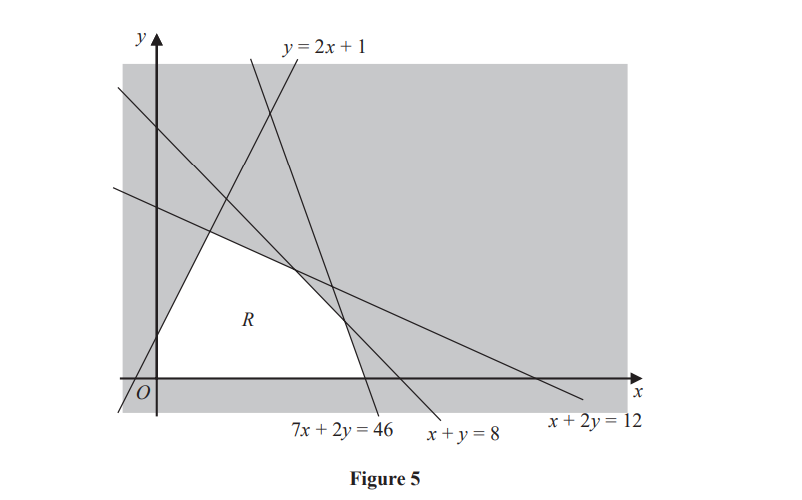
Graph with lines forming a triangular region R, labelled x and y axes. Equations: y=2x+1, x+y=8, 7x+2y=46, x+2y=12. Shaded area surrounds R.

Figure 5 shows the constraints of a linear programming problem in x spaceand y spacewhere R is the feasible region.

The objective is to maximise P space equals space x space plus space k y, where k is a positive constant.

The optimal vertex of R is to be found using the Simplex algorithm.

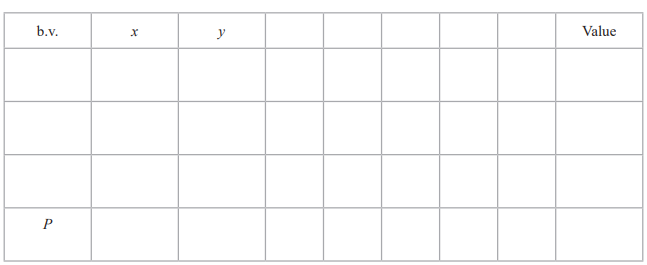
Set up an initial tableau for solving this linear programming problem using the Simplex algorithm.

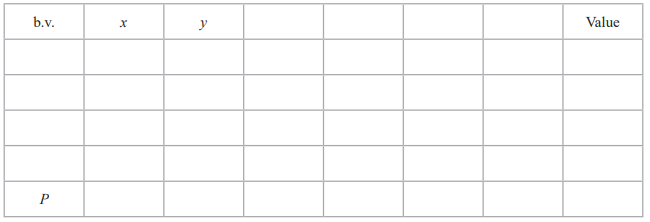
A blank table with six rows and five columns. Headers read: b.v., x, y, and Value; the first column under b.v. lists P.
7b
1 mark

After two iterations of the Simplex algorithm a possible tableau T is

b.v.

x

y

s subscript 1

s subscript 2

s subscript 3

s subscript 4

Value

s subscript 1

0

0

1

negative 3 over 5

0

1 fifth

1

x

1

0

0

1 fifth

0

negative 2 over 5

2

s subscript 3

0

0

0

negative 11 over 5

1

12 over 5

22

y

0

1

0

2 over 5

0

1 fifth

5

P

0

0

0

1 fifth plus 2 over 5 k

0

negative 2 over 5 plus 1 fifth k

5 k space plus space 2

State the value of each variable after the second iteration.

7c
Sme Calculator
9 marks

It is given that T does not give an optimal solution to the linear programming problem.

After a third iteration of the Simplex algorithm the resulting tableau does give an optimal solution to the problem.

Perform the third iteration of the Simplex algorithm and hence determine the range of possible values for P. You should state the row operations you use and make your method and working clear.

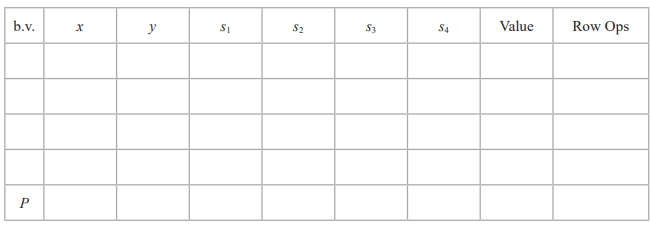
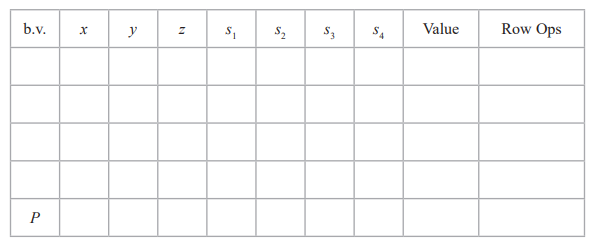
A table with headers: b.v., x, y, s1, s2, s3, s4, Value, Row Ops. Row P is visible with empty cells below each header.
8a
5 marks

A publisher plans to produce three versions of the same book: a paperback, a hardcover, and a deluxe edition.

  • Each paperback takes 4 minutes to print and 1 minute to bind

  • Each hardcover takes 8 minutes to print and 5 minutes to bind

  • Each deluxe edition takes 15 minutes to print and 12 minutes to bind

The printing machine is available for at most 150 hours and the binding machine must be used for at least 60 hours.

The publisher decides to produce

  • at least 1600 books in total

  • at least three times as many paperbacks as hardcovers

The profit on each paperback sold is £8, the profit on each hardcover sold is £20 and the profit on each deluxe edition sold is £40

Let x comma space y and z represent the number of paperbacks, hardcovers and deluxe editions produced.

Formulate this as a linear programming problem, stating the objective and listing the constraints as simplified inequalities with integer coefficients.

8b
6 marks

The publisher decides to solve this linear programming problem by using the two-stage simplex method.

Set up an initial tableau for solving this problem using the two-stage simplex method.

As part of your solution, you must show how

  • the constraints have been made into equations by using slack variables, exactly two surplus variables and exactly two artificial variables

  • the rows for the two objective functions are formed

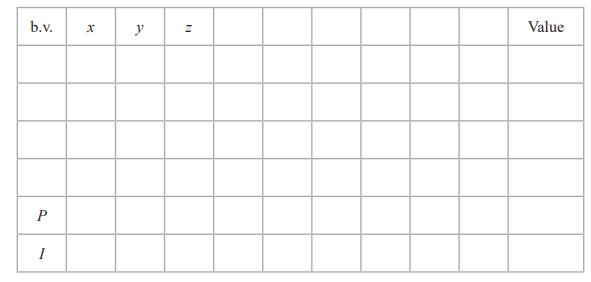
Empty table with six columns labeled b.v., x, y, z, and Value. Rows include variables P and I, with spaces for additional data entries.
8c
Sme Calculator
5 marks

The following tableau is obtained after two iterations of the first stage of the two-stage simplex method.

b.v.

x

y

z

s subscript 1

s subscript 2

s subscript 3

s subscript 4

a subscript 1

a subscript 2

Value

s subscript 1

0

0

0

1

1

3

0

negative 1

negative 3

600

z

0

4 over 11

1

0

negative 1 over 11

1 over 11

0

1 over 11

negative 1 over 11

2000 over 11

x

1

7 over 11

0

0

1 over 11

negative 12 over 11

0

negative 1 over 11

12 over 11

15600 over 11

s subscript 4

0

40 over 11

0

0

1 over 11

negative 12 over 11

1

negative 1 over 11

12 over 11

15600 over 11

P

0

negative 4 over 11

0

0

negative 32 over 11

negative 56 over 11

0

32 over 11

56 over 11

204800 over 11

I

0

0

0

0

0

0

0

1

1

0

Taking the most negative number in the profit row to indicate the pivot column, perform one complete iteration of the second stage of the two-stage simplex method to obtain a new tableau. Make your method clear by stating the row operations you use.

Table for a linear programming tableau with columns for variables, slack variables, value, and row operations. Six rows, starting with b.v. and P.
8d
Sme Calculator
2 marks

After three iterations of the second stage of the two-stage simplex method, the following tableau is obtained.

b.v.

x

y

z

s subscript 1

s subscript 2

s subscript 3

s subscript 4

Value

s subscript 2

0

0

0

1

1

3

0

600

z

0

0

1

1 over 10

0

1 half

negative 1 over 10

100

x

1

0

0

negative 3 over 40

0

negative 9 over 8

negative 7 over 40

1125

y

0

1

0

negative 1 over 40

0

negative 3 over 8

11 over 40

375

P

0

0

0

29 over 10

0

7 over 2

1 over 10

20500

Given that the publisher produces the optimal number of each version of the book,

(i) state the maximum profit the publisher can earn,

(ii) find the number of hours the binding machine will be used.

8e
1 mark

Give a reason why the publisher may not earn the profit stated in (d)(i).

9a
6 marks

Two friends, Anaira and Tommi, play a game involving two positive numbers x and y space

Anaira gives Tommi the following clues to see if he can correctly determine the value of x and the value of y space

  • x is greater than y spaceand the difference between the two is at least 100

  • x is at most 5 times as large as y space

  • the sum of space 2 x and 3 y is at least 350

  • the sum of x and y spaceis as small as possible

Tommi decides to solve this problem by using the big-M method.

Set up an initial tableau for solving this problem using the big-M method.

As part of your solution, you must show

  • how the constraints were made into equations using one slack variable, exactly two surplus variables and exactly two artificial variables

  • how the objective function was formed

Blank table with 5 columns labelled b.v., x, y, and Value. First row under b.v. is marked P; rest of the cells are empty.
9b
3 marks

The big-M method is applied until the tableau containing the optimal solution to the problem is found. One row of this final tableau is as follows.

b.v.

x

y

s subscript 1

s subscript 2

s subscript 3

a subscript 1

a subscript 2

Value

x

1

0

negative 3 over 5

0

negative 1 fifth

3 over 5

1 fifth

130

(i) State the value of x

(ii) Hence deduce the value of y, making your reasoning clear.

10a
2 marks

A maximisation linear programming problem in x comma space y and z is to be solved using the Simplex method.

The tableau after the 1st iteration is shown below.

b.v.

x

y

z

s subscript 1

s subscript 2

s subscript 3

Value

s subscript 1

0

negative 1 half

3 over 2

1

negative 1 half

0

30

x

1

1 fourth

negative 1 fourth

0

1 fourth

0

10

s subscript 3

0

1

1

0

0

1

26

P

0

negative 1 fourth

negative 11 over 4

0

3 over 4

0

30

 State the column that contains the pivot value for the 1st iteration. You must give a reason for your answer.

10b
5 marks

By considering the equations represented in the above tableau, formulate the linear programming problem in x comma space y and z only. State the objective and list the constraints as inequalities with integer coefficients.

10c
Sme Calculator
4 marks

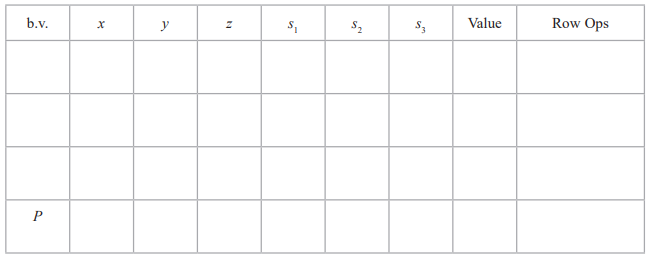
Taking the most negative number in the profit row to indicate the pivot column, perform the 2nd iteration of the Simplex algorithm, to obtain a new tableau, T. Make your method clear by stating the row operations you use.

Simplex tableau with columns labelled b.v., x, y, z, s1, s2, s3, Value, Row Ops. Rows are mostly blank, except one labelled P.
10d
2 marks

(i) Explain, using T, how you know that an optimal solution to the original linear programming problem has not been found after the 2nd iteration.

(ii) State the values of the basic variables after the 2nd iteration.

10e
1 mark

A student attempts the 3rd iteration of the Simplex algorithm and obtains the tableau below.

b.v.

x

y

z

s subscript 1

s subscript 2

s subscript 3

Value

z

0

0

1

1 half

negative 1 fourth

1 fourth

43 over 2

x

1

0

0

1 fourth

1 over 8

negative 1 over 8

57 over 4

y

0

1

0

negative 1 half

1 fourth

3 over 4

9 over 2

P

0

1

0

5 over 4

1 over 8

7 over 8

361 over 4

Explain how you know that the student’s attempt at the 3rd iteration is not correct.