Henry VII: Royal Finance & Domestic Policies (AQA A Level History: Component 1: Breadth study): Revision Note
Exam code: 7042

Summary
Henry VII inherited a near-bankrupt Crown in 1485. By 1509, he had transformed royal finances through the systematic maximisation of ordinary revenue
He reduced his dependence on Parliament to just 7 sessions in 24 years
The key distinction is between ordinary revenue (regular income requiring no parliamentary approval) and extraordinary revenue (taxation granted by Parliament for specific purposes, such as war)
Henry’s strategy was to minimise his dependence on extraordinary revenue by maximising ordinary income
Henry revived and ruthlessly enforced long-neglected feudal dues
He pursued non-payment through the Council Learned in Law
Bonds and recognisances were Henry’s most effective domestic tool, binding roughly two-thirds of the English nobility to the Crown
These were enforced ruthlessly by Empson and Dudley
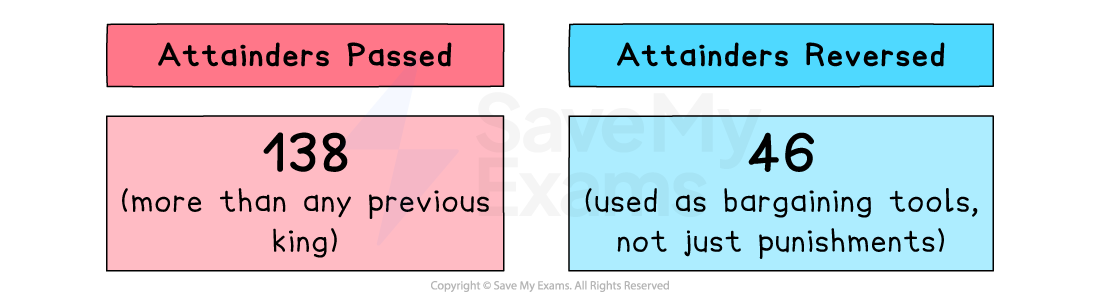
Acts of Attainder allowed Henry to seize the lands and titles of enemies without trial
He strategically reversed many of them, using them as bargaining tools rather than simply as punishments
Historians debate whether Henry’s financial success came at too high a cost
The methods of Empson and Dudley were so deeply resented that Henry VIII immediately dissolved the Council Learned and executed both men in 1510
Ordinary & Extraordinary Revenue
Understanding Henry VII's finances requires grasping one fundamental distinction: the difference between ordinary and extraordinary revenue
Henry's overriding financial aim was to make the Crown self-sufficient through ordinary income, reducing his dependence on Parliament to an absolute minimum
Ordinary revenue
Ordinary revenue was regular, predictable income that did not require parliamentary approval
Henry worked systematically to maximise every stream
Source of ordinary revenue | What was it, and how did Henry use it? |
|---|---|
Crown lands |
|
Customs duties |
|
Feudal dues |
|
Legal dues |
|
Extraordinary revenue
Extraordinary revenue was income raised for specific purposes, primarily through parliamentary grants of taxation
Henry kept this to a minimum – only 7 parliamentary sessions in 24 years
Type of extraordinary revenue | What was it, and how did Henry use it? |
|---|---|
Bonds and recognisances |
|
Parliamentary subsidies/grants |
|
Loans and benevolences |
|
Clerical taxes |
|
Why does this distinction matter?
Henry's predecessors, particularly Henry VI, had been financially weak and dependent on parliamentary taxation
This gave Parliament leverage over royal policy
By building up ordinary revenue, Henry VII broke this cycle
A financially self-sufficient king was a politically powerful king
When Henry did call Parliament for taxation, as in 1496 for the Scottish Campaign, he faced serious resistance
The Cornish Rebellion of 1497 was triggered by anger at taxation
This reinforced his preference for ordinary income
Examiner Tips and Tricks
The distinction between ordinary and extraordinary revenue is one of the most important concepts in this topic. Always make it clear that his financial strategy lay not in raising taxes, but in making taxation largely unnecessary. That was a remarkable achievement given the near-bankruptcy of the Crown in 1485.
Feudal Dues, Crown Lands & Customs Revenue
Henry’s financial strategy focused on squeezing maximum income from sources that were already legally his
Crown lands
Crown lands were the single largest source of Henry's income by the end of his reign
A remarkable transformation from 1485, when the Crown estate had been depleted by decades of royal generosity
Henry expanded the crown estate through:
Acts of Attainder: Seizing land from enemies
Resumption: Reclaiming lands granted away since the Wars of the Roses; formalised through the Act of Resumption, 1486
Inheritance: From the Duchy of Lancaster and Duchy of Cornwall
Reversion: To the crown when a tenant died without an heir
Sir Reginald Bray improved estate management techniques, developing methods that Edward IV had begun and applying them more rigorously across Crown lands
He maximised income from leases and rents
Henry did not give land away as rewards in the way that previous kings had
He preferred to reward loyalty with offices and cash payments, keeping his landed income intact
Feudal dues
Feudal dues were ancient financial obligations owed to the Crown by those who held land directly from the king (tenants-in-chief)
Henry revived and enforced dues that previous kings had simply neglected to collect
He enforced these dues ruthlessly through the Council Learned in Law, pursuing nobles for unpaid obligations going back years
In 1503, Henry appointed Sir John Hussey as Master of the King's Wards to professionalise the management of wardship revenue
Income from wardship and marriages rose from just £350 in 1487 to £6,000 a year by 1507
Henry also exploited feudal dues for political purposes, not just financial ones
Example: When the Earl of Northumberland was killed in 1489, leaving a 10-year-old son, Henry used wardship to take control of the Percy estates
This weakened one of the most powerful noble families in the North
Customs duties/revenue
Customs duties/revenue (taxes on goods entering or leaving the country, known as tonnage and poundage), were a significant stream of ordinary income
England's wealth rested on the wool and cloth trade, and Henry worked to maximise customs income by stimulating trade
The Magnus Intercursus (1496) with the Habsburg Netherlands secured favourable trading conditions for English merchants, boosting cloth exports and therefore customs revenue
Henry twice updated the Book of Rates, which set out the charges on imports and exports
This closed loopholes and reduced the corruption and revenue leakage that had plagued previous reigns
Results
Customs duties rose from around £33,000 a year at the start of the reign to around £40,000 by 1509
A direct result of Henry's active commercial diplomacy and tighter administration
Legal dues
Legal dues were money collected from fines and other payments made by people appearing before the king's courts
Henry increased the use of fines and attainders as lucrative sources of income
Example: The attainder of Sir William Stanley in 1495 brought an immediate payment of £9,000 plus £1,000 per year thereafter
Legal dues reinforced Henry's broader approach: every mechanism of royal authority was also a potential source of income
Domestic Policies: Law, Order & Stability under Henry VII
Henry VII's domestic policies were inseparable from his financial ones
Law and order served royal authority, and royal authority served financial security
His domestic agenda had three interlocking priorities:
Maintaining law and order, stability and regional control
Maintaining law and order
Henry extended the powers of the Justices of the Peace (JPs): unpaid local gentry appointed by the Crown
He made them responsible for enforcing royal proclamations, assessing taxes, dealing with local disorder and administering justice at quarter sessions
The Star Chamber Act (1487): strengthened the Star Chamber to try powerful men who could not be brought to justice in ordinary courts, where they might intimidate juries
Act Against Retaining (1504): Targeted the private armies of the nobility
Henry enforced it rigorously
Example: Most famously, he fined the loyal Earl of Oxford a reported £10,000 for displaying too large a retinue during a royal visit
Stability and regional control
The Council of the North and the Council of Wales and the Marches extended royal authority into regions where the power of great nobles had traditionally outweighed that of the Crown
Henry used a combination of conciliation and coercion with regional magnates
Rewarding cooperation with office
Using bonds and attainders to discipline those who resisted
Weaknesses?
The Yorkshire Rebellion (1489) and the Cornish Rebellion (1497) both demonstrated the limits of Henry’s domestic control
Yorkshire (1489): tax resistance against demands for money for intervention in Brittany
Cornwall (1497): opposition to taxation for a northern war
Both forced Henry to respond militarily and reassert authority, tightening his grip in their aftermath
Examiner Tips and Tricks
When answering questions about Henry's domestic policies, avoid treating law, order, finance and noble control as separate topics. Henry himself did not see them that way. Each policy area reinforced the others. A strong answer will show how these strands interlocked to serve his overriding aim of dynastic security.
Control of the Nobility: Bonds, Recognisances & Attainders
The control of the nobility was Henry VII's most fundamental domestic challenge
The Wars of the Roses had demonstrated what happened when powerful nobles were allowed to build independent powerbases
Henry was determined to prevent a repeat
The scale of Henry's control
Of the 62 noble families in England during Henry's reign, roughly 47 were subject to bonds or recognisances at some point
By the final years of the reign, the use of bonds had become so widespread and aggressive that it shaded into what many historians regard as systematic extortion
Henry personally reviewed financial accounts and bond agreements
This was hands-on royal control, not bureaucratic delegation
Managing individual nobles
Those he trusted from the start (such as the Earl of Oxford) were rewarded with office but never given complete regional power
Those who proved themselves over time (such as Thomas Howard, Earl of Surrey) gradually gained influence, but only little by little
Those he never trusted (such as Edward Stafford, Duke of Buckingham) were frustrated at every turn and kept from accumulating power
Bonds and recognisances
A bond was a legal document in which a noble acknowledged a debt to the Crown
This was sometimes for a specific offence, sometimes simply as a guarantee of future loyalty
A recognisance was a formal acknowledgement before a court that the noble owed a sum of money to the Crown
These were cancelled if the noble behaved, or called in if they stepped out of line
The threat of financial ruin was, for most nobles, a more effective deterrent than the threat of execution
Example: Lord Burgavenny was fined £70,650 for illegal retaining (later reduced)
Example: The Earl of Northumberland's entire family were placed under recognisances after a period of disloyalty
Acts of Attainder
Acts of Attainder were parliamentary acts that declared a person guilty of treason without trial, allowing the Crown to seize their land and titles
Henry used them extensively, but strategically
The high number of reversals is significant
It shows Henry used attainders as threats and bargaining tools, not simply as punishments
A reversed attainder could bind a noble to the Crown in gratitude
Key examples:
Edmund de la Pole (Earl of Suffolk) was attainted and imprisoned
Humphrey Stafford was attainted and executed
The contrast illustrates Henry's selective use of severity
How Successful were Henry VII's Financial Policies?
Henry VII's financial achievement is one of the most debated aspects of his reign
He inherited a Crown on the verge of bankruptcy in 1485 and left, by 1509, a substantial treasury surplus
But the methods he used to achieve this were deeply controversial, and their long-term sustainability is questioned by historians
Henry's policies were highly successful
Henry transformed Crown finances from near-bankruptcy in 1485 to a substantial surplus by 1509
Estimates suggest reserves between £200,000 and £1.25 million
The wide range of figures raises questions about the transparency of Henry's finances and the reliability of sources
By maximising ordinary revenue, Henry reduced reliance on Parliament to just 7 sessions in 24 years
This demonstrates genuine financial self-sufficiency
The revival of feudal dues and expansion of Crown lands showed systematic exploitation of existing royal rights
No new taxes required
Bonds and recognisances gave Henry both financial income and political control over the nobility
A dual benefit from a single policy
Key Historians:
David Grummitt, The Tudors, England 1485–1603 (2019) |
|
|---|---|
G. R. Elton, England under the Tudors (1985) |
|
Significant limitations remained
The methods of Empson and Dudley were so resented that Henry VIII dissolved the Council Learned and executed both men in 1510
This suggests the system was built on fear, not consent
Henry's financial system was highly personal, dependent on his own energy and suspicious oversight
It did not outlast him in its original form
The Cornish Rebellion (1497), triggered in part by anger at taxation, showed that financial demands could provoke dangerous popular resistance
Key Historians:
John Guy, Tudor England (1988) |
|
|---|---|
R. Lockyer, Henry VII (1983) |
|
Examiner Tips and Tricks
The AQA A Level The Tudors exam does not require you to use historians' interpretations in this section of the course. However, for top grades it is recommended that you do wider reading.
For this topic, the key debate is whether Henry's financial success was genuinely transformative or simply a more aggressive enforcement of existing rights, and whether the resentment it generated outweighed the financial gains.

Unlock more, it's free!
Join the 100,000+ Students that ❤️ Save My Exams
the (exam) results speak for themselves:

Was this revision note helpful?
