Data Presentation (Edexcel A Level Maths: Statistics): Exam Questions

Exam code: 9MA0

3 hours28 questions
1a
1 mark

Each member of a group of 27 people was timed when completing a puzzle.

The time taken, x minutes, for each member of the group was recorded.

These times are summarised in the following box and whisker plot.

Box plot showing data distribution in minutes from 0 to 70. 'Box' goes from 14 to 25 with a line at 20. 'Whiskers' extend to 7 and 40. 'x' marks at 46 and 68.

Find the range of the times.

1b
1 mark

Find the interquartile range of the times.

2a
3 marks

The box and whisker diagram below shows the train journey times, in minutes, between March and Peterborough on a weekday.

Box and whisker diagram showing weekday train journey times in minutes between March and Peterborough, with whiskers extending from approximately 17 to 25 minutes and a box from 18 to 21 minutes

(i) Find the median journey time.

(ii) Find the lower and upper quartiles.

(iii) Find the interquartile range.

2b
2 marks

The box and whisker diagram in part (a) shows the journey times on a weekday. The table below summarises the times for the same journey on a Saturday.

Journey time (minutes)

Fastest

16

Lower quartile

18

Median

19

Upper quartile

20

Slowest

25

On the grid below, draw a box plot for the information given in the table.

Blank grid with a horizontal axis labelled 'Train journey times (mins)' showing tick marks at 15, 20, and 25
3a
3 marks

In a paper aeroplane competition, 55 contestants flew their paper aeroplanes in the airtime pre-eliminations round. The flight times achieved by the contestants' paper aeroplanes are shown in the table below.

Time, t seconds

Frequency f

0 \leq t < 4

12

4 \leq t < 8

25

8 \leq t < 12

16

12 \leq t < 16

2

On the grid below, draw a cumulative frequency graph for the information in the table.

Blank cumulative frequency grid with x-axis labelled 'Time (seconds)' from 0 to 20 and y-axis labelled 'Cumulative frequency' from 0 to 60
3b
1 mark

Use your graph to estimate the median time.

4a
3 marks

The heart rates, in beats per minute (bpm), of 60 randomly selected athletes during a training session were recorded. The data are summarised in the table below.

Heart rate, b (bpm)

Frequency

140 \leq b < 160

10

160 \leq b < 170

20

170 \leq b < 175

20

175 \leq b < 180

10

On the grid below, draw a histogram to represent these data.

Blank histogram grid with x-axis labelled 'BPM' from 130 to 190 and y-axis labelled 'Frequency density' from 0 to 4
4b
2 marks

Use the histogram to estimate the number of athletes with a heart rate less than 150 bpm.

5a
1 mark

A company recorded the commute times, in minutes, for a sample of 15 employees travelling to work one morning. The times are given below.

4

8

12

9

7

14

6

5

8

7

9

10

7

3

6

Find the median commute time.

5b
2 marks

Find the interquartile range of the commute times.

5c
1 mark

On the grid below, draw a box plot for the commute times.

Blank horizontal number line from 0 to 15 minutes, labelled “Commute times (mins)” with major ticks at 0, 5, 10 and 15 and a right arrow.
6a
2 marks

To quality-control the elasticity of elastic bands, a company selects random elastic bands from the end of their production line and has a machine stretch them until they snap. The length, in millimetres, of an elastic band at the moment it snaps is recorded. The histogram and frequency table below show the results, but each is incomplete.

Incomplete histogram showing the snap length distribution of elastic bands; bars for the classes 100–150, 150–175 and 175–200 mm are drawn with frequency densities 0.1, 0.4 and 0.8, but no bars are drawn for 200–225 mm or 225–275 mm

Snap length, l (mm)

Frequency

Frequency density

100 \leq l < 150

5

0.1

150 \leq l < 175

0.4

175 \leq l < 200

0.8

Use the histogram to complete the frequency table.

6b
2 marks

Use the frequency table below to complete the histogram by drawing the missing bars for the classes 200 \leq l < 225 and 225 \leq l < 275.

Snap length, l (mm)

Frequency

200 \leq l < 225

15

225 \leq l < 275

10

Incomplete histogram showing the snap length distribution of elastic bands; bars for the classes 100–150, 150–175 and 175–200 mm are drawn with frequency densities 0.1, 0.4 and 0.8, but no bars are drawn for 200–225 mm or 225–275 mm
7a
3 marks

In a paper aeroplane competition, 40 contestants flew their paper aeroplanes in the distance pre-eliminations round. The distances achieved by the contestants' paper aeroplanes are shown in the cumulative frequency diagram below.

Cumulative frequency diagram for the distances thrown, with the horizontal axis showing distance in metres from 0 to 60 and the vertical axis showing cumulative frequency from 0 to 40. The curve rises slowly to about cumulative frequency 8 by 25 metres, then steeply through about (33, 20) before levelling off near (50, 40)

Use the cumulative frequency graph to estimate

(i) the median distance

(ii) the interquartile range.

7b
2 marks

The contestants whose paper aeroplanes flew the furthest 9 distances qualified for the super finals. Use the graph to estimate the minimum distance a paper aeroplane needed to fly to qualify for the super finals.

1a
Sme Calculator
4 marks
Partially completed box plot on a grid with horizontal axis numbered from 7 to 33. A rectangle is drawn going from 19.4 to 26.6, with a vertical line at 23.6 separating it into two parts.
Figure 1

The partially completed box plot in Figure 1 shows the distribution of daily mean air temperatures using the data from the large data set for Beijing in 2015.

An outlier is defined as a value

  • more than 1.5 cross times IQR below Q subscript 1 or

  • more than 1.5 cross times IQR above Q subscript 3

The three lowest air temperatures in the data set are 7.6 °C, 8.1 °C and 9.1 °C.

The highest air temperature in the data set is 32.5 °C.

Complete the box plot in Figure 1 showing clearly any outliers.

1b
1 mark

Using your knowledge of the large data set, suggest from which month the two outliers are likely to have come.

2a
4 marks

A meteorologist is investigating the Daily Total Rainfall, r mm, in Heathrow using a random sample of 120 days from the large data set.

The results are summarised in the table below.

Rainfall, bold italic r (mm)

Frequency

0 less or equal than r less than 2

18

2 less or equal than r less than 5

36

5 less or equal than r less than 10

42

10 less or equal than r less than 20

16

20 less or equal than r less than 40

8

On the grid below, draw a histogram to represent these data.

Grid paper with small squares, featuring horizontal and vertical axes with arrowheads, suggesting a blank graph or plot area.
2b
2 marks

A "light-rain" day is defined as a day with rainfall between 1 mm and 5 mm.

Calculate an estimate for the number of "light-rain" days recorded in this sample.

2c
1 mark

Before producing the grouped frequency table, the meteorologist had to clean the data.

Using your knowledge of the large data set, explain why the daily total rainfall data needed to be cleaned.

3a
1 mark

Jiang is studying the variable Daily Mean Pressure from the large data set.

He drew the following box and whisker plot for these data for one of the months for one location using a linear scale but

  • he failed to label all the values on the scale

  • he gave an incorrect value for the median

Box plot showing daily mean pressure in hPa with a central box, whiskers, and an arrowed axis labelled Daily Mean Pressure (hPa). The centre line of the 'box' is directly above 1200 on the horizontal axis.

Using your knowledge of the large data set, suggest a suitable value for the median.

(You are not expected to have memorised values from the large data set. The question is simply looking for sensible answers.)

3b
1 mark

Using your knowledge of the large data set, suggest a suitable value for the range.

(You are not expected to have memorised values from the large data set. The question is simply looking for sensible answers.)

4
Sme Calculator
2 marks

A medical researcher is studying the number of hours, T, a patient stays in hospital following a particular operation.

The histogram summarises the results for a random sample of 90 patients.

Histogram showing frequency density of time in hours. 0-4 bar has height 2.5, 4-7 bar has height 3, 7-12 bar has height 4.2, 12-16 bar has height 4, 16-20 bar has height 3.5, 20-40 bar has height 1.

Use the histogram to estimate straight P open parentheses 10 less than T less than 30 close parentheses.

5a
Sme Calculator
2 marks

The histogram and its frequency polygon below give information about the weights, in grams, of 50 plums.

Histogram and line graph showing frequency density of weight in grams, ranging from 60 to 68. Bars are divided into intervals with superimposed line plot.

Show that an estimate for the mean weight of the 50 plums is 63.72 grams.

5b
Sme Calculator
2 marks

Calculate an estimate for the standard deviation of the 50 plums.

5c
1 mark

Later it was discovered that the scales used to weigh the plums were broken.

Each plum actually weighs 5 grams less than originally thought.

State the effect this will have on the estimate of the standard deviation in part (b).

Give a reason for your answer.

6a
Sme Calculator
2 marks

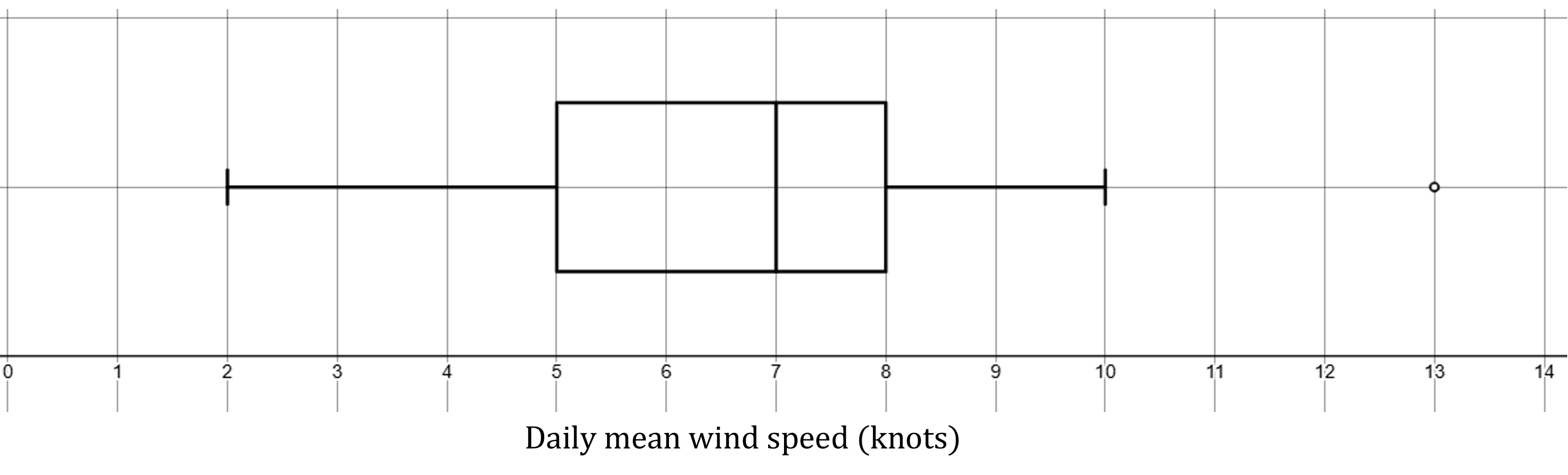
The box plot in Figure 1 shows the Daily Mean Wind Speed, w knots, for the 31 days in October 2015 in Hurn from the large data set.

Box plot with lowest line at 2, next line at 5, next at 7, next at 8, and last at 10. Another point is indicated at 13
Figure 1

Show that the value 13 is an outlier.

6b
2 marks

The Daily Mean Wind Speed data for Leuchars for the same period (October 2015) is summarised below.

Lowest Value

3

Lower Quartile

4

Median

6

Upper Quartile

9

Highest Value

22

Compare the Daily Mean Wind Speed in Hurn and Leuchars for October 2015.

6c
2 marks

A meteorologist wants to calculate the mean wind speed for Leuchars. The data in the large data set contains some entries recorded as "n/a".

State what "n/a" represents in the large data set and how the meteorologist should handle these entries.

1a
1 mark

Taruni is studying the time it takes members of her company to travel to the office.

Taruni decided to ask every member of the company the time, x minutes, it takes them to travel to the office.

Taruni’s results are summarised by the box plot below.

Box plot showing journey times from 20 to 90 minutes, with outliers at 118 and 124 minutes. The median is 40 minutes. The quartiles are at 26 and 58.

Write down the interquartile range for these data.

1b
3 marks

Rana and David both work for the company and have both moved house since Taruni collected her data.

Rana’s journey to work has changed from 75 minutes to 35 minutes and David’s journey to work has changed from 60 minutes to 33 minutes.

Taruni drew her box plot again and only had to change two values.

Explain which two values Taruni must have changed and whether each of these values has increased or decreased.

2a
3 marks

The partially completed table and partially completed histogram give information about the ages of passengers on an airline.

There were no passengers aged 90 or over.

Age (x years)

0 less or equal than x less than 5

5 less or equal than x less than 20

20 less or equal than x less than 40

40 less or equal than x less than 65

65 less or equal than x less than 80

80 less or equal than x less than 90

Frequency

5

45

90

1

Histogram showing frequency density of age groups, 5-20 has height of 6 large squares, 40-65 has height of 5.2 large squares, 65-80 has height of 4 large squares and 80-90 has height of 0.1 large squares.

Complete the histogram.

2b
Sme Calculator
5 marks

Use linear interpolation to estimate the median age.

2c
Sme Calculator
2 marks

An outlier is defined as a value greater than Q subscript 3 plus 1.5 cross times interquartile space range.

Given that Q subscript 1 equals 27.3 and Q subscript 3 equals 58.9, determine, giving a reason, whether or not the oldest passenger could be considered as an outlier.

3a
Sme Calculator
1 mark

The amounts of time engineers spent dealing with individual faults in a power plant were recorded to the nearest minute.  Data on 30 different faults is summarised in the table below.

Time t (minutes)

Frequency f

90 - 129

6

130 - 169

8

170 - 199

12

200 - 249

4

Give a reason to support the use of a histogram to represent these data.

3b
Sme Calculator
4 marks

On the grid below, draw a histogram to represent the data.

q1b-hard-2-2-data-presentation-edexcel-a-level-maths-statistics
3c
Sme Calculator
3 marks

Estimate the proportion of individual faults on which engineers spent longer than three hours.

4a
Sme Calculator
3 marks

A teacher took 19 students on an international trip.  The incomplete box plot below shows part of the summary of the weights, in kg, of the luggage brought by each student.  Each student’s luggage weighed a different value.

q2-hard-2-2-data-presentation-edexcel-a-level-maths-statistics

The median weight is 4 kg more than the lower quartile.  The range of weights is three times the interquartile range of weights.

Use the information above to complete the box plot.

4b
Sme Calculator
2 marks

Calculate the proportion of luggage weights which were less than 20 kg.

4c
Sme Calculator
2 marks

Students had to pay an additional fee if the weight of their luggage exceeded 23 kg.

Find the number of students who had to pay the additional fee.

5a
Sme Calculator
2 marks

Remy is timing how long it takes each of his 80 rats to find the exit to a maze.  Every two and a half minutes he records the number of rats which have found the exit which he then represents as a cumulative frequency curve.

q3-hard-2-2-data-presentation-edexcel-a-level-maths-statistics

Based on the graph, write down an inequality for the time, t, taken by the fastest rat.  

5b
Sme Calculator
3 marks

Remy’s assistant also recorded the actual times taken by the fastest and slowest rats.  She has used this information to begin constructing a box plot to represent the data.

Use the cumulative frequency curve to complete the box plot for the times.

q3b-hard-2-2-data-presentation-edexcel-a-level-maths-statistics
6a
Sme Calculator
1 mark

An annual cheese-rolling contest involves participants chasing a 4 kg round of cheese down a steep 200 yard long hillside.  A group of 60 friends participated in the contest and the table below summarises the distances travelled by each before first falling over.

Distance d (yards)

Frequency f

0 ≤ d < 40

23

40 ≤ d < 80

11

80 ≤ d < 120

9

120 ≤ d < 160

7

160 ≤ d < 200

6

How many of the 60 friends made it to the bottom without falling over?

6b
Sme Calculator
3 marks

Draw a cumulative frequency graph for the information in the table.

q4b-hard-2-2-data-presentation-edexcel-a-level-maths-statistics
6c
Sme Calculator
3 marks

The steepest part of the hill is between 100 and 140 yards away from the start. Using your graph, estimate how many people fell during this section of the hill.

7a
Sme Calculator
5 marks

The histogram below shows the masses, in grams, of 80 apples.

q5-hard-2-2-data-presentation-edexcel-a-level-maths-statistics

Find estimates for the median, lower quartile and upper quartile.

7b
Sme Calculator
2 marks

Given that the lightest apple weighs 41 g and that the range of masses is 97 g, draw a box plot to show the distribution of the masses of the apples.

q5b-hard-2-2-data-presentation-edexcel-a-level-maths-statistics
8a
Sme Calculator
1 mark

Wendy is using the large data set to learn about the daily mean windspeeds for Leeming in June 2015.  She lists the data below:

4

4

4

5

5

5

5

6

6

6

6

7

7

7

7

7

8

8

8

9

9

9

10

10

10

11

11

16

17

17

Using your knowledge of the large data set, state the units for the values in the table.

8b
Sme Calculator
4 marks

On the grid below draw a box plot for the information above.

q6b-hard-2-2-data-presentation-edexcel-a-level-maths-statistics
8c
Sme Calculator
2 marks

Wendy discovers that the value 16 is incorrect.  Wendy corrects the value and redraws the box plot.

Given that the box plot is unchanged, write down a range of values for the correct value x.

1a
Sme Calculator
4 marks

The histogram summarises the heights of 256 seedlings two weeks after they were planted.

Histogram with 'Frequency density' on the vertical axis and 'Height of seedling (cm)' on the horizontal address. There are 6 bars: from 0 to 1 cm with a height of 15,  from 1 to 2 cm with a height of 35,  from 2 to 3.5 cm with a height of 50, from 3.5 to 4.5 cm with a height of 55,  from 4.5 to 6.5 cm with a height of 26,  and from 6.5 to 8 cm with a height of 16.

Use linear interpolation to estimate the median height of the seedlings.

1b
Sme Calculator
3 marks

Chris decides to model the frequency density for these 256 seedlings by a curve with equation

y equals k x open parentheses 8 space – space x close parentheses space space space space space space space space space space space 0 less or equal than x less or equal than 8

where k is a constant.

Find the value of k.

1c
1 mark

Using this model, write down the median height of the seedlings.

2a
Sme Calculator
4 marks

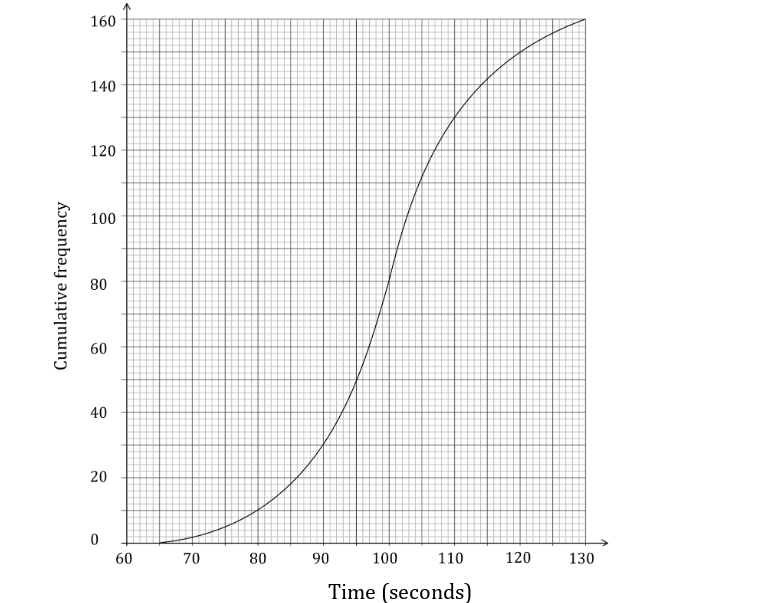
The cumulative frequency graph below shows the IQs of 160 employees of a company.

q1-veryhard-2-2-data-presentation-edexcel-a-level-maths-statistics

Using the graph, estimate the number of employees whose IQ is within 5 of the median IQ.

2b
Sme Calculator
2 marks

The employees who are within the top 10% of IQs are offered training for a management role. Estimate the lowest IQ of an employee who is offered the training.

2c
Sme Calculator
2 marks

The employees who are within the bottom 5% of IQs must attend a meeting with the director of the company. Estimate the highest IQ of an employee who must attend a meeting with the director.

3a
Sme Calculator
1 mark

There are 180 dogs in a rescue shelter. The histogram below shows the highest sound level reached by each individual dog’s bark, measured in decibels (dB).

q2-veryhard-2-2-data-presentation-edexcel-a-level-maths-statistics

Write down the underlying feature associated with each of the bars in a histogram.

3b
Sme Calculator
5 marks

Estimate how many dogs had a bark which ranged between 99 dB and 107 dB.

4a
Sme Calculator
3 marks

Mr Shapesphere, a history teacher, records the time, to the nearest minute, it takes him to mark each student’s essay. The times were summarised in a grouped frequency table and an extract is shown below:

Time t (minutes)

Frequency f

0 - 10

7

11 – 30

16

31 – 35

4

A histogram was drawn to represent these data. The 11 – 30 group was represented by a bar of width 6 cm and height 4.5 cm.

Find the width and height of the 0 – 10 group.

4b
Sme Calculator
3 marks

The total area under the histogram was 60.75 cm².

Find the number of essays which Mr Shapesphere recorded as taking longer than 35 minutes, to the nearest minute.

5a
Sme Calculator
3 marks

The grouped frequency table below contains information about the lengths of time of Susie’s calls with her customers. The table was used to draw the cumulative frequency curve also shown below.

Time (t minutes)

4 < t ≤8

8 < t ≤ 12

12 < t ≤ 16

16 < t ≤20

Frequency

16

a

b

c

q4-veryhard-2-2-data-presentation-edexcel-a-level-maths-statistics

Use the graph to find the values of a, b and c.

5b
Sme Calculator
3 marks

Use the graph to calculate the interquartile range of times for Susie’s calls.

5c
Sme Calculator
2 marks

Use the graph to estimate the percentage of customers whose calls lasted longer than 10 minutes.

6a
Sme Calculator
5 marks

Crystal is given an incomplete box plot showing the lengths of 99 unicorn horns. She also knows that the median length is the midpoint of the minimum and maximum lengths and that the range is 2.5 times as big as the interquartile range.

Complete the diagrams below to show that there are two possible distributions given the information above.

q5a-1-veryhard-2-2-data-presentation-edexcel-a-level-maths-statistics
6b
Sme Calculator
3 marks

The box plot below shows the masses of the 99 unicorn horns.

q5b-veryhard-2-2-data-presentation-edexcel-a-level-maths-statistics

Crystal discovers that two masses were recorded incorrectly; 11 kg should have been 8 kg and 9 kg should have been 10 kg. 

Explain why at most one value will need to be changed to fix the box plot.

6c
Sme Calculator
2 marks

Explain why it is possible that the box plot will remain unchanged when it is fixed.

7a
Sme Calculator
2 marks

The table below shows the information for the daily maximum relative humidity, rounded to the nearest per cent, for Leuchars between June and August 2015.

Daily maximum relative humidity (x %)

Frequency f

80 - 89

7

90 – 95

21

96 – 98

21

99 - 100

43

Using your knowledge of the large data set, explain why roughly 70% of these days contained fog and/or mist.

7b
Sme Calculator
2 marks

The data from the table are to be presented on a statistical diagram.

For a histogram, the frequency density for the 96 – 98 class is 7. Find the frequency density for the 80 – 89 class.

7c
Sme Calculator
2 marks

For a cumulative frequency graph, state the coordinates of all the points that should be plotted.

7d
Sme Calculator
1 mark

Explain why an exact box plot cannot be drawn using only the information from the table.