Reading Test: Completion Questions B (British Council Academic IELTS: Reading): Study Material

Flow chart completion: applying strategies & skills
These questions test your ability to understand details and/or the main ideas of a section of the text
The passage will describe a sequence – this could be the steps of a process or a sequence of events
You need to fill in gaps in the information presented in a series of steps or boxes connected by arrows
There are two types of flow chart completion:
Type 1: You fill the gaps in the flow chart with words taken directly from the text
Type 2: You fill the gaps with words from a list of possible answer options
In the second type, the words in the list may be taken directly from the passage
How to answer flowchart completion questions
Skim read the text and the flow chart
For each gap, see if you can predict what the word might be
Use the grammar of the notes to decide if the gap needs to be filled by a verb, noun, adverb or adjective
If the topic of the text is a sequence of events, note down any dates or time periods to help you
Worked Example
Note: The following is a worked example, written to demonstrate the style and approach expected in the exam.
The Development of Lighthouses
Lighthouses, the towers that give out a light to warn or guide ships at sea, have existed for thousands of years. Early lighthouses, such as the famous Pharos of Alexandria in ancient Egypt, relied on massive wood fires. However, these were difficult to maintain and often obscured by smoke. By the 1700s, coal became the primary fuel, but it wasn't until the late 18th century that the Argand lamp revolutionised the system. This lamp used a circular wick and a glass chimney to create a steady, bright flame.
To further intensify the light, engineers began using curved metal reflectors. While effective, much of the light was still lost. This changed in 1822 when Augustin Fresnel invented the Fresnel lens. By using a "stepped" design, this lens could capture and focus light into a powerful horizontal beam visible for miles.
As the 20th century approached, electricity replaced oil and gas, allowing for the use of incandescent bulbs. Eventually, the need for human lighthouse keepers declined as systems became fully automated, controlled by remote sensors and computers. Today, many modern beacons have transitioned to LED technology, which is highly energy-efficient and requires very little maintenance.
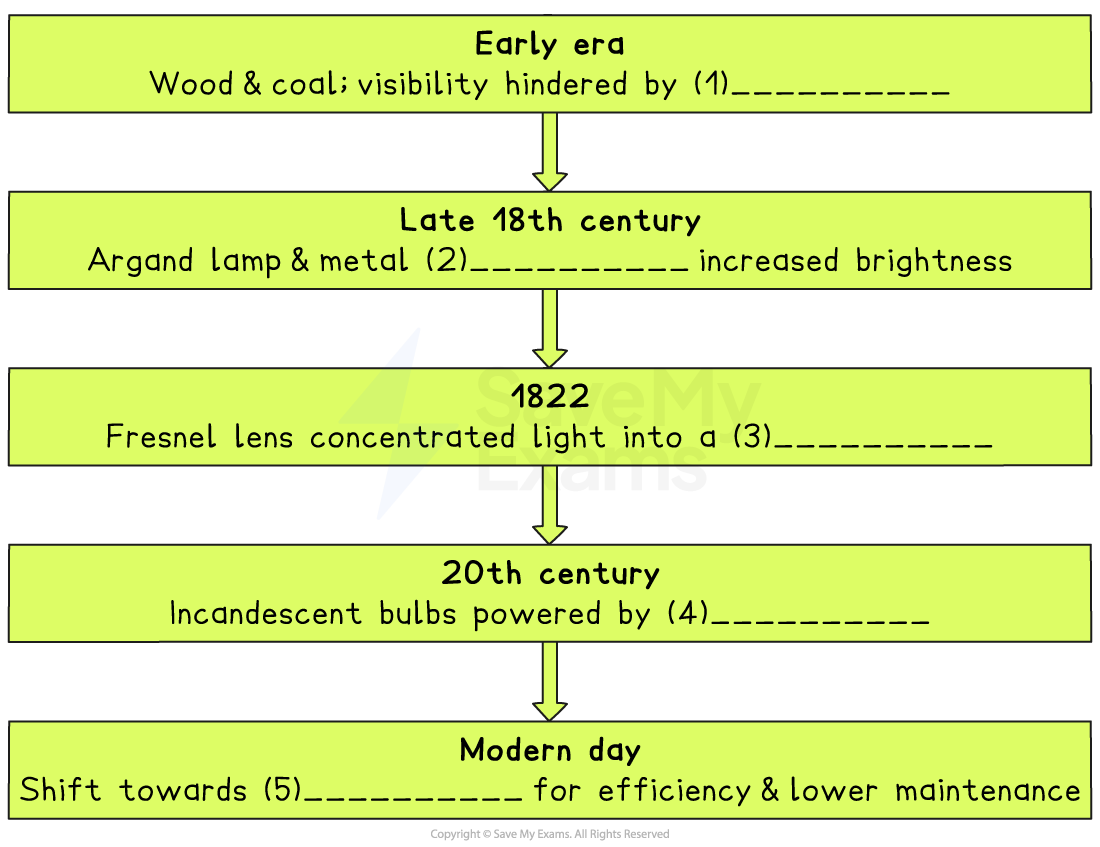
Questions 1-5
Complete the flow chart below
Choose NO MORE THAN TWO WORDS from the passage for each answer
Answer
Smoke: The text states wood fires were "often obscured by smoke." "Obscured" is a near synonym for "hindered."
Reflectors: The passage mentions that engineers used "curved metal reflectors" alongside lamps to further intensify light.
(Horizontal) beam: The Fresnel lens focused light into a "powerful horizontal beam." Both "horizontal beam" or just "beam" are grammatically correct. The phrase “ concentrate light into…” is a paraphrase of “capture and focus light into…”
Electricity: The text states that "electricity replaced oil and gas," enabling the use of bulbs.
LED technology: The final paragraph notes that modern lighthouses have moved to "LED technology" for its energy efficiency. the key words “efficiency” and “maintenance” can guide you here, as well as the synonym “shift” for “transition”
Diagram label completion: applying strategies & skills
These questions test your ability to locate information
The types of diagram that you may have:
A natural process, such as lake formation
A technical drawing of an invention or machine
A diagram or plan, such as a building
How to answer diagram completion questions
Check the number of words you need to add to each gap
Look at the diagram quickly and try to understand it
Work out what the part of speech you need (e.g. verb, noun or adjective)
Try to predict what word is needed
Focus on the relationship between the diagram and the text instead of trying to understand the diagram completely
Scan the text to quickly locate the part where the information is, then read that part closely to check details
Check you have copied the word or phrase exactly from the text
Worked Example
Note: The following is a worked example, written to demonstrate the style and approach expected in the exam.
The Evolution of the Bicycle
The modern bicycle is a masterpiece of mechanical efficiency. At its core is the frame, typically composed of two triangles. The front of the frame is connected to the handlebars, which the rider uses for steering. These are attached to the front forks, which hold the front wheel in place.
For comfort, the rider sits on the saddle, positioned atop a seat post. To provide motion, the rider pushes down on the pedals. This force is transferred to the chain, a loop of metal links that connects the front chainring to the rear cogset (a cluster of gears). As the chain rotates, it spins the rear wheel, propelling the bicycle forward. To manage speed, most bicycles use hand-operated brake levers mounted on the handlebars, which pull cables to engage the braking mechanism.
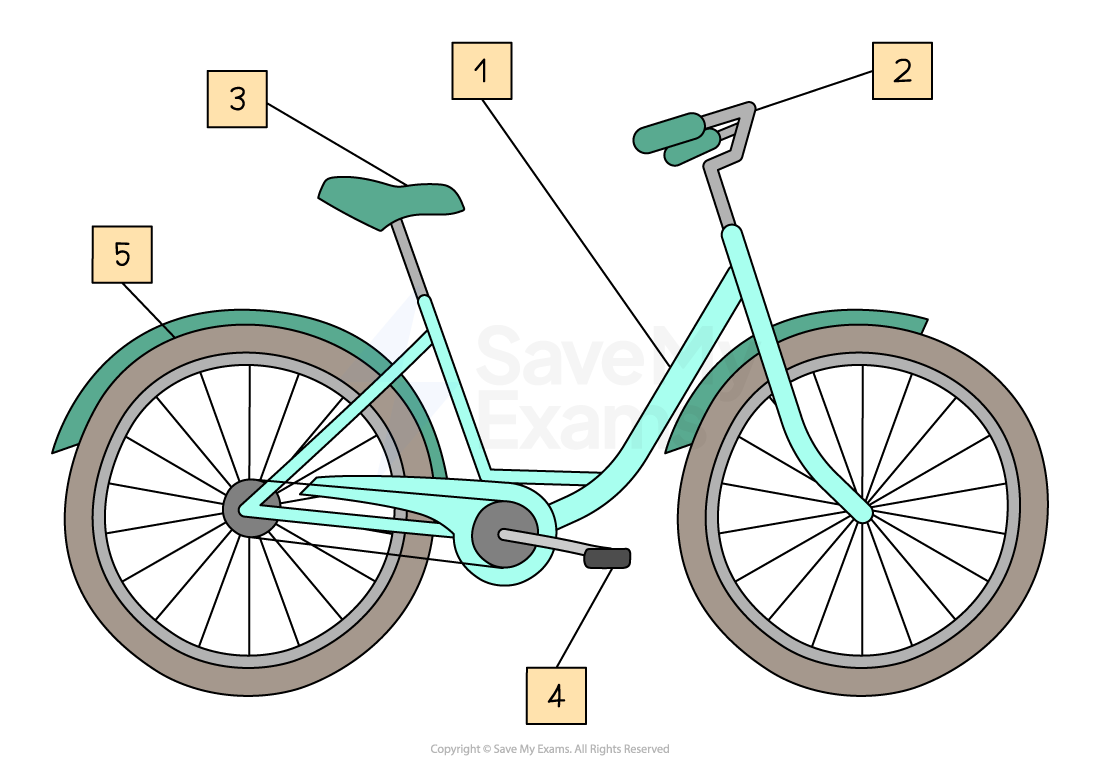
Questions 1–5
Label the diagram below
Choose NO MORE THAN TWO WORDS from the passage for each answer
Answer
Frame: the text mentions this is made up of two triangles
Handlebars: the text mentions that these are attached to the front forks which hold the wheel in place
Saddle: the text mentions this is on top of the seat post
Pedals: the text mentions that the rider pushes down on these and they are connected to the chain
Rear wheel: the text mentions the chain spins this as the rider pushes down on the pedals
Table completion: applying strategies & skills
In table completion questions, you fill in gaps in a table using information from the reading passage
The table organises information into rows and columns
often comparing categories, features, or data points across different subjects
The answers must be exact words from the passage
Do not change the spelling or word form
There are two types of table completion:
Type 1: You fill the gaps in the table with words taken directly from the text
Type 2: You fill the gaps with words from a list of possible answer options
In the second type, the words in the list may be taken directly from the passage
How to answer a table completion question in the reading test
Read the instructions carefully and note the word limit before looking at the table
Survey the table first; check the title, column headings, and row headings to understand what type of information each gap requires
Use the row and column headings to locate the correct section of the passage
Predict the part of speech for each gap
is it likely to be a noun, adjective, number, or phrase?
Scan the passage for the relevant section, then read closely to find the exact words that fit
The answers usually follow the order of the passage, but not always
read the table from left to right (not up and down) and work through it row by row, from top to bottom
Write the exact words from the passage
do not paraphrase or change the word form
Examiner Tips and Tricks
Watch out for distractors
The passage might include nearby information that sounds plausible but answers a different question
Always check the column heading to confirm your answer matches what is actually being asked.
Worked Example
Note: The following is a worked example, written to demonstrate the style and approach expected in the exam.
Long-Distance Migration in Birds
Each year, millions of birds undertake remarkable journeys between their breeding and wintering grounds. Among the most celebrated long-distance migrants are the Arctic tern, the bar-tailed godwit and the common swift, each displaying a distinct migratory strategy.
The Arctic tern holds the record for the longest annual migration of any animal. Breeding across the Arctic tundra during the northern summer, it travels south to the Antarctic each winter — a round trip of approximately 70,000 kilometres. During the crossing, the tern feeds primarily on fish and crustaceans caught at the ocean surface, and typically flies at altitudes above 1,000 metres.
The bar-tailed godwit, by contrast, is known for completing the longest non-stop flight of any bird. It breeds in Alaska and Siberia before migrating each year to New Zealand, a journey of up to 11,000 kilometres. Flying at a relatively low altitude of around 300 metres, the godwit does not feed during the crossing, surviving instead by metabolising fat reserves built up before departure.
The common swift spends almost its entire life in the air, breeding across Europe each summer before migrating south to sub-Saharan Africa. Unlike the other species, it feeds exclusively on airborne insects throughout the migration, adjusting its altitude — typically between 1,500 and 3,000 metres — according to where insect populations are densest.
Questions 9–13
Complete the table below
Choose NO MORE THAN THREE WORDS from the passage for each answer
Write your answers in boxes 9–13 on your answer sheet
Species | Breeding region | Wintering region | Annual distance | Flight altitude | Feeding behaviour |
Arctic tern | Arctic tundra | the Antarctic | 70,000 km | above 1,000 metres | fish and crustaceans |
Bar-tailed godwit | Alaska and Siberia | (9) .......... | up to 11,000 km | (10) .......... | (11) .......... |
Common swift | (12) .......... | sub-Saharan Africa | not specified | 1,500–3,000 metres | (13) .......... |
Answers
New Zealand: The passage states the bar-tailed godwit migrates "each year to New Zealand."
around 300 metres: The passage describes the godwit as "flying at a relatively low altitude of around 300 metres."
does not feed: The passage states the godwit "does not feed during the crossing." Note: surviving on fat reserves is a distractor — this describes how it survives, not its feeding behaviour.
Europe:The passage states the common swift breeds "across Europe each summer."
airborne insects: The passage says the swift "feeds exclusively on airborne insects throughout the migration." Note: the altitude detail that follows is a distractor — the gap asks about diet, not height.
Sign up now for IELTS Academic
or
Was this study material helpful?