Perception (College Board AP® Psychology): Exam Questions

4 mins4 questions
1
1 mark

A researcher shows the same ambiguous image to participants from different cultural backgrounds. Participants from cultures where horizontal lines dominate the landscape tend to perceive the image differently from participants raised in environments with more vertical structures.

Which of the following best explains this finding?

  • Bottom-up processing causes participants to focus on different physical features of the image

  • Selective attention filters out irrelevant visual information based on prior experience

  • Perceptual set shapes how individuals interpret ambiguous stimuli based on experience

  • Signal detection thresholds vary systematically across cultural groups

2
1 mark

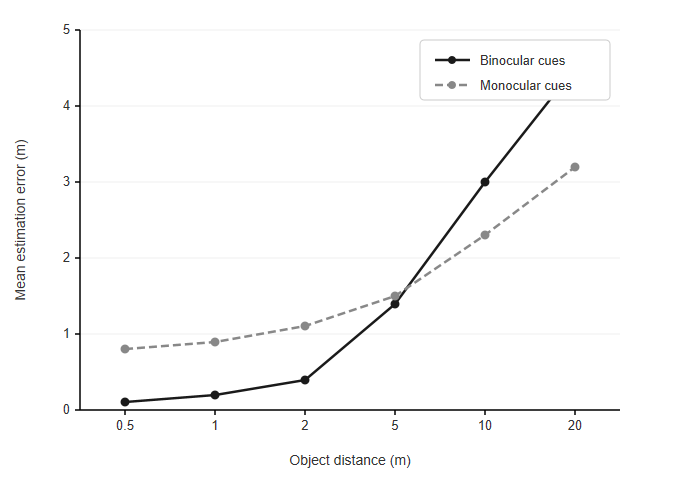
A researcher investigated how accurately people judge the distance of objects using different types of depth cues.

Forty participants were tested individually in a controlled room. In one condition, participants used only monocular cues (one eye covered) to estimate the distance of objects placed at six different distances (0.5 m, 1 m, 2 m, 5 m, 10 m, and 20 m).

In a second condition, the same participants used binocular cues (both eyes open) to estimate the same distances. The graph below shows the mean estimation error (in meters) for each condition at each distance. Lower error scores indicate more accurate distance judgments.

Line graph comparing binocular and monocular cues' mean estimation error over object distances from 0.5 to 20 metres, showing errors increase with distance.

Based on the data in the graph, which of the following statements is best supported?

  • Monocular cues produce more accurate distance judgments than binocular cues at all distances tested

  • Binocular cues produce more accurate distance judgments than monocular cues at all distances tested

  • Binocular cues produce more accurate distance judgments than monocular cues at short distances, but monocular cues become relatively more accurate at longer distances

  • The type of depth cue used has no effect on distance judgment accuracy beyond 5 meters

3
1 mark

A researcher investigated how accurately people judge the distance of objects using different types of depth cues.

Forty participants were tested individually in a controlled room. In one condition, participants used only monocular cues (one eye covered) to estimate the distance of objects placed at six different distances (0.5 m, 1 m, 2 m, 5 m, 10 m, and 20 m).

In a second condition, the same participants used binocular cues (both eyes open) to estimate the same distances. The graph below shows the mean estimation error (in meters) for each condition at each distance. Lower error scores indicate more accurate distance judgments.

Line graph comparing binocular and monocular cues' mean estimation error over object distances from 0.5 to 20 metres, showing errors increase with distance.

Which of the following is an example of a monocular depth cue that participants in the monocular condition of this study could have used to estimate distance?

  • Retinal disparity

  • Convergence

  • Stereopsis

  • Linear perspective

4
1 mark

A radiologist with 20 years of experience scans a chest X-ray and immediately notices a faint shadow that a medical student reviewing the same image completely overlooks. The radiologist explains that years of training have taught her what features to look for and where.

Which of the following best explains the difference in their perceptual experiences?

  • The medical student is using top-down processing while the radiologist relies purely on bottom-up processing

  • Top-down processing allows the radiologist to use prior knowledge and expectations to guide perception, making the shadow stand out

  • The radiologist has a lower absolute threshold due to years of practice, allowing her to detect fainter stimuli

  • The medical student lacks the sensory acuity required to detect the shadow at the physical level