Syllabus Edition

First teaching 2025

First exams 2027

Firms & Production (Cambridge (CIE) IGCSE Economics): Exam Questions

Exam code: 0455 & 0987

1 hour33 questions
1
Sme Calculator
1 mark

What does productivity in economics refer to?

  • The total revenue earned by a company in a year

  • The number of employees working in a firm

  • The amount of outputs to inputs in the production process

  • The amount of profit generated by a business

2
Sme Calculator
1 mark

How can an increase in productivity benefit a business?

  • By reducing the number of employees required

  • By decreasing the demand for its products

  • By increasing costs and lowering profitability

  • By producing more output with the same amount of input

3
Sme Calculator
1 mark

How does technology improve productivity?

  • Technology has no impact on productivity

  • Technology can lead to decreased efficiency

  • Technology can enhance efficiency and output

  • Technology only affects managers decisions

4
Sme Calculator
1 mark

Which of the following examples is derived demand?

  • The demand for entertainment services

  • The demand for clothing and fashion items

  • The demand for labour in the construction industry

  • The demand for personal electronics

5
Sme Calculator
1 mark

Which of the following is not a disadvantage of labour intensive production?

  • The firm may find it difficult to recruit workers when needed & letting go of staff when they are not required is unpopular

  • The firm can adjust the number of workers hired as demand for its goods/services fluctuate

  • Each worker requires both wage & non-wage benefits, which can prove expensive for the firm

  • The more skilled the labour required, the higher the wage bill for the firm will be

1
1 mark

All countries need to produce food.

Which type of agriculture would make the best use of the resources of developing and developed economies?


developing

developed

A

B

C

D

capital-intensive

capital-intensive

labour-intensive

labour-intensive

capital-intensive

labour-intensive

capital-intensive

labour-intensive

    2
    1 mark

    What is the main difference between capital-intensive production and labour-intensive production?

    • the market structure of the production process

    • the output that the production process creates

    • the resources on which the production relies

    • the size of the firm that uses the production process

    3
    Sme Calculator
    1 mark

    How might an increase in workforce education levels impact productivity growth?

    • It could lead to decreased technological innovation

    • It might reduce overall labor force participation

    • It could result in a more skilled and adaptable workforce

    • It might lead to decreased demand for goods and services

    4
    Sme Calculator
    1 mark

    Which factor will lead to long-term productivity growth in an economy?

    • A decrease in technological advancements

    • An increase in regulations and bureaucratic processes

    • Growth in human capital through education and training

    • A decrease in capital investment

    5
    Sme Calculator
    1 mark

    How might a decrease in the demand for cars impact derived demand for steel used in car manufacturing?

    • It could lead to decreased derived demand for steel due to reduced car production

    • It might lead to increased derived demand for steel as manufacturers look to reduce costs

    • It would have no impact on derived demand for steel

    • It could lead to increased derived demand for steel as alternative materials are sought

    6
    1 mark

    A firm adopts more capital-intensive methods of production.
    What is the likely result?

    • lower productivity of capital

    • higher productivity of labour

    • fewer workers employed

    • greater job security for workers

    7
    1 mark
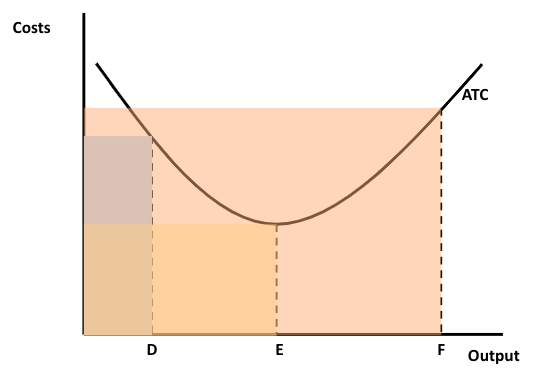
    Graph showing a U-shaped ATC curve on a cost-output axis, marked with three shaded areas labelled D, E, and F, indicating different cost segments.

    The diagram shows a firm’s average total cost (ATC) curve. At the lowest point of the curve (E), what is the firm experiencing?

    • economies of scale

    • diseconomies of scale

    • constant returns to scale

    • reduced revenue

    1
    1 mark

    The table shows units of output, value of output and number of people employed in an industry over three years.


    output (units, millions)

    output value ($ millions)

    number employed (000)

    year 1

    10

    10

    5

    year 2

    21

    25

    7

    year 3

    32

    40

    8

    What can be concluded from the table?

    • Inflation has increased.

    • Productivity has increased.

    • Profit has increased.

    • Working population has increased.

    2
    Sme Calculator
    1 mark

    What might cause a decrease in the price of factors of production?

    • Increased demand for the final goods and services

    • A shortage of labour and other inputs

    • Reduced costs of production materials

    • Technological advancements that reduce the need for labour

    3
    Sme Calculator
    1 mark

    How might government policies impact the availability of factors of production?

    • Government policies have no influence on factor availability

    • Government interventions can increase factor scarcity

    • Favorable policies can lead to improved factor availability

    • Government policies only affect consumer goods prices

    4
    Sme Calculator
    1 mark

    The diagrams below show the demand and supply for tyres and rubber. Which of the following statements describing the diagrams is correct?

    3-6-1-demand-for-factors-of-production
    • In the tyre market, the increased demand for tyres is represented by a shift in the demand curve from D1 to D

    • Rubber is a natural resource (land) & there is now decreased demand from the firm for rubber in order to meet higher levels of tyre production

    • The demand for tyres is derived demand from the demand for rubber

    • If a tyre manufacturer benefits from increased demand for their tyres, they will require less rubber to meet the demand

    5
    Sme Calculator
    1 mark

    What impact might a capital-intensive approach have on production costs?

    • It would lead to lower initial investment costs

    • It would result in higher ongoing labour costs

    • It would decrease the need for energy consumption

    • It would lead to unstable production processes