1

1 mark
Which of the following is not a property of water?
High specific heat capacity
Excellent solvent
Low latent heat of vaporisation
High surface tension
Was this exam question helpful?
Exam code: H420
Which of the following is not a property of water?
High specific heat capacity
Excellent solvent
Low latent heat of vaporisation
High surface tension
Was this exam question helpful?
Which of the following best describes the bonding between amino acids in the tertiary structure of a protein?
Hydrogen and ionic bonds, disulfide bridges and hydrophobic interactions.
Glycosidic, peptide and hydrogen bonds.
Ionic and glycosidic bonds, and disulfide bridges.
Peptide and glycosidic bonds, hydrophobic interactions and disulfide bridges.
Was this exam question helpful?
Which of the following is an example of a fibrous protein?
Elastin
Haemoglobin
Enzymes
Insulin
Was this exam question helpful?
Carbohydrates, such as starch, are made from monosaccharides joined together. Which of the following types of bond joins monosaccharides together?
Peptide
Ester
Glycosidic
Phosphodiester
Was this exam question helpful?
Which biological molecule is tested for using the emulsion biochemical test?
Lipid
Protein
Reducing sugars
Starch
Was this exam question helpful?
Which of the following reactions, A to D, describes the conversion of a polymer to a monomer?

Was this exam question helpful?
Collagen is found in tendons. Tendons attach muscles to bones. Which of the following lists of properties, A to D, makes collagen suitable for this role?
strong, inflexible, insoluble
strong, flexible, soluble
strong, inflexible, soluble
strong, flexible, insoluble
Was this exam question helpful?
The following are a series of organic molecules and the chemical processes that occur to convert them into different molecules.
Which of the rows, A to D, is correct?

Was this exam question helpful?
The following table describes the approximate percentage mass of different chemical elements in organic polymers.
| Polymer | N (%) | C (%) | O (%) | H (%) | P (%) |
A | nucleic acid | 20.0 | 30.0 | 20.0 | 10.0 | 20.0 |
B | carbohydrate | 0.0 | 33.3 | 33.3 | 33.3 | 0.0 |
C | protein | 30.0 | 10.0 | 10.0 | 0.0 | 50.0 |
D | lipid | 0.0 | 50.0 | 49.0 | 1.0 | 0.0 |
Which of the rows, A to D, is correct?
Was this exam question helpful?
Which of the following processes involves the formation of ester bonds?
1 synthesis of polynucleotides 2 synthesis of triglycerides 3 synthesis of polypeptides
1, 2 and 3
Only 1 and 2
Only 2 and 3
Only 1
Was this exam question helpful?
Which of the following could not be an amino acid?

Was this exam question helpful?
Lipids are a diverse group of chemicals that are neither polar nor charged and hence are insoluble in water. The ___(1)___ nature of the heads of phospholipids allows them to form membranes. ___(2)___ also contain fatty acids and form part of the membrane. Lipids can be used for energy storage in the form of ___(3)___. Some hormones are also lipids and they are similar in structure to ___(4)___.
Which row shows the correct sequence of missing words?
| 1 | 2 | 3 | 4 |
A | hydrophilic | glycolipids | triglycerides | cholesterol molecules |
B | hydrophilic | triglycerides | cholesterol molecules | glycolipids |
C | hydrophobic | cholesterol molecules | triglycerides | bile |
D | hydrophilic | cholesterol molecules | triglycerides | glycolipids |
Was this exam question helpful?
Which of the statements, A to D, correctly describes the process of adhesion?
attraction of water molecules to the impermeable walls of xylem tissue
attraction of water molecules to other water molecules in the xylem tissue
active transport of water molecules into phloem tissue
attraction of water molecules to other water molecules in the phloem tissue
Was this exam question helpful?
Which of the statements, A to D, about amylopectin is correct?
it contains 1-4 and 1-6 glycosidic bonds between α-glucose monomers
it is an unbranched chain of α-glucose monomers
it contains α 1-4 and β 1-6 glycosidic bonds
it is made up of β-glucose monomers and is uncoiled
Was this exam question helpful?
An unknown solution of a single sugar was tested. The results were recorded in Table 9.1.
Colours observed after testing | |
Benedict’s test for reducing sugars | Benedict’s test for non-reducing sugars |
blue | brick red |
Table 9.1
Identify the unknown sugar.
fructose
lactose
sucrose
glucose
Was this exam question helpful?
The diagram shows the structures of two molecules.

Which of the following statements correctly identifies a difference between molecule 1 and molecule 2?
Molecule 1 contains a glycerol backbone, whereas molecule 2 does not.
Molecule 1 contains a phosphate group, a nitrogen-containing group and two fatty acid chains, whereas molecule 2 contains three fatty acid chains but no phosphate group or nitrogen-containing group.
Molecule 1 contains only saturated fatty acid chains, whereas molecule 2 contains an unsaturated fatty acid chain.
Molecule 1 is hydrophilic, whereas molecule 2 has both hydrophilic and hydrophobic regions.
Was this exam question helpful?
A student carried out biochemical tests on four unknown solutions (1–4). The results are shown in the table below.
Solution | Benedict's test | Biuret test | Iodine test | Emulsion test |
|---|---|---|---|---|
1 | Brick-red precipitate | Blue | Blue-black | Cloudy white |
2 | Blue | Purple/lilac | Brown | Clear |
3 | Brick-red precipitate | Purple/lilac | Brown | Clear |
4 | Blue | Blue | Blue-black | Cloudy white |
Which option correctly identifies the components present in solution 3.
Reducing sugar, protein and starch only
Reducing sugar only
Reducing sugar and protein only
Protein and lipid only
Was this exam question helpful?
A student carried out biochemical tests on four unknown solutions (1–4). The results are shown in the table below.
Solution | Benedict's test | Biuret test | Iodine test | Emulsion test |
|---|---|---|---|---|
1 | Brick-red precipitate | Blue | Blue-black | Cloudy white |
2 | Blue | Purple/lilac | Brown | Clear |
3 | Brick-red precipitate | Purple/lilac | Brown | Clear |
4 | Blue | Blue | Blue-black | Cloudy white |
A student observes that solutions 1 and 4 both gave a blue-black colour with iodine and a cloudy white emulsion with ethanol.
Which of the following correctly describes the structural features of the molecules responsible for these results in solutions 1 and 4?
The molecule responsible for the iodine result has a 1,4 and 1,6 glycosidic bonds forming a branched structure; the molecule responsible for the emulsion result is formed from one glycerol and three fatty acid molecules joined by ester bonds and is polar
The molecule responsible for the iodine result is a polysaccharide with a helical structure that traps iodine molecules; the molecule responsible for the emulsion result is a triglyceride formed by condensation reactions and is non-polar
The molecule responsible for the iodine result is a polysaccharide made of β-glucose monomers joined by 1,4 glycosidic bonds; the molecule responsible for the emulsion result is a triglyceride formed by hydrolysis reactions
The molecule responsible for the iodine result has a helical structure stabilised by hydrogen bonds between glucose monomers; the molecule responsible for the emulsion result is formed from glycerol and fatty acids joined by peptide bonds
Was this exam question helpful?
Which row correctly identifies the molecules and one function of each?
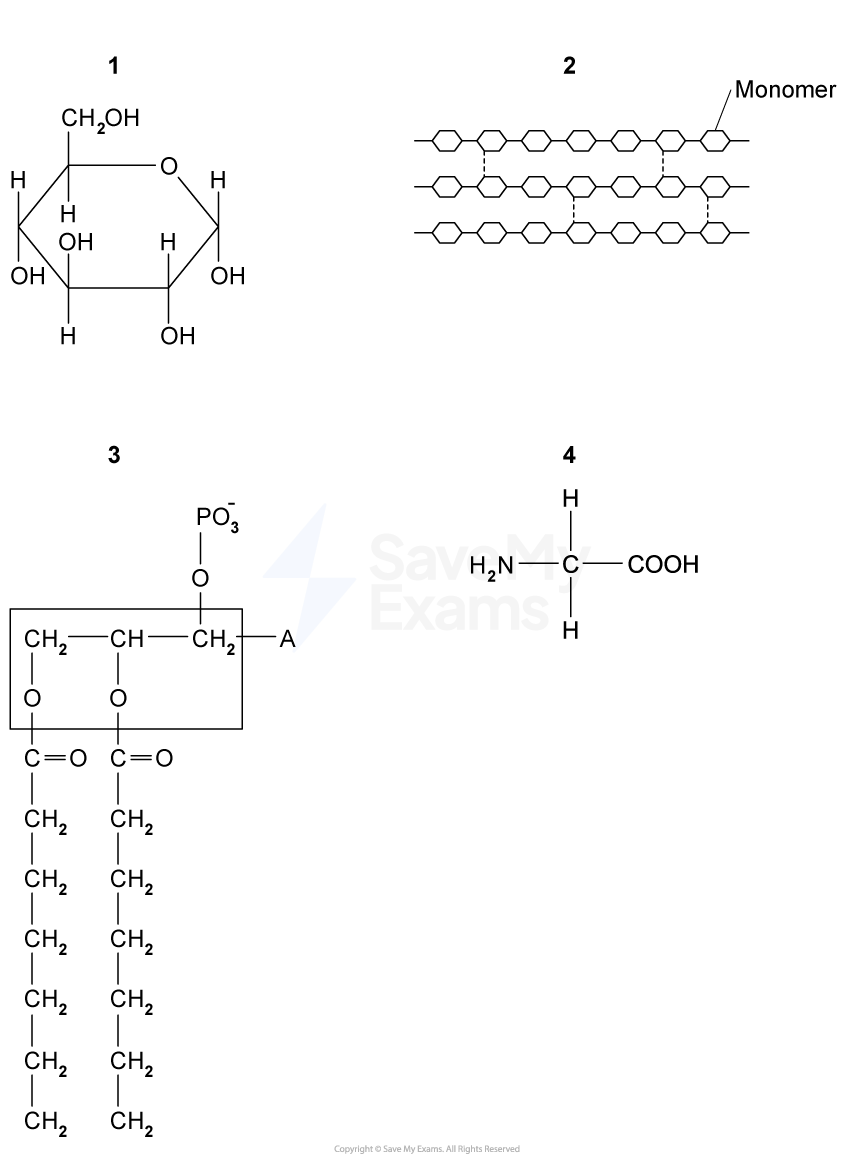
Row | Molecule 1 | Molecule 2 | Molecule 3 | Molecule 4 |
|---|---|---|---|---|
A | β-glucose; monomer of cellulose | Cellulose; energy storage in plant cells | Triglyceride; long term energy storage | Amino acid; monomer of enzymes |
B | α-glucose; monomer of starch | Cellulose; structural support in plant cell walls | Phospholipid; forms bilayer of cell membranes | Nucleotide; monomer of nucleic acids |
C | β-glucose; monomer of cellulose | Glycogen; energy storage in animal cells | Triglyceride; long term energy storage | Nucleotide; monomer of nucleic acids |
D | α-glucose; monomer of starch | Cellulose; structural support in plant cell walls | Phospholipid; forms bilayer of cell membranes | Amino acid; monomer of enzymes |
Was this exam question helpful?
Some of the properties of water make it a vital component of certain organelles such as the matrix in mitochondria.
Which of the following statements does not describe a useful property of water in the mitochondria?
Water is adhesive.
Water is a liquid.
Water is a substrate for reactions
Water is a polar solvent.
Was this exam question helpful?
Fibroin, the protein found in silk, mainly consists of amino acids in anti-parallel beta-sheets.
Which of the following statements explains why haemoglobin has a more complex structure than fibroin?
1 | Fibroin has a basic, repeating structure. |
2 | Interactions between R-groups when forming haemoglobin are within and between protein molecules. |
3 | The quaternary structure of haemoglobin is formed from folding of the secondary structure. |
4 | In fibroin, hydrogen bonds only form between the amino group and R group of the amino acids. |
All 4 statements.
Statements 1, 2 and 3.
Statements 1, 2 and 4
Statements 1 and 2 only.
Was this exam question helpful?
Chitin is a structural polysaccharide that is found in the cell walls of fungi. The chemical structure of chitin is shown below, it shares some similarities with the structure of cellulose.

Which of the following statements accurately compares the structures of cellulose and chitin?
Chitin contains α-glycosidic bonds, cellulose contains β-glycosidic bonds.
Chitin contains nitrogen, cellulose does not.
Chitin contains 1-4 glycosidic bonds, cellulose contains 1-6 glycosidic bonds.
Chitin does not have branching, cellulose has branching.
Was this exam question helpful?
A patient is experiencing the following symptoms:
Muscle cramps
Seizures
Headaches
Increased urine production.
Which of the following ions is likely to be deficient in this patient?
Na+
HCO3-
NH4+
H+
Was this exam question helpful?
Sickle cell anaemia is a genetic disease affecting red blood cells which is caused by base substitution in the haemoglobin protein which results in a polar amino acid being replaced with a non-polar amino acid in the globin subunits.
The diagram below shows the difference between a normal red blood cell and a sickle cell.

Which of the following statements correctly explain the impact of the amino acid substitution?
The haemoglobin becomes less soluble.
The haemoglobin subunits lose their prosthetic groups.
The disulfide bonds holding the subunits together break.
The haemoglobin becomes less compact.
Was this exam question helpful?