Travel & Transport: Exam Skills (AQA GCSE German): Revision Note
Exam code: 8662

The topic of travel and transport can appear in any of the exams - from listening to someone describe their daily commute to writing about the advantages of public transport
Let's use the vocabulary, grammar and phonics we have seen so far to take a closer look at some typical exam questions and how you might tackle them
Travel & transport: listening
Section B of the listening exam is a dictation
You will hear each sentence three times: first as a full sentence, then in short sections, then as a full sentence again
You must write down in German exactly what you hear, paying close attention to spelling and grammar
The two questions below will help you to practise this skill
Foundation tier
Worked Example
You will hear four short sentences. Write down in German exactly what you hear for each sentence.
Answers:
Sentence 1: Ich fahre jeden Tag mit dem Bus zur Schule.
Sentence 2: Der Zug kommt um neun Uhr an.
Sentence 3: Wir reisen mit dem Auto nach Deutschland.
Sentence 4: Der Bahnhof ist links vom Zentrum.
Examiner Tips and Tricks
Dictation tests both your listening and your knowledge of German spelling and grammar
Use the second hearing - when the sentence is read in short sections - to check individual words carefully
Listen out for grammatical clues: for example, dem tells you the following noun is masculine or neuter in the dative case, which can help you spell it correctly
Always re-read what you have written against the third hearing to catch any errors
Higher tier
Worked Example
You will hear five short sentences. Write down in German exactly what you hear for each sentence.
Answers:
Sentence 1: Ich nehme lieber den Zug, weil er schneller als das Auto ist.
Sentence 2: Die Straßenbahn fährt direkt ins Zentrum der Stadt.
Sentence 3: Letztes Jahr bin ich mit dem Schiff in die Türkei gefahren.
Sentence 4: Wegen des Unfalls auf der Hauptstraße war der Verkehr sehr langsam.
Sentence 5: Unterwegs habe ich Musik gehört und aus dem Fenster geschaut.
Examiner Tips and Tricks
At Higher tier, sentences are longer and more grammatically complex, so the short-section hearing is especially valuable - use it to focus on individual words and endings
Dictation shows grammatical awareness as well as accurate listening, and both are rewarded in the mark scheme
Travel & transport: speaking
In part 3 of the speaking exam, you need to describe two photos and then have a conversation with your teacher about the theme covered in the photos
This question will help you to practise describing a photo on the topic of 'Travel and transport'
Foundation tier
Worked Example
Sag mir etwas über das Foto.
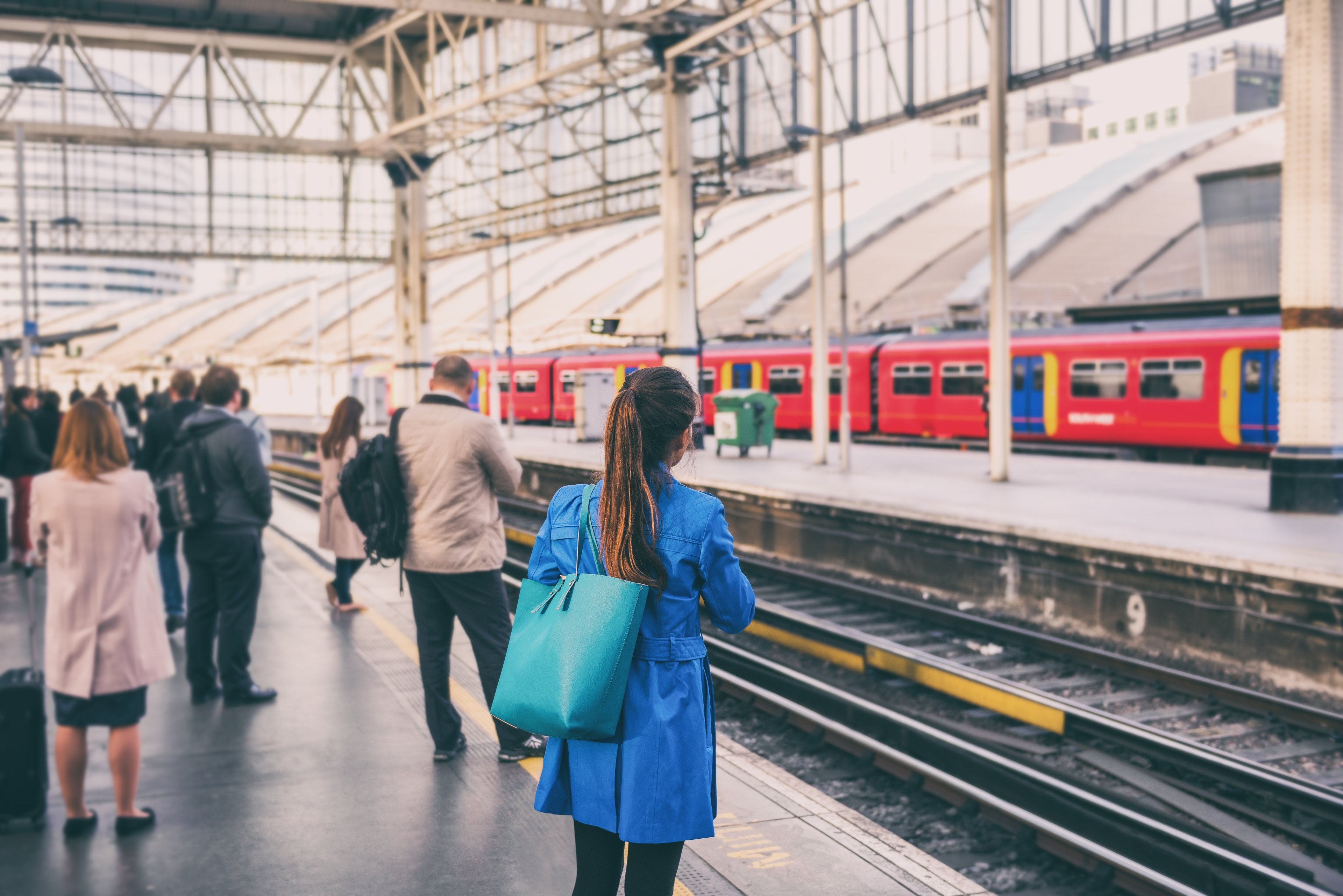
Answer:
Here is an example answer:
Auf dem Foto sehe ich einen Zug. Es gibt viele Männer und Frauen. Sie warten auf einen anderen Zug. Sie sind in einem Bahnhof, und draußen ist es sonnig. Ich denke, dass es Morgen ist und dass sie zur Arbeit gehen. Ich glaube, dass sie ein bisschen unglücklich sind, weil sie Fahrkarten gekauft haben, aber der Zug noch nicht angekommen ist.
In the photo, I see a train. There are many men and women. They are waiting for another train. They are in a train station, and it is sunny outside. I think that it is morning and that they are going to work. I believe that they are a little unhappy because they bought tickets, but the train has not arrived yet.
Examiner Tips and Tricks
Use the acronym PALM to help you - People and objects, Action, Location, Mood
Look at the aspects of PALM mentioned in the response above:
P: Es gibt viele Männer und Frauen.
A: Sie warten auf einen anderen Zug. Sie gehen zur Arbeit.
L: Sie sind in einem Bahnhof, und draußen ist es sonnig.
M: Ich glaube, dass sie ein bisschen unglücklich sind, weil sie Fahrkarten gekauft haben, aber der Zug noch nicht angekommen ist.
Higher tier
In part 1 of the speaking exam, you will take part in a role-play
Your teacher will play the part of your friend and will speak first
Each response must include a verb
The two questions below will help you to practise responding to role-play prompts on the topic of 'Travel and transport'
Worked Example
Prepare the following role-play. You are talking to your Austrian friend about travel and transport.
Say how you travel into town. (Give one detail.)
Say which form of transport you prefer and why. (Give one detail and one reason.)
Give two disadvantages of travelling by car.
Say where you would like to travel in the future. (Give two details.)
? Ask your friend a question about how they travel to school.
Answers:
Here are some example responses.
Ich fahre meistens mit dem Fahrrad ins Zentrum. I usually cycle into the town centre.
Ich reise am liebsten mit dem Zug, weil er schneller als das Auto ist. I most like travelling by train because it is faster than the car.
Das Auto ist schlecht für die Umwelt und der Verkehr in der Stadt ist oft sehr langsam. The car is bad for the environment and the traffic in town is often very slow.
In der Zukunft möchte ich mit dem Schiff nach Japan fahren und die Landschaft sehen. In the future I would like to travel to Japan by ship and see the scenery.
Fährst du oft mit dem Bus oder mit dem Zug? Do you often travel by bus or by train?
Examiner Tips and Tricks
The phrase öffentliche Verkehrsmittel (public transport) does not appear as a standalone entry in the AQA vocabulary list
However, it has been used in official AQA exam material and is a highly useful phrase for this topic
It is worth knowing and using actively but be aware that it goes beyond the core vocabulary list
Travel & transport: reading
In Section B of the reading exam, you need to translate sentences from German into English
There are two marks per sentence
The two questions below will help you to practise translating into English on the topic of 'Travel & Transport'
Foundation tier
Worked Example
Translate these sentences into English.
Ich benutze mein Fahrrad, weil es nicht viel kostet.
Der Bus hält links vom Bahnhof.
Meine Familie fliegt nächsten Sommer nach Spanien.
Der Zug ist schnell und günstig.
Letztes Jahr bin ich mit dem Schiff in die Schweiz gefahren.
Answers:
I use my bicycle because it does not cost much.
The bus stops to the left of the station.
My family is flying / will fly / is going to fly to Spain next summer.
The train is fast and cheap.
Last year I travelled to Switzerland by ship.
Higher tier
Worked Example
Translate these sentences into English.
Die Straßenbahn fährt direkt ins Zentrum und hält vor dem Bahnhof.
Wegen des Unfalls auf der Hauptstraße kamen viele Leute zu spät an.
Mein Vater reist lieber mit dem Flugzeug, obwohl es nicht gut für die Umwelt ist.
Wenn man in die Stadt fahren will, ist die U-Bahn am schnellsten.
In der Zukunft wird es wichtiger sein, mit dem Bus oder der Bahn zu fahren.
Answers:
The tram goes directly into the town centre and stops in front of the station.
Because of the accident on the main road, many people arrived late.
My father prefers to travel by plane, although it is not good for the environment.
If you want to travel into town, the underground is the fastest.
In the future it will be more important to travel by bus or train.
Examiner Tips and Tricks
Translation sentences often contain structures that cannot be translated word for word
Sentence 5 uses werden + infinitive for the future tense, and zu + infinitive after wichtiger sein - both need careful handling in English
Always ask yourself whether your translation sounds like natural English, not just a word-by-word conversion
If it sounds odd in English, look again at the German structure
Travel & transport: writing
Foundation tier
In the Foundation writing paper, you are required to write a 50-word response guided by bullet points
Worked Example
Your German friend has asked about a trip.
Write approximately 50 words in German.
You must write something about each bullet point.
Mention:
where you go
who you travel with
the transport
the tickets
the journey
Example answer of approximately 50 words:
Nächstes Wochenende fahre ich mit meiner Mutter nach Berlin. Wir fahren mit dem Zug, weil er schnell und praktisch ist. Die Karten kaufen wir online. Die Reise dauert drei Stunden. Im Zug höre ich Musik und lese ein Buch. Ich finde die Reise interessant und nicht zu teuer.
Next weekend I am travelling to Berlin with my mother. We are travelling by train because it is fast and practical. We buy the tickets online. The journey lasts three hours. On the train I listen to music and read a book. I think the journey is interesting and not too expensive.
Examiner Tips and Tricks
The most important thing in this question is to cover all five bullet points clearly
Aim for one clear sentence per bullet point
You will not be penalised for writing more than 50 words, but make sure you do not spend so long on one bullet point that you run out of space for the others
Every sentence must include a verb
Higher tier
In the writing paper, you are required to write a 90-word response guided by bullet points
The same question will appear on both Foundation and Higher papers
Worked Example
Your German friend has asked about travel and transport.
Write approximately 90 words in German.
You must write something about each bullet point.
Describe:
how you normally travel
a journey you made recently
where you would like to travel in the future
Example answer of approximately 90 words:
Allgemein fahre ich am liebsten mit dem Bus, weil er am billigsten und am praktischsten ist. Jeden Tag fahre ich mit dem Bus zur Schule, obwohl er manchmal ziemlich langsam ist.
Letztes Jahr bin ich mit meiner Familie nach Österreich gefahren. Wir sind mit dem Zug gereist und die Reise war wirklich interessant. Leider mussten wir lange am Bahnhof warten, aber das Essen war gut.
In Zukunft möchte ich in die Schweiz reisen, weil ich die Berge wunderbar finde. Ich würde auch gern mit dem Flugzeug nach Amerika fliegen, denn das wäre eine spannende Erfahrung.
In general, I prefer travelling by bus because it is the cheapest and the most practical. Every day I go to school by bus, although it is sometimes quite slow.
Last year I travelled to Austria with my family. We travelled by train and the journey was really interesting. Unfortunately, we had to wait a long time at the station, but the food was good.
In the future, I would like to travel to Switzerland because I find the mountains wonderful. I would also like to fly to America because that would be an exciting experience.
Examiner Tips and Tricks
This answer includes a variety of tenses and ambitious structures:
superlatives (am billigsten)
subordinating conjunctions (obwohl)
the conditional (wäre)

Unlock more, it's free!
Join the 100,000+ Students that ❤️ Save My Exams
the (exam) results speak for themselves:

Was this revision note helpful?
