The Development of Neuropsychology for Studying Schizophrenia & Clinical Depression (OCR GCSE Psychology): Revision Note
Exam code: J203

Neuropsychological tests
Neuropsychological tests help psychologists and doctors assess how well the brain is functioning
They explore how changes in brain structure, chemistry, or activity relate to mental health conditions such as schizophrenia and depression
These tests have advanced understanding of the biological basis of these disorders and supported the development of more effective treatments
They are used with people who have depression, schizophrenia, or brain injuries
Neuropsychological tests are standardised to compare individual performance with typical results to identify specific difficulties
Examples
Wisconsin Card Sorting Test (WCST)
Commonly used with people who have schizophrenia
It tests the functioning of the frontal lobe, which is linked to planning, problem-solving, and decision-making
Participants must match cards without being told the sorting rule (e.g. colour, shape, or number)
This assesses the ability to adapt thinking and switch strategies, which is often impaired in schizophrenia
Beck Depression Inventory (BDI)
Commonly used to measure the severity of depression
It is a multiple-choice, self-report test assessing symptoms such as mood, irritability, hopelessness, tiredness, and weight loss
It provides a score indicating mild, moderate, or severe depression
Importance of neuropsychological tests
These tests help psychologists identify which brain areas are affected and how cognitive functions such as memory, attention, and reasoning are impaired
They also allow researchers to evaluate the effectiveness of treatments (e.g. medication or therapy) by measuring changes in performance over time
Brain imaging techniques
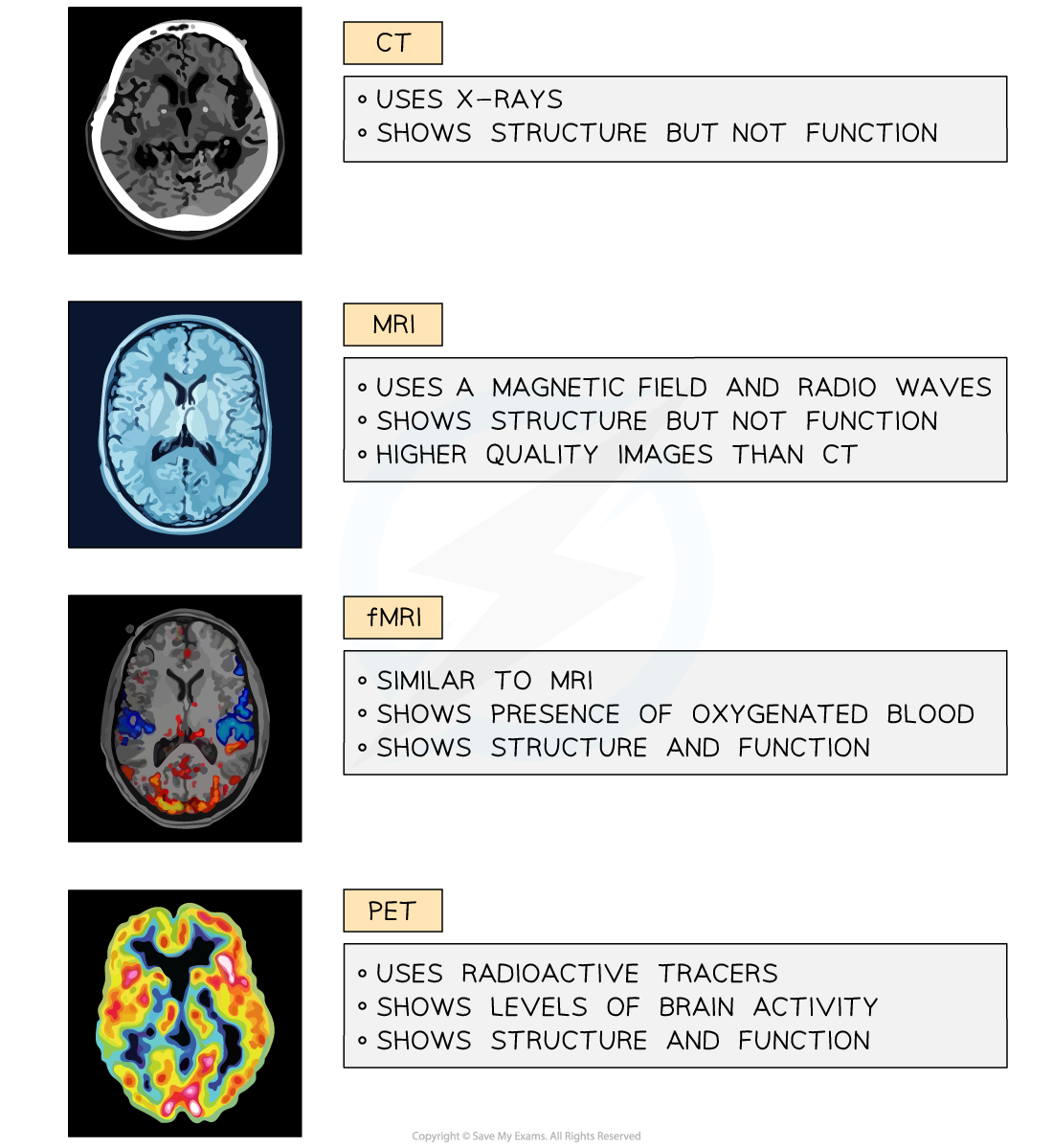
Brain imaging allows neuropsychologists to see how the brain is structured and functions in real time
These techniques show differences in brain activity and structure between people with and without mental health conditions
Examples
Positron Emission Tomography (PET)
PET scans allow neuropsychologists to see brain activity as a radioactive tracer is injected into the bloodstream and travels to the brain
The scanner detects areas of high or low activity, showing how different parts of the brain use energy
PET scans can demonstrate how medication affects neurotransmitters like dopamine and serotonin
This helps researchers understand why certain drugs work for some people and not for others
Other imaging methods
MRI (Magnetic Resonance Imaging) shows brain structure in detail
fMRI (Functional MRI) measures brain activity by detecting changes in blood flow
These techniques identify structural or functional abnormalities linked to:
schizophrenia (e.g. enlarged ventricles, reduced prefrontal activity)
depression (e.g. underactive frontal lobes, disrupted serotonin pathways)
How neuropsychology helps improve mental health
By identifying biological causes of schizophrenia and depression, neuropsychology contributes to:
the development of more effective medications, such as those targeting dopamine or serotonin systems
improved diagnosis and early detection through brain scans and testing
a clearer understanding of why treatments work differently between individuals
the creation of personalised treatment plans and therapies tailored to each person's needs

Unlock more, it's free!
Join the 100,000+ Students that ❤️ Save My Exams
the (exam) results speak for themselves:

Was this revision note helpful?