The Stages of Information Processing (OCR GCSE Psychology): Revision Note
Exam code: J203

Information processing
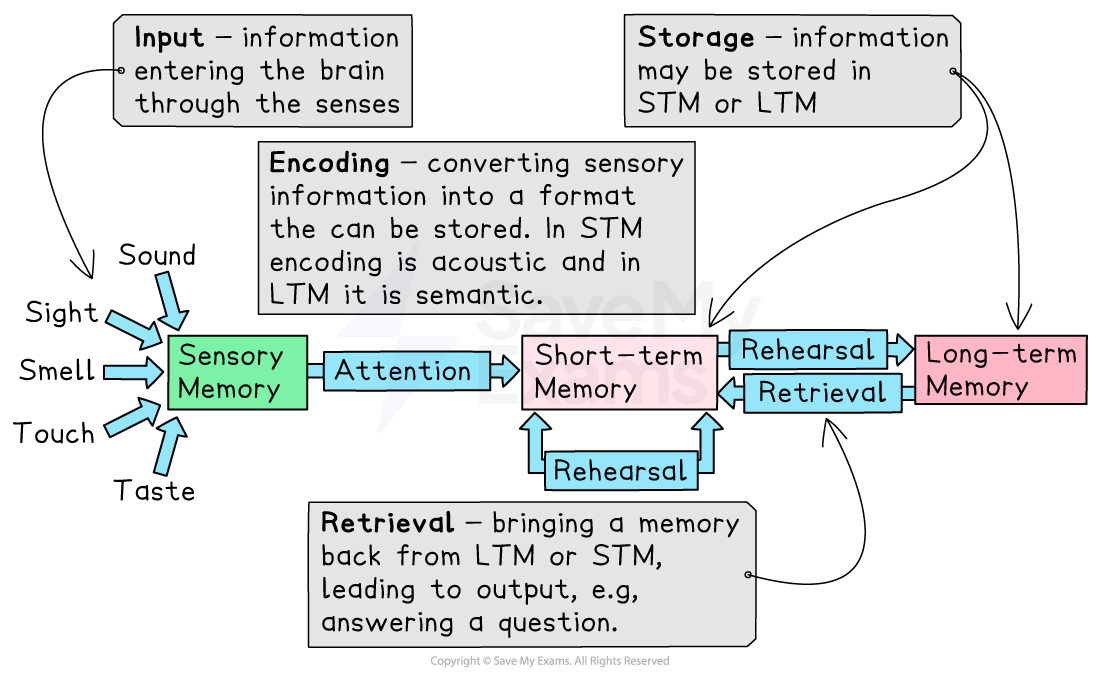
Information processing explains how we take in, transform, store, and retrieve information, similar to how a computer processes data
Cognitive psychologists compare the human brain to a computer, describing memory as a sequence of mental operations
There are five main stages in the information processing model:
input
encoding
storage
retrieval
output
Input
Information enters the brain through the senses, such as sight, sound, and touch
The eyes and ears detect sensory information and send it to the brain for further processing
E.g. hearing a song or seeing a red rose
Encoding
This is the process of transforming sensory input into a form that the brain can understand
Encoding converts information into a mental code, similar to how a computer turns data into binary
There are different types of encoding:
Visual encoding—storing what something looks like
e.g. a face, a painting
Acoustic encoding—storing what something sounds like
e.g. a tune or spoken words
Semantic encoding—storing the meaning of information
e.g. understanding a definition
Elaborative encoding—linking new information to what is already known, helping long-term learning
e.g. revising by connecting topics
Storage
Once encoded, information is stored for later use
Storage is where information is kept in the brain
Some memories remain briefly in short-term memory (STM)—lasting about 15–30 seconds
Rehearsal or repetition moves information into long-term memory (LTM), where it can last for years or even a lifetime
E.g. remembering lyrics after practicing a song multiple times
Retrieval
The process of recovering stored information when needed
Retrieval can take different forms:
Free recall—remembering without cues (“I remember that definition!”)
Cued recall—recalling with a hint (“It starts with a G—oh, it’s Grenade!”)
Recognition—identifying something seen or heard before (e.g. recognising a friend in a photo)
Successful retrieval depends on how well the information was encoded and stored
Output
The use of retrieved information
E.g. singing a song, answering a question, or applying knowledge in an exam
A computer analogy
Stage | Computer example | Human example |
|---|---|---|
Input | Downloading a song | Hearing a song on the radio |
Encoding | Turning it into computer code, e.g. binary | Brain interprets sound waves |
Storage | Saving the song on the hard drive | Memory of the song is stored in the brain |
Retrieval | Finding the song file | Recalling the song |
Output | Playing the song | Singing the song |

Unlock more, it's free!
Join the 100,000+ Students that ❤️ Save My Exams
the (exam) results speak for themselves:

Was this revision note helpful?