Effects of Forces (Cambridge (CIE) IGCSE Physics): Exam Questions

Exam code: 0625 & 0972

3 hours43 questions
1a
1 mark

State Newton's first law of motion.

1b
1 mark

Extended tier only

Newton's second law describes the change in motion caused by a resultant force. 

State the equation which links acceleration, resultant force and mass.

1c
1 mark

State what happens to the motion of a moving object when a resultant force is applied to it in the opposite direction to the motion.

1d
1 mark

Extended tier only

State what happens to the motion of a moving object when a resultant force is applied to it in a perpendicular direction to the motion.

2a
1 mark

Fig.3.1 shows the load-extension graphs for two springs, A and B.

feb-march-2018-32-q3

Determine the extension of spring A for a load of 10N.


extension = .................................................. mm 

2b
2 marks

Extended tier only

State which spring is easier to stretch and give a reason for your answer.

2c
3 marks

A different spring is suspended from the edge of a bench, as shown in Fig.3.2.

feb-march-2018-32-q3c

With no load on the spring, the pin points to 19.7 cm on the metre rule, as shown in Fig. 3.2.

When a load of 6.0N is attached to the spring, the pin points to 43.9 cm, as shown in Fig. 3.3.

(i) Calculate the extension of this spring for a load of 6.0 N. 

extension = .................................................... cm [1]

(ii) Describe how a student could use the equipment in Fig. 3.2 to obtain accurate readings for a load-extension graph for this spring.

[2]

3a
3 marks

A model aircraft is flying through air. Fig. 3.1 shows the forces acting on the model aircraft. The weight of the model aircraft is 15.0 N.

screenshot-2022-10-27-at-12-45-23

(i) Determine the size and direction of the resultant horizontal force acting on the model aircraft.


size of resultant horizontal force = ...................................................... N

  direction of resultant horizontal force = ..........................................................

[1]

(ii) Describe the change in the motion of the model aircraft.

[2]

3b
1 mark

The horizontal forces acting on the model aircraft become balanced.

Suggest how the horizontal forces acting on the model aircraft have changed.

4a
2 marks

A truck of mass 8.0 kg is rolling down a slight incline as shown in Fig. 1.1. 

1-4-4a-e-balanced-forces-incline

Fig. 1.1

The truck travels at a constant speed.

  Explain why the truck does not accelerate, even though it is on an incline.

4b
2 marks

The slope of the incline is increased. As a result of this, the truck now accelerates.

Explain why the truck now accelerates.

4c
2 marks

Extended tier only

The truck’s acceleration is 2.0 m/s2.

Calculate the resultant force on the truck.


resultant force = .................................... 

4d
1 mark

The acceleration of the truck can be increased by reducing the force of friction.

Suggest a way of reducing the friction in this investigation.

5a
1 mark

Fig. 1.1 shows a man pulling a child on a sledge. 

1-4-5a-e-force-child-on-sledge

The mass of the child and the sledge is 42 kg. 

The unbalanced force acting on the sledge is 46 N.

State the magnitude of the force that needs to be exerted by the man to make the sledge move.

5b
1 mark

Name the force that is opposing the motion of the sledge.

5c
3 marks

Extended tier only

The sledge is then placed at the top of a hill and accelerates down the hill at 0.75 m/s2 .

Calculate the resultant force acting on the sledge.

5d
2 marks

Assuming that the force opposing the motion of the sledge is the same, calculate the total force acting down the hill.

You may draw a diagram in your answer.

1a
3 marks

A student stretches a spring by adding different loads to it. She measures the length of the spring for each load. She plots a graph of the results.

Fig. 2.1 shows the graph of her results.


cie-2020-31-3

Use the graph to determine:


(i) the length of the spring without a load


length = .................................................. cm [1]


(ii) the length of the spring with a load of 4.0 N


length = .................................................. cm [1]


(iii) the extension due to a 4.0 N load.


extension = .................................................. cm [1]

1b
2 marks

Complete the sentence about effects of forces. Choose words from the box.

colour  friction   pressure   shape   size   speed

Stretching a spring with a load is an example of how a force can change the .................................... and the .................................... of an object.

2a
3 marks

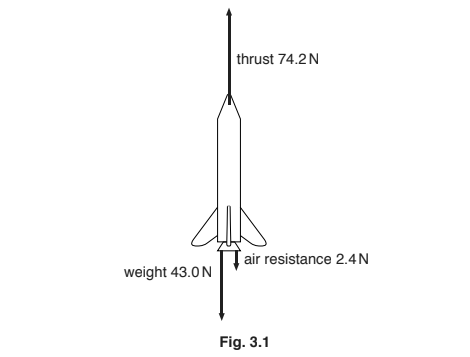
Fig. 3.1 shows the vertical forces on a rocket.

Diagram of a rocket with thrust force 74.2 N upwards, weight 43.0 N downwards, and air resistance 2.4 N downwards, labelled as Fig. 3.1.

Calculate the resultant force on the rocket.


resultant force = ........................................................... N

direction = ...........................................................

2b
1 mark

Fig. 3.2 shows the speed and direction of motion of an object at a point in time.

3b

The resultant force on the object is zero for 10 seconds.

Deduce the speed and direction of motion after 5 seconds. Indicate the speed and direction of the object by drawing a labelled arrow next to the object in Fig. 3.3.

q3b-ms
3a
3 marks

Fig. 3.1 shows a spring with no load attached. Fig. 3.2 shows the same spring with a load attached.

screenshot-2022-10-12-at-13-54-47

Describe how a student can determine the extension of the spring. You may draw on Fig. 3.1 and Fig. 3.2 as part of your answer.

3b
2 marks

The student plots a graph of load against extension, as shown in Fig. 3.3.

screenshot-2022-10-12-at-13-58-07

(i) Determine the extension produced by a load of 7.5 N.


extension = ...................................................... cm [1]


(ii) Determine the load that would produce an extension of 10.0 cm. 


load = ...................................................... N [1]

3c
3 marks

Calculate the mass that has a weight of 6.0 N.

mass = ...................................................... kg 

4a
4 marks

Fig. 3.1 shows the horizontal forces acting on a swimmer.

screenshot-2022-10-20-at-09-18-12

(i) Calculate the size and direction of the resultant horizontal force on the swimmer.  


size of resultant horizontal force = ...................................................... N

direction of resultant horizontal force = ......................................................    

[1]


(ii) State the name of the 110 N force on the swimmer.

[1]


(iii) Fig. 3.2 shows the horizontal forces acting on the swimmer as he moves forwards a short time later.

screenshot-2022-10-20-at-09-22-47

Describe and explain the motion of the swimmer.

[2]

4b
3 marks

Another swimmer weighs 700N. He stands on a diving board, as shown in Fig. 3.3.

screenshot-2022-10-20-at-09-26-19

Calculate the moment of the swimmer’s weight about point P.


moment = ...................................................... N m 

5a
1 mark

Extended tier only

A car travels around a circular track at constant speed.

Explain why it is incorrect to describe the circular motion as having constant velocity.

5b
2 marks

Extended tier only

A force is required for the car to maintain the circular motion.

Explain why a force is required.

5c
1 mark

Extended tier only

State the direction in which the force acts for objects in circular motion.

5d
1 mark

Extended tier only

State the name of this force for the car on the track.

6a
Sme Calculator
3 marks

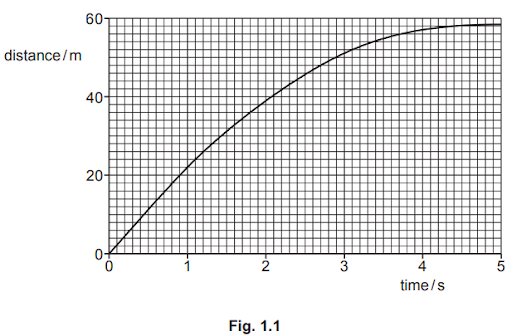
 Fig. 1.1 is the distance–time graph for the car from t = 0.

Graph showing distance over time. The curve starts at origin, rising steadily, then gradually levels off towards 60 metres over 5 seconds.

(i) State the property of a distance–time graph that corresponds to speed. 

[1] 

(ii) Using Fig. 1.1, determine the initial speed v of the car. 


v = ......................................................... [2]

6b
3 marks

Extended Tier Only

When the car is decelerating, there is a constant resistive force F on the car due to the brakes. 

The deceleration of the car is greater than F over m and is not constant. 

Explain why: 

(i) the deceleration of the car is greater than F over m

 [1] 

(ii) the deceleration is not constant.

[2] 

1a
3 marks

A student is using some 50 g masses.

Calculate the weight of one 50 g mass.


weight of 50 g mass = ...................................................... N 

1b
4 marks

The student uses the 50g masses as loads to stretch a spring.

Fig. 2.1 shows the apparatus the student uses to obtain readings for a load-extension graph.


q2b

Describe how the student could use the apparatus and ensure that the readings are accurate.

2a
4 marks

The mass of a small steel ball is 120 g. The volume of the ball is 16.0 cm3.


(i) Calculate the density of the steel ball.


density = ............................................... g / cm3 [3]


(ii) The ball falls to the ground from rest. At a time of 0.2 s after it started to fall, its acceleration is 10 m / s2.

State the acceleration of the ball at a time of 0.1 s after it started to fall.

[1]

2b
2 marks

Fig. 3.1 shows the vertical forces that act on a large plastic ball as it is falling.

q3b

(i) State the name given to each of the forces shown in Fig. 3.1.

[1]

(ii) Calculate the size of the resultant force on the ball.


resultant force = ...................................................... N [1]

3a
2 marks

A load is attached to a spring, as shown in Fig. 3.1. Two arrows indicate the vertical forces acting on the load. The spring and the load are stationary.

cie-2019-3

(i) State the name of the force acting vertically downwards.

[1]


(ii) The vertical force that acts upwards is 4.0 N.  

State the value of the force acting vertically downwards.


force = ..................................................... N [1]

3b
2 marks

The load is pulled downwards and then released. The load moves up and down.

Fig. 3.2 represents the vertical forces acting on the load at some time after it is released.

cie-2019-4

Calculate the resultant force on the load and state its direction.


resultant force = ........................................................... N

direction = ............................................................... 

3c
3 marks

(i) State the principle of conservation of energy.

[1]

(ii) Eventually the load stops moving up and down.

Describe and explain why the load stops moving. Use your ideas about conservation of energy.

[2]

4a
4 marks

Extended tier only

Fig. 1.1 shows an aeroplane accelerating uniformly on a runway. 

1-4-4a-h-aeroplane

Fig. 1.1

The aeroplane has a mass of 3.1 × 10⁶ kg. 

From rest, the aeroplane reaches a speed of 70 m/s after 32 s.


Calculate the following quantities


(i) The acceleration of the aeroplane.

acceleration = .................................... [2]


(ii) The resultant force acting on the aeroplane.

resultant force = .................................... [2]

4b
3 marks

Extended tier only

When the aeroplane reaches its destination, air traffic control directs it to circle the airfield until there is a safe time to land.

Fig. 1.2 shows a head on view of the aeroplane flying at a constant speed in a circular horizontal path. 


1-4-q4b-h-aeroplane-circular-motion

Fig 1.2

Draw an arrow showing the resultant force on the aeroplane.

Explain your answer.

4c
1 mark

Extended tier only

The pilot wants to decrease the radius of the circular flight path whilst maintaining a constant speed.

Suggest how the pilot could achieve this.

4d
4 marks

Extended tier only

As the aeroplane lands on the runway, it decelerates from its top speed. The resultant force on the aeroplane is less than it was at take off. 

Explain why this is the case.

5a
1 mark

A resultant force acts on an object at rest. 

State the direction of the acceleration.

5b
1 mark

Extended tier only

A resultant force acts perpendicularly on a object traveling at a constant speed. 

State the effect of the force on the object.

5c
4 marks

Extended tier only

A man with a mass of 70 kg steps into an elevator. 


(i) State the value of the force exerted on the man by the elevator. 

force = .................................... [1]


(ii) Calculate the force required to accelerate the man at 1.6 m/s2.


force = .................................... [1]


(iii) Explain why these values are different.

[2]