Hooke's Law (Cambridge (CIE) IGCSE Physics): Revision Note
Exam code: 0625 & 0972

Hooke's law
Extended Tier Only
The relationship between the extension of an elastic object and the applied force is defined by Hooke's law
Hooke's law states that:
The extension of an elastic object is directly proportional to the force applied, up to the limit of proportionality
The force applied to the spring is sometimes referred to as the load
Directly proportional means that as the force is increased, the extension increases
If the force is doubled, then the extension will double
If the force is halved, then the extension will also halve
The limit of proportionality is the point beyond which the relationship between force and extension is no longer directly proportional
This limit varies according to the material
Examiner Tips and Tricks
You may have met the term 'elastic limit' elsewhere. It is not on this syllabus, and using it in place of 'limit of proportionality' will not earn the mark.
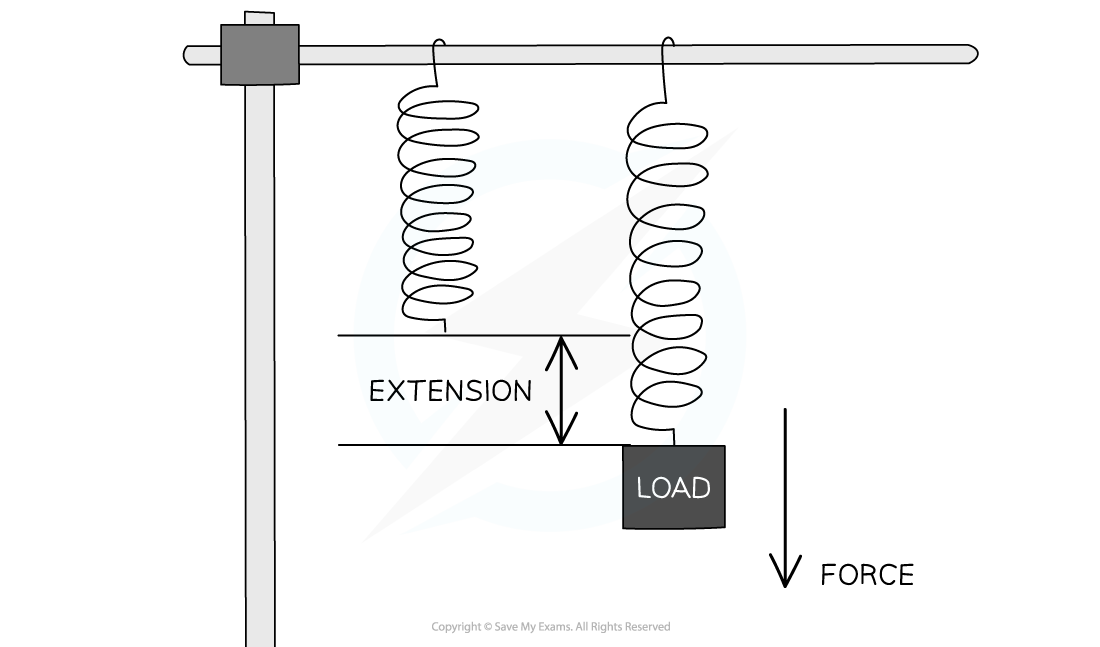
Hooke's law can be described by the following equation:
Where:
= force applied, measured in newtons (N)
= the spring constant, measured in newtons per metre (N/m)
= extension of spring, measured in metres (m)
Spring constant
The spring constant is defined as:
The force per unit extension
Therefore, the units are newtons per metre (N/m), though newtons per centimetre (N/cm) is equally acceptable and is often more convenient when extensions are measured in centimetres.
The spring constant is a measure of how stiff the spring is
Stiff springs have a high spring constant
Stretchy springs have a low spring constant
Any elastic object has a spring constant, not just springs
The Hooke's law equation can be used to calculate the spring constant of a material
The load-extension graph
Hooke's law is a linear relationship
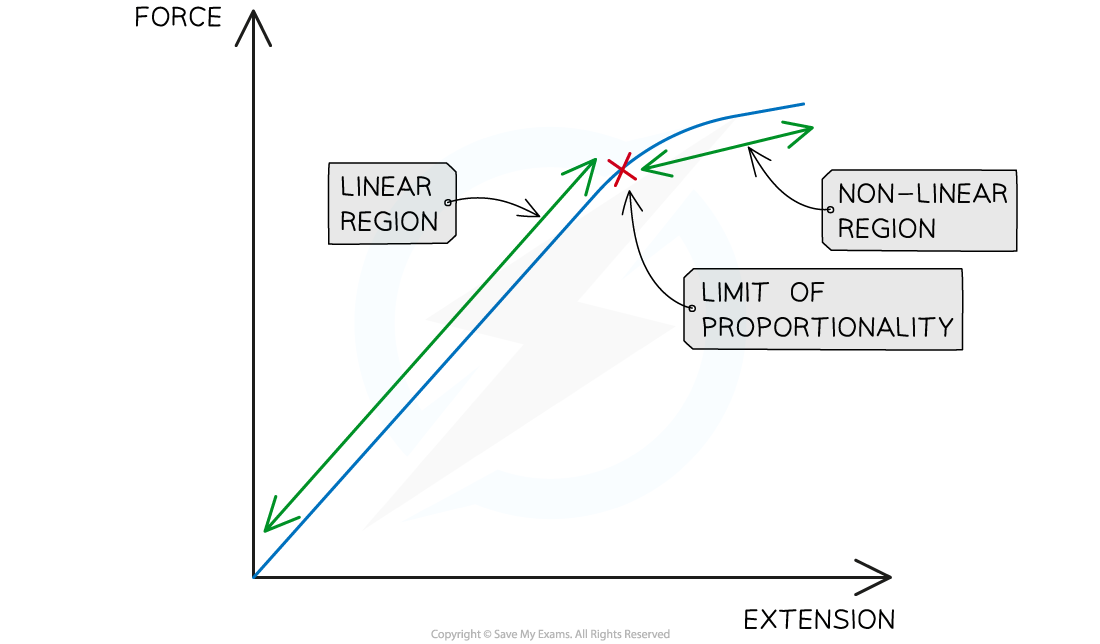
This is represented by a straight line on a load-extension, or force-extension graph
Load-extension graph for a spring
Important features of the load-extension graph
The linear portion of the graph
This represents the load or force under which the spring obeys Hooke's law
Load and extension are directly proportional
The gradient of the linear portion is equal to the spring constant for a load-extension graph
The gradient of the linear portion is equal to for an extension-load graph
The limit of proportionality
This is the point at which the graph begins to curve
Beyond this point, load and extension are no longer proportional
The curved portion of the graph
This is where the material does not obey Hooke's law
Load and extension are not proportional
Worked Example
A force of 32 N pulls a spring from its orginal length of 8 cm to 18 cm. Calculate the spring constant of the spring in N/m.
[3]
Answer:
Step 1: List the known quantities
Force, F = 32 N
Original length = 8 cm
Final length = 18 cm
Step 2: Write the relevant equation
Step 3: Rearrange to make spring constant the subject
[1 mark]
Step 4: Calculate the extension, x
[1 mark]
Step 5: Convert any units
must be in metres (m) to get a spring constant in N/m
Step 6: Substitute the values for force and extension
[1 mark]
Worked Example
The figure below shows the forces acting on a child who is balancing on a pogo stick. The child and pogo stick are not moving.
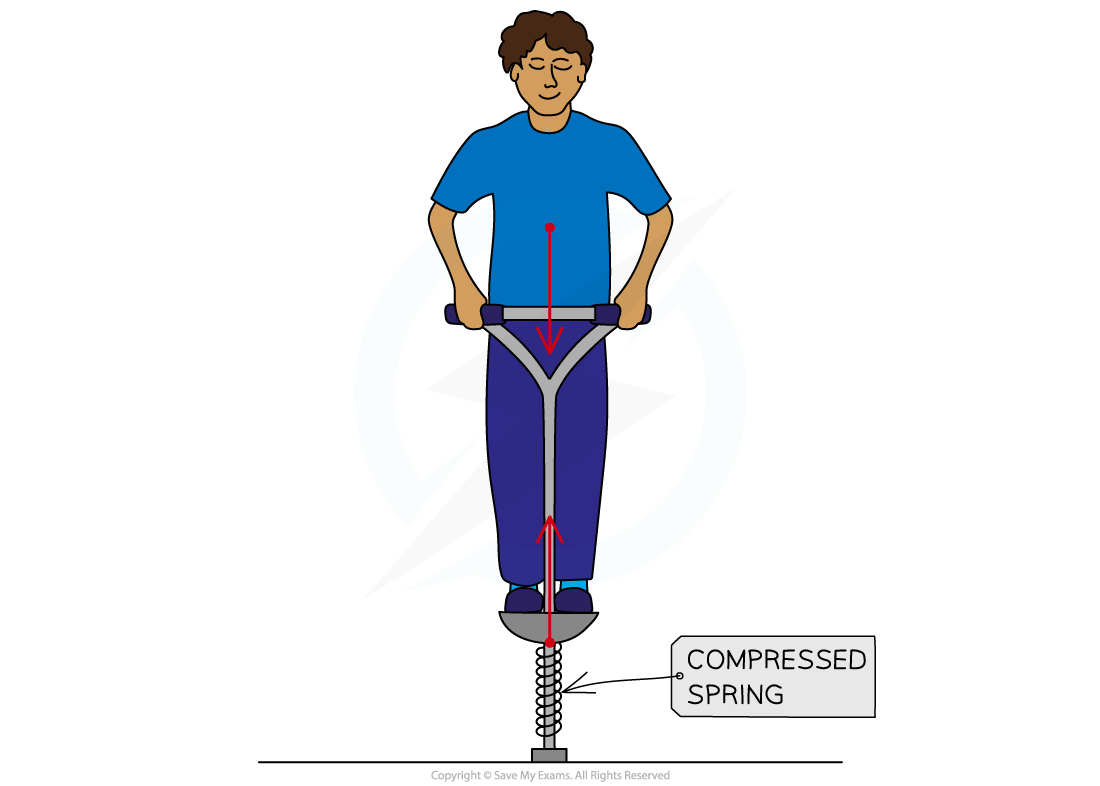
The spring constant of the spring on the pogo stick is 4900 N/m. The weight of the child causes the spring to compress elastically from a length of 40 cm to a new length of 33 cm.
Calculate the weight of the child.
[4]
Answer:
Step 1: List the known quantities
Spring constant, k = 4900 N/m
Original length = 40 cm
Final length = 33 cm
Step 2: Write the relevant equation
[1 mark]
Step 3: Calculate the extension, x
A negative extension represents a compression of 7 cm [1 mark]
Step 4: Convert any units
Since the spring constant is given in N/m, must be in metres (m)
[1 mark]
Step 5: Substitute the values into the Hooke's law equation
The minus sign simply indicates the direction of the force, downwards in this case
The child's weight is 343 N [1 mark]
Examiner Tips and Tricks
Remember that the spring constant is calculated by dividing the load by the extension of the elastic object, not the total length of the elastic object.
In the exam, mark the limit of proportionality as a single precise point at the end of the straight section, and label it L. A mark placed on the curved part of the line, or a range drawn between two points, will not be accepted.

Unlock more, it's free!
Join the 100,000+ Students that ❤️ Save My Exams
the (exam) results speak for themselves:

Was this revision note helpful?
Build on this topic