Features of Waves (Cambridge (CIE) IGCSE Physics): Revision Note
Exam code: 0625 & 0972

Waves & energy transfer
Waves transfer energy without transferring matter
For sound waves, this means it is the wave and not the air molecules (the matter) itself that travels
Objects floating on water provide evidence that waves only transfer energy and not matter
It is possible to see objects on the surface of the water bob up and down but not change their position
This is because it is the wave, and not the water (the matter), that travels
Waves are described as oscillations or vibrations about a fixed point
For example, ripples cause particles of water to oscillate up and down
Sound waves cause particles of air to vibrate back and forth
Worked Example
The diagram below shows a toy duck bobbing up and down on top of the surface of some water, as waves pass it underneath.

Explain how the toy duck demonstrates that waves do not transfer matter.
[2]
Answer:
The plastic duck moves up and down but does not travel with the wave along the surface of the water
The water waves transfer energy, but the water particles only oscillate up and down about a fixed position — they do not travel along with the wave [1 mark]
This means when a wave travels between two points, no matter travels with it and the points on the wave vibrate up and down about fixed positions [1 mark]
Examiner Tips and Tricks
There is a key distinction between the particles (or oscillations) of a wave and the wave itself.
The motion of the wave causes the particles to move. The particles themselves are not the wave.
Wave motion
Wave motion can be illustrated by:
vibrations in ropes and springs
experiments using water waves
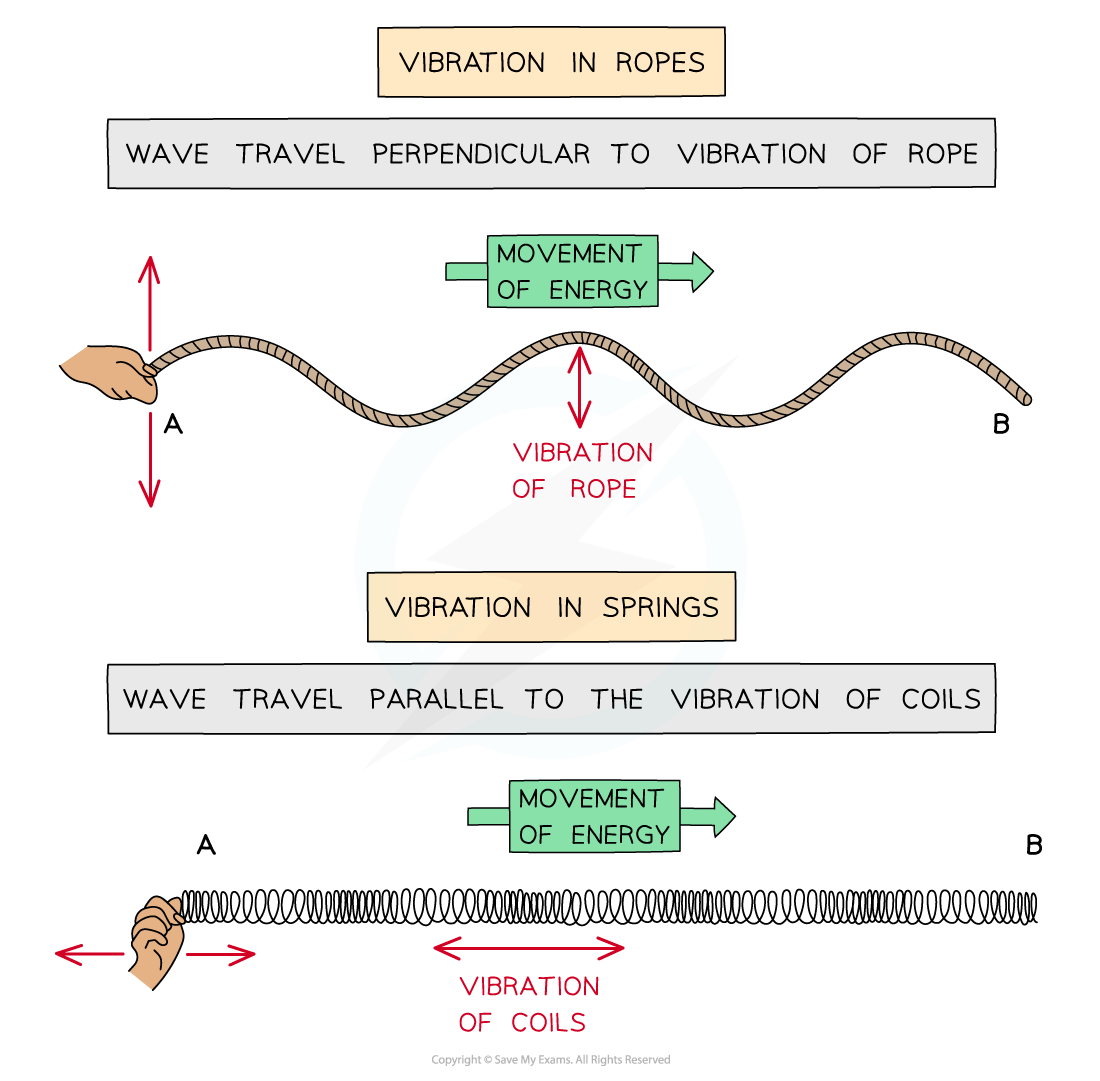
Properties of waves can be observed using water waves in a ripple tank (opens in a new tab)
These properties include frequency, wavelength, amplitude and wave speed

Features of a wave
When describing wave motion, there are several terms which are important to know, including:
wavefront
amplitude
wavelength
frequency
crest (peak)
trough
wave speed
Wavefront
Wavefronts are a useful way of picturing waves from above
Each wavefront, drawn as a single line, joins points on the wave that are in step with each other, which in practice are usually the crests
The image below illustrates how wavefronts are visualised:
The arrow shows the direction the wave is moving and is sometimes called a ray
The space between each wavefront represents the wavelength
When the wavefronts are close together, this represents a wave with a short wavelength
When the wavefronts are far apart, this represents a wave with a long wavelength
Wavefronts as viewed from above

Amplitude
Amplitude is defined as:
The maximum displacement of a wave from its undisturbed position
It is given the symbol and is measured in metres (m)
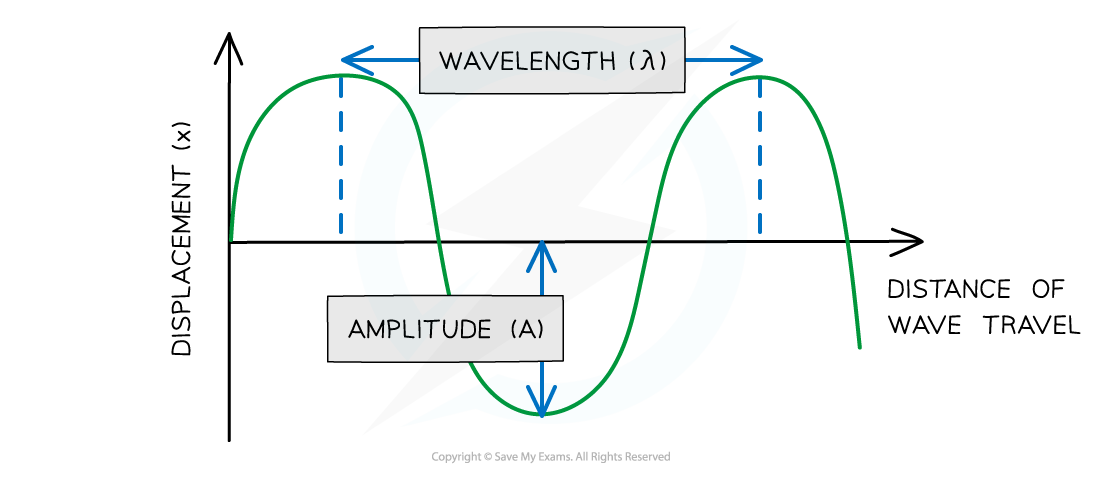
On a graph where the vertical axis is displacement, amplitude is measured from the undisturbed position to either the highest point of the wave (peak) or the lowest point (trough)
Wavelength
Wavelength is defined as:
The distance from one point on the wave to the same point on the next wave
In a transverse wave (opens in a new tab):
The wavelength can be measured from one peak to the next peak
In a longitudinal wave:
The wavelength can be measured from the centre of one compression to the centre of the next
Wavelength is given the symbol (lambda) and is measured in metres (m)
On a graph where the horizontal axis is distance, the wavelength can be determined by measuring the distance from one point on the wave to the same point on the next wave
Using a graph to determine wavelength and amplitude
Frequency
Frequency is defined as:
The number of waves passing a point in a second
Frequency is given the symbol and is measured in hertz (Hz)
Crests and troughs
A crest, or a peak, is defined as:
The highest point on a wave above its undisturbed position
A trough is defined as:
The lowest point on a wave below its undisturbed position
Wave crests and troughs

Wave speed
Wave speed is the speed at which energy is transferred through a medium
Wave speed is defined as:
The distance travelled by a wave each second
The equation used to calculate wave speed is explained in The wave equation
Worked Example
Small water waves are created in a ripple tank by a wooden bar. The wooden bar vibrates up and down hitting the surface of the water. The diagram below shows a cross-section of the ripple tank and water.

Identify the letter which shows:
a) the amplitude of a water wave. [1]
b) the wavelength of the water wave. [1]
Answer:
Part (a)
Step 1: Recall the definition of amplitude
Amplitude = The distance from the undisturbed position to the peak or trough of a wave
Step 2: Mark the undisturbed position on the wave
This is the centre of the wave

Step 3: Identify the arrow between the undisturbed position and a peak
The amplitude is shown by arrow D [1 mark]
Part (b)
Step 1: Recall the definition of wavelength
Wavelength = The distance from one point on the wave to the same point on the next wave
Step 2: Draw lines on each horizontal arrow
This helps to identify the points on the wave the arrows are referring to

Step 3: Identify the arrow between two of the same points on the wave
The wavelength is shown by arrow C [1 mark]
Examiner Tips and Tricks
Make sure you understand how to identify the wavelength and amplitude of a wave from a diagram. On a displacement-distance graph, the wavelength is the distance from one point on the wave to the same point on the next wave (e.g. crest to crest), while amplitude is the distance from its undisturbed position to either a peak or trough (not the crest to trough distance).

Unlock more, it's free!
Join the 100,000+ Students that ❤️ Save My Exams
the (exam) results speak for themselves:

Was this revision note helpful?
Build on this topic