Energy Stores & Transfers (Cambridge (CIE) IGCSE Physics): Revision Note
Exam code: 0625 & 0972

Energy stores
Energy is a property of an object that is stored or transferred
Energy must be transferred to an object to perform work on (opens in a new tab) or heat up that object
Energy is measured in units of joules (J)
Systems
Energy will often be described as part of an energy system
In physics, a system is defined as:
An object or group of objects
In physics, defining the system is a way of narrowing the parameters to focus only on what is relevant to the situation being observed
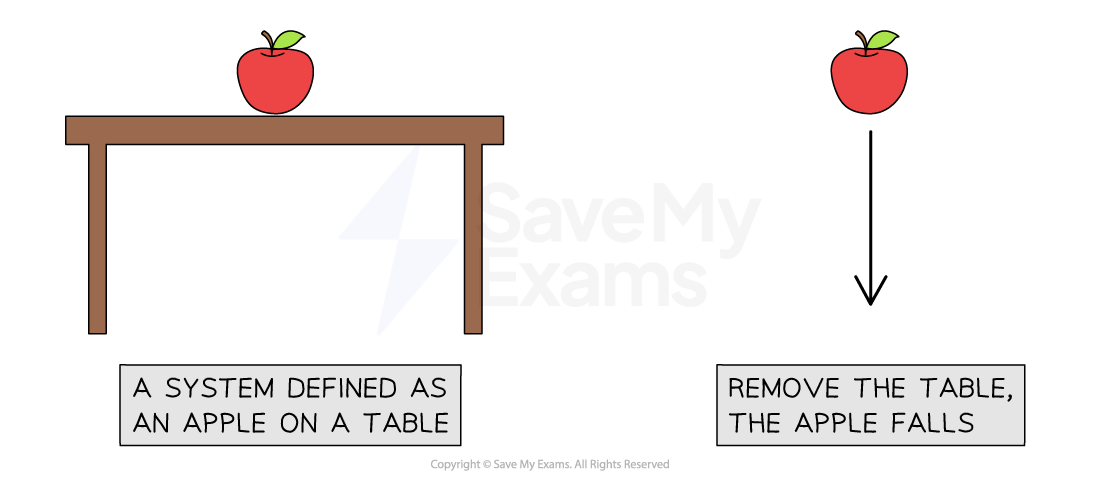
A system could be as large as the whole Universe, or as small as an apple sitting on a table
When nothing is changing within a system, no energy is transferred
When there is a change to a system, energy is transferred
If an apple sits on a table and that table is suddenly removed, the apple will fall
As the apple falls, energy is transferred
Example of a system
Types of energy store
Energy is stored in objects in different energy stores
Table of energy stores
Energy Store | Description |
|---|---|
Kinetic | Moving objects have energy in their kinetic store |
Gravitational potential | Objects gain energy in their gravitational potential store (opens in a new tab) when they are lifted through a gravitational field |
Chemical | Chemical reactions transfer energy into or away from a substance's chemical store |
Elastic (strain) | Objects have energy in their elastic potential store if they are stretched, squashed or bent |
Nuclear | Atomic nuclei release energy from their nuclear store during nuclear reactions |
Electrostatic | Objects with charge (like electrons and protons) interacting with one another have energy in their electrostatic store |
Internal (thermal) | All objects have energy in their thermal stores; the hotter the object, the more energy it has in this store |
Examiner Tips and Tricks
These are the seven types of energy store you need to learn. There are no electrical, light or sound stores of energy; they are considered as transfer pathways.
Energy transfers
Energy is transferred between stores through different energy transfer pathways
Energy transfer pathways
The energy transfer pathways are:
Mechanical work done
Electrical work done
Heating
Electromagnetic, sound and other waves
Table of energy transfer pathways
Transfer Pathway | Description |
|---|---|
Mechanical work done | When a force acts on an object (e.g. pulling, pushing, stretching, squashing) |
Electrical work done | A charge moving through a potential difference (e.g. current) |
Heating (by particles) | Energy is transferred from a hotter object to a colder one (e.g. conduction) |
(Heating by) waves | Energy transferred by electromagnetic waves (e.g. visible light), sound and other waves |
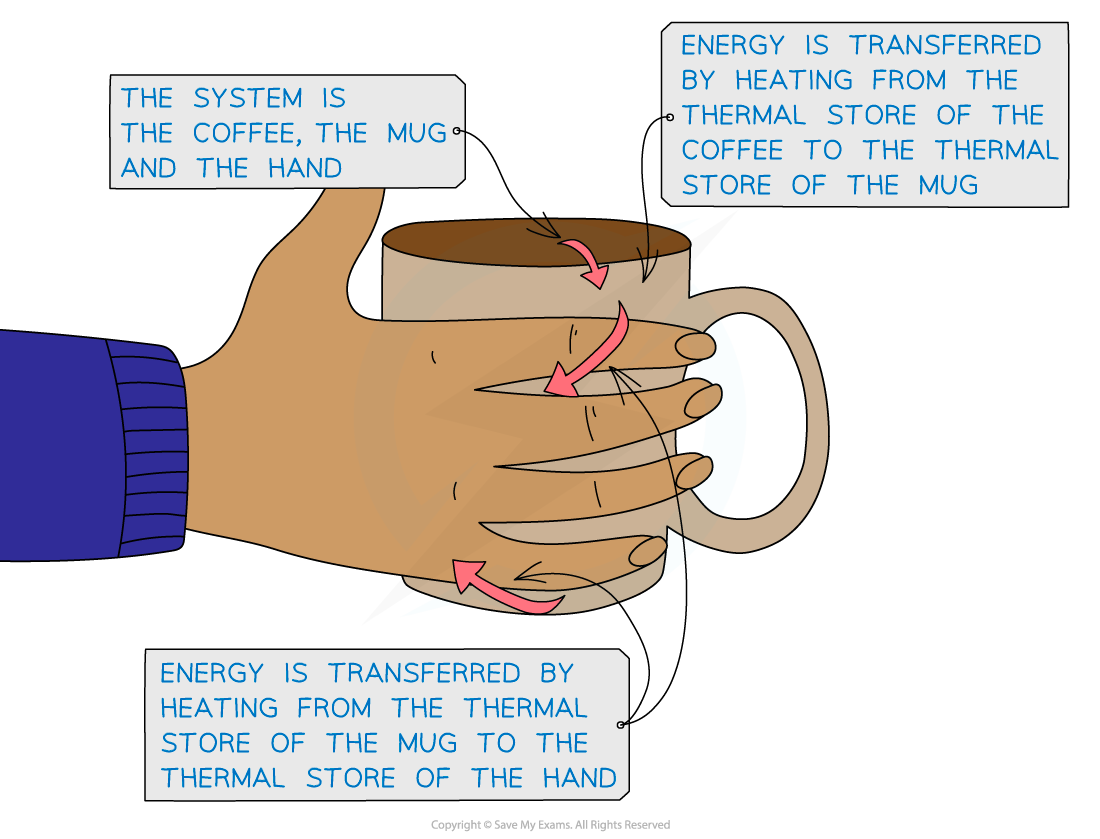
An example of an energy transfer by heating is a hot coffee heating up cold hands
Energy transfer by heating
Worked Example
Describe the energy transfers in the following scenarios:
a) A battery powering a torch [2]
b) A falling object [2]
Answer:
Part a)
Step 1: Identify the store that energy is being transferred away from
For a battery powering a torch
The system is defined as the battery and the torch
Therefore, the energy began in the chemical store of the cells of the battery [1 mark]
Step 2: Identify the store that energy is transferred to
When the circuit is closed, the bulb lights up
Therefore, energy is transferred to the thermal store of the bulb
Energy is then transferred usefully from the bulb to the surroundings by light and wastefully by heat, but this is not described in the parameters of the system
Step 3: Identify the transfer pathway
Energy is transferred by the flow of charge around the circuit
Therefore, the transfer pathway is electrical work done
Step 4: State the energy transfer
Energy is transferred electrically from the chemical store of the battery to the thermal store of the bulb
Energy is transferred usefully from the thermal store of the bulb to the surroundings by light and wastefully by heat [1 mark]
Part b)
Step 1: Identify the store that energy is being transferred away from
For a falling object
In order to fall, the object must have been raised to a height
Therefore, it began with energy in its gravitational potential store [1 mark]
Step 2: Identify the store that energy is transferred to
As the object falls, it is moving
Therefore, energy is being transferred to its kinetic store
Step 3: Identify the transfer pathway
For an object to fall, a resultant force must act on it,
That force is its weight, and it acts over a distance (the height of the fall)
Therefore, the transfer pathway is mechanical work done
Step 4: State the energy transfer
Energy is transferred from the gravitational potential store to the kinetic store of the object via a mechanical work done transfer pathway [1 mark]
Examiner Tips and Tricks
Make sure to name both energy stores and the energy transfer pathway between them.
If you follow any process back far enough, you would get many energy transfers taking place. For example, an electric kettle heating water. The relevant energy transfer is from the thermal store of the kettle to the thermal store of the water, with some energy dissipated to the surroundings. But you could take it all the way back to how the electricity was generated in the first place. This is beyond the scope of the question. Defining the system gives you a starting point and a stopping point for the energy transfers you need to consider.

Unlock more, it's free!
Join the 100,000+ Students that ❤️ Save My Exams
the (exam) results speak for themselves:

Was this revision note helpful?
Build on this topic