Calculating with Vectors (Cambridge (CIE) IGCSE Physics): Revision Note
Exam code: 0625 & 0972

Calculations with vectors
Extended Tier Only
Vectors can be drawn using vector diagrams
Vector diagrams
Vectors are represented by an arrow
The length of the arrow represents the magnitude
The direction of the arrow indicates the direction
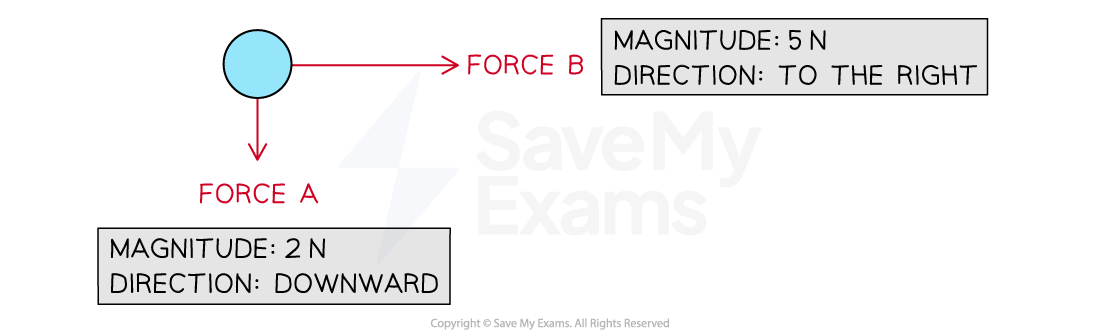
The scale of the arrows should be proportional to the relative magnitudes of the forces
An arrow for a 4 N force should be twice as long as an arrow for a 2 N force
Vector diagram of two forces acting on an object
Calculating vectors graphically
Vector diagrams can be used to combine vectors
Vectors at right angles to one another can be combined into one resultant vector
The resultant vector will have the combined effect of the two original vectors
For example, a resultant force vector will have the combined effect of two component forces
Component vectors are sometimes drawn with a dotted line and a subscript indicating horizontal or vertical
A force , for example, may have two components:
is the vertical component of the force
is the horizontal component of force
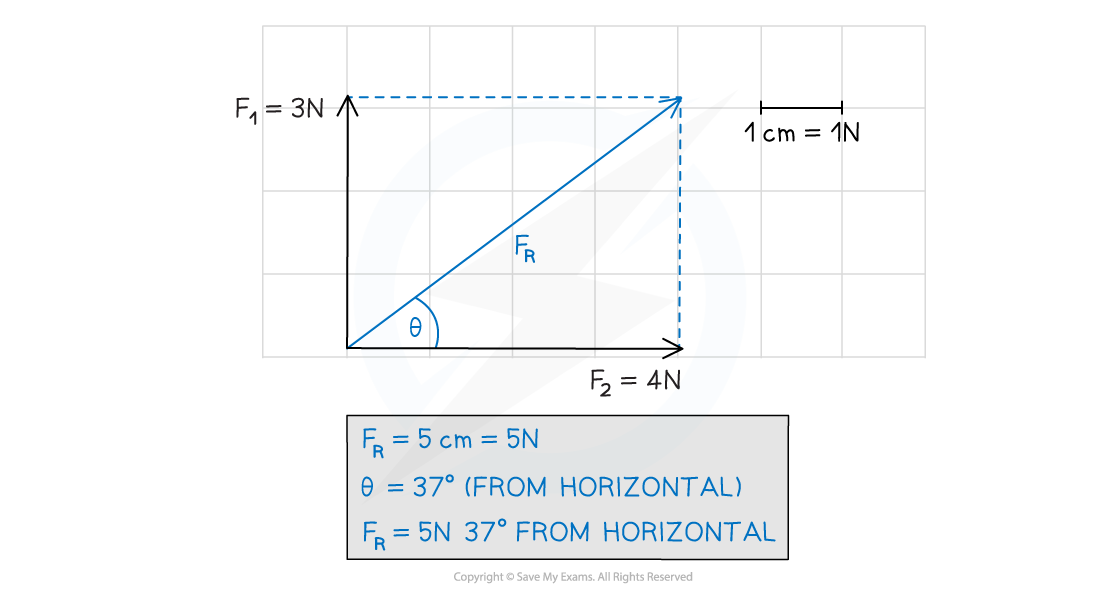
To calculate vectors graphically means carefully producing a scale drawing with all lengths and angles correct
This should be done using a sharp pencil, ruler and protractor
Follow these steps to carry out calculations with vectors using a scale drawing:
Choose a scale which fits the page
For example, use 1 cm = 10 m/s or 1 cm = 1 N, so that the diagram is around 10 cm high
Draw the vectors at right angles to one another
Complete the rectangle
Draw the resultant vector diagonally from the origin
Carefully measure the length of the resultant vector
Use the scale factor to calculate the magnitude
Use the protractor to measure the angle
Combining vectors by calculation
In this method, a vector diagram is still essential, but it does not need to be exactly to scale
The vector diagram can take the form of a sketch, as long as the resultant side and component sides are clearly labelled
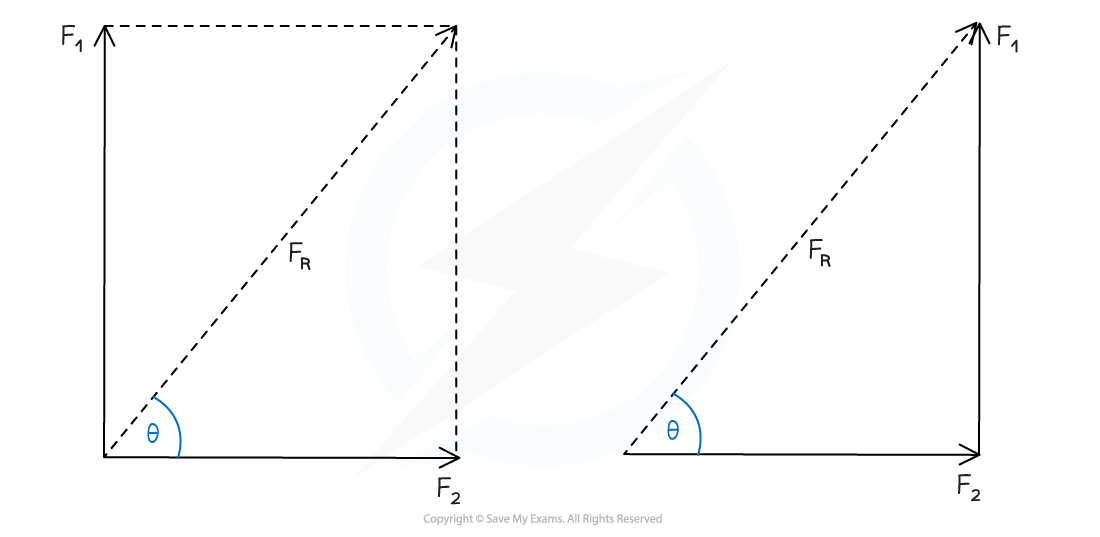
When the magnitudes of the two vectors at right angles are known, then Pythagoras' theorem can be used to find the magnitude of the missing vector
Using Pythagoras' theorem, the magnitude of FR is related to the magnitudes of F1 and F2 by

Trigonometry can then be used to find the angle of the resultant vector

Two vectors at right angles to each other represent the opposite and adjacent sides of a right-angled triangle
The tangent function relates the opposite and adjacent sides of a right-angled triangle by
Therefore, the angle of FR can be calculated by
Worked Example
A force acts on an object with 60 N to the right. A second force of 100 N acts on the same object in the upward direction.
Calculate the resultant force acting on the object.
[4]
Answer:
Step 1: Draw a vector diagram

Step 2: Calculate the magnitude of the resultant force using Pythagoras' theorem
[1 mark]
[1 mark]
Step 3: Calculate the direction of the resultant vector using trigonometry

[1 mark]
Step 4: State the final answer, complete with magnitude and direction
from the horizontal [1 mark]
Examiner Tips and Tricks
If the question specifically asks you to use the calculation or graphical method, you must solve the problem as asked. However, if the choice is left up to you, then any correct method will lead to the correct answer.
Remember to give both the magnitude of the resultant vector and its direction. The resultant of two vectors is limited to forces and velocities only in this course.

Unlock more, it's free!
Join the 100,000+ Students that ❤️ Save My Exams
the (exam) results speak for themselves:

Was this revision note helpful?
Build on this topic