Impulse (Cambridge (CIE) IGCSE Physics): Revision Note
Exam code: 0625 & 0972

Impulse
Extended Tier Only
The impulse of a force is the product of the force applied and the time for which it acts
Where:
= resultant force, measured in newtons (N)
= the time for which the force acts, measured in seconds (s)
Therefore, the units of impulse are newton seconds (N s)
The impulse of a force acting on an object can change the object's motion
For example:
Kicking a ball
Catching a ball
A collision between two objects
The impulse of the resultant force is equal to the change in momentum of the object
Change in momentum (opens in a new tab) can also be described as:
Where:
= change in momentum, measured in kilogram metres per second (kg m/s)
= mass, measured in kilograms (kg)
= final velocity, measured in metres per second (m/s)
= initial velocity, measured in metres per second (m/s)
Therefore:
Since impulse is equal to the change in momentum, kilogram metres per second (kg m/s) is also accepted as the units of impulse
Examiner Tips and Tricks
Make sure to provide one precise definition for impulse in the exam. Stating either "the product of a force and the time for which that force acts" or "the change in momentum of the object" is an acceptable definition for impulse.
Note that N/s are not the correct units for impulse.
Examples of impulse
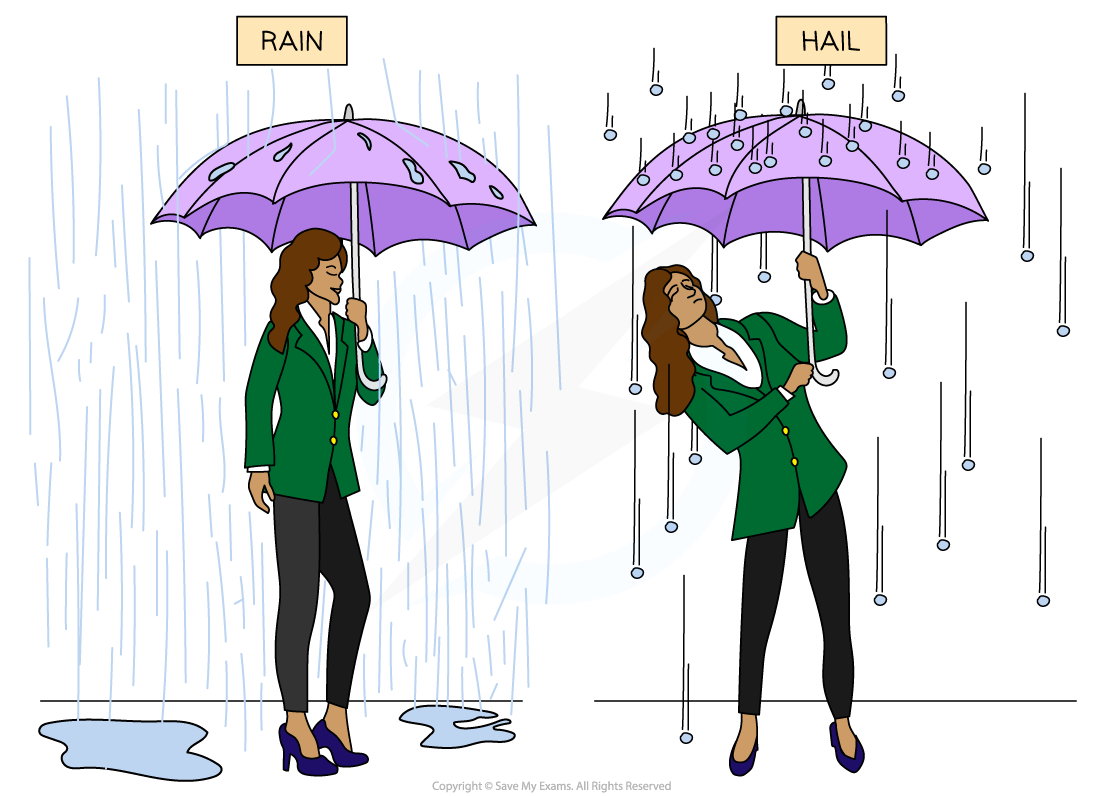
When rain and hail (frozen water droplets) hit an umbrella, they feel very different due to the impulse of the force
Water droplets tend to splatter and roll off the umbrella, so their velocity is reduced to near zero — a relatively small change in momentum
Hailstones have a larger mass and tend to bounce back off the umbrella, so their velocity reverses — a greater change in momentum than simply stopping
Therefore, the impulse that the umbrella applies on the hail stones is greater than the impulse the umbrella applies on the raindrops
This means that more force is required to hold an umbrella upright in hail compared to rain
Worked Example
A 58 g tennis ball moving horizontally to the left at a speed of 30 m s–1 is struck by a tennis racket which returns the ball back to the right at 20 m s–1.
(i) Calculate the impulse of the force exerted by the racket on the ball. [3]
(ii) State which direction the impulse is in. [1]
Answer:
Part (i)
Step 1: Write the known quantities
The left is taken as positive because the ball is initially travelling left; (either direction choice works, provided this stays consistent in the calculation)
Initial velocity,
Final velocity,
Mass,
Step 2: Write down the impulse equation
[1 mark]
Step 3: Substitute in the values
[1 mark]
[1 mark]
Part (ii)
State the direction of the impulse
Since the impulse is negative, it must be in the opposite direction to which the tennis ball was initially travelling
Therefore, the direction of the impulse is to the right [1 mark]
Examiner Tips and Tricks
Remember that if an object changes direction, then this must be reflected by the change in sign of the velocity. For example, if the left is taken as positive and therefore the right as negative, an impulse of 20 N s to the right is equal to -20 N s
Force & momentum
Extended Tier Only
Newton's second law is defined by the equation:
Momentum is given by the equation:
Since , this can be substituted into Newton's second law:
Since , combining these equations gives Newton's second law in terms of momentum:
Therefore, the resultant force on an object is defined as the change in momentum per unit time
This is also described as the rate of change of momentum
Worked Example
A tennis ball hits a racket twice, with a change in momentum of 0.5 kg m/s both times.
During the first hit, the contact time is 0.05 s and during the second hit, the contact time is 0.005 s.
Determine during which hit the racket experiences the greater force from the ball.

[3]
Answer:
Step 1: Calculate the force during the first hit
[1 mark]
Step 2: Calculate the force during the second hit
[1 mark]
Step 3: State your answer
The tennis racket experiences the greater force from the ball during the second hit [1 mark]
Impulse and safety features
This result has important implications when it comes to safety
A large force acting for a short time can have the same impulse and same change in momentum as a smaller force acting for a longer time
Safety features such as air bags and crumple zones increase the time taken for a driver to stop
This would reduce the force on the driver in a collision and the risk of injury, since the change in momentum is fixed
Examiner Tips and Tricks
You should use rather than primarily in collision, impact, and rebound questions. is primarily used when the question explicitly provides the mass and the acceleration.

Unlock more, it's free!
Join the 100,000+ Students that ❤️ Save My Exams
the (exam) results speak for themselves:

Was this revision note helpful?
Build on this topic