Freefall (Cambridge (CIE) IGCSE Physics): Revision Note
Exam code: 0625 & 0972

Acceleration of free fall
In the absence of air resistance, all objects fall with the same acceleration regardless of their mass
This is called the acceleration of free fall
This is also sometimes called acceleration due to gravity
For an object near to the surface of the Earth, the acceleration of free fall, g,
is approximately constant and is approximately 9.8 m/s2

This means that for every second an object falls, its velocity will increase by 9.8 m/s
The symbol also stands for the gravitational field strength, and can be used to calculate the force of weight acting on an object using its mass:
Where:
= the force of weight acting on an object, measured in newtons (N)
= mass of object, measured in kilograms (kg)
= gravitational field strength, measured in newtons per kilogram (N/kg)
Motion of falling objects
Extended Tier Only
Falling objects without air resistance
A vacuum is a space that contains no matter, so there are no particles to exert frictional forces on a falling object
When objects fall in a vacuum, there is no air resistance or liquid resistance so the only force acting on them is the force of weight
Newton's second law of motion describes acceleration as:
Where:
= acceleration, measured in metres per second squared (m/s2)
= force exerted on object, measured in newtons (N)
= mass of object, measured in kilograms (kg)
Since the only force acting on a falling object in a vacuum is weight, the equation can be expressed as
Weight is the product of mass and gravitational field strength, so the equation can be expressed as
Here, the masses cancel each other out
So, for objects falling in a vacuum
Where = acceleration of free fall
This theory was tested by astronauts on the Moon
A hammer and a feather were dropped from equal heights on the Moon, where there is no air resistance
The hammer and the feather fell with the same acceleration and landed at the same time
This proved that objects falling in a vacuum have the same acceleration regardless of their mass
This also applies when air resistance is so small that it can be disregarded
When air resistance is described as negligible, it can be approximated to an object falling in a vacuum
Object falling with no air resistance

Objects falling through a vacuum will never reach a terminal velocity
Falling objects with air resistance
When an object falls through air, it experiences air resistance
Air resistance is a frictional force produced by collisions with air particles as the object moves through the air
Air resistance increases as the speed of the object increases
When objects fall through air, two forces are exerted on the object:
The force of weight
The force of air resistance
When the force of air resistance becomes equal to the force of weight, then the object stops accelerating and falls at a constant speed
This is called terminal velocity
How does a skydiver reach terminal velocity?
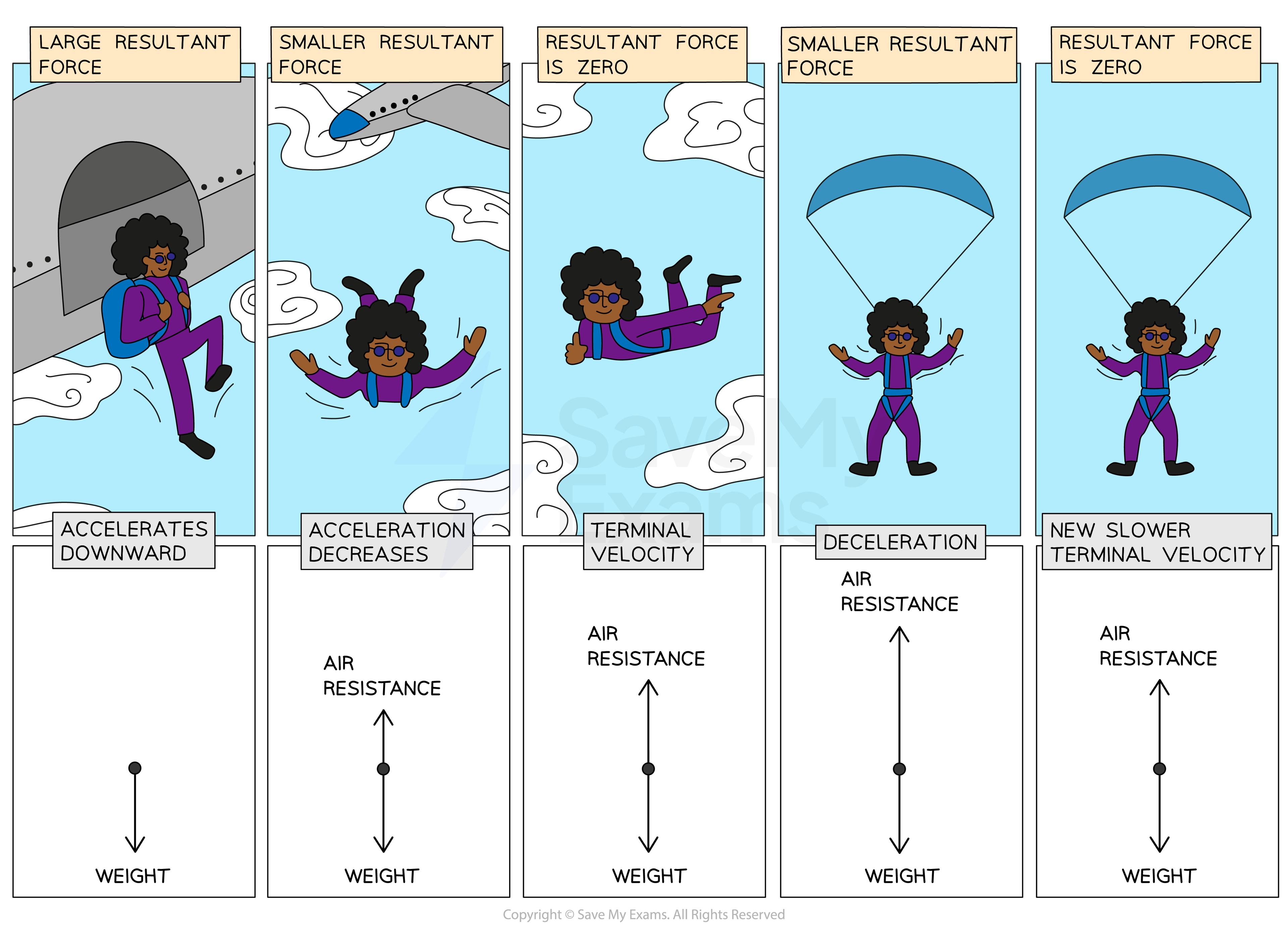
When a skydiver jumps out of a plane, initially the only force acting on them is weight
The resultant force acts in the downward direction
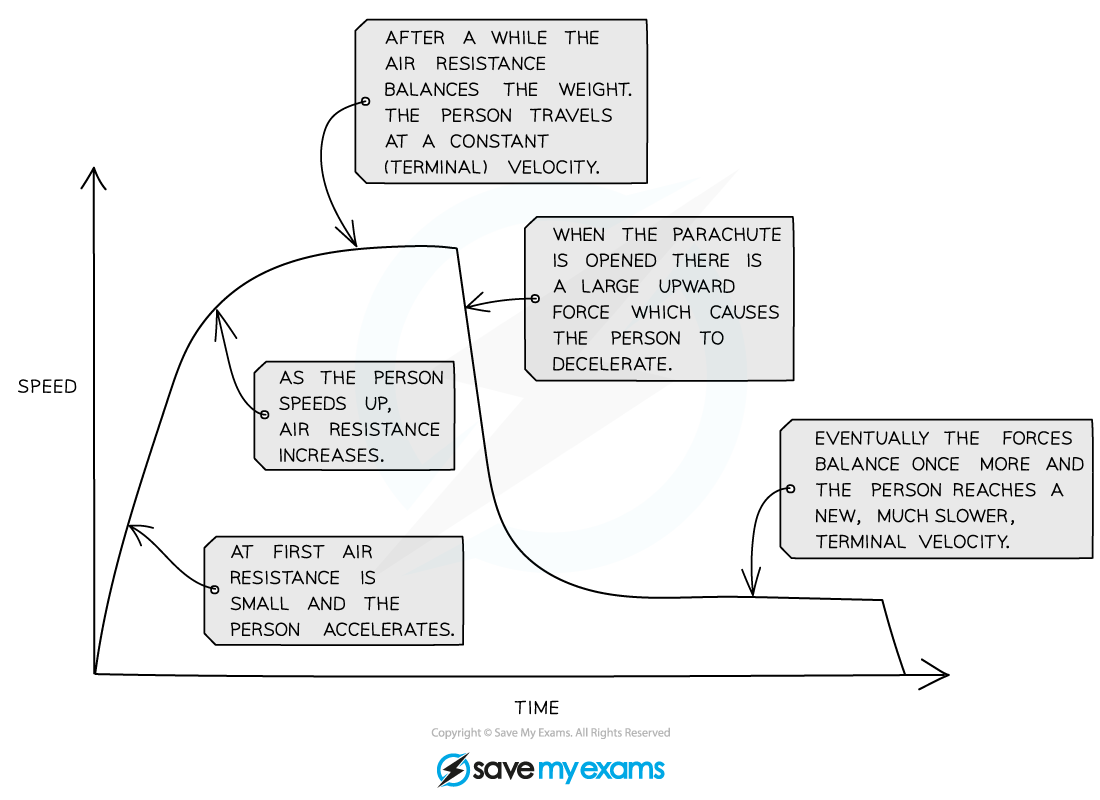
The skydiver accelerates
As the skydiver accelerates, their speed increases, so the force of air resistance increases
The resultant force acts in the downward direction with a smaller magnitude
The skydiver continues to accelerate but at a slower rate
Air resistance increases until it is equal to the weight
The forces are balanced
There is no resultant force
Terminal velocity is reached
The parachute is deployed, increasing the surface area of the skydiver
The parachute collides with many more air particles
Air resistance increases greatly
The force of air resistance is now greater than the force of weight
The resultant force acts in the upward direction
The skydiver continues falling in a downward direction
The skydiver is decelerating
As the skydiver decelerates, their speed decreases
Therefore, air resistance decreases
Therefore, the resultant force decreases
Air resistance decreases until it is equal to the weight
The forces are balanced
There is no resultant force
A new, slower terminal velocity is reached
Graph showing the motion of the skydiver as they reach terminal velocity
Falling objects with liquid resistance
When objects fall through a liquid due to the force of weight, the liquid exerts a frictional (drag) force on the object as it falls
Drag forces oppose the motion of an object
They act to slow it down
Drag increases as the speed of the object increases
When the drag force becomes equal to the force of weight, the object stops accelerating and reaches a terminal velocity
Worked Example
A small object falls out of an aircraft. Choose words from the table to complete the sentences below:
accelerates | air pressure |
air resistance | falls at a steady speed |
gravitational field strength | slows down |
(a) The weight of an object is the product of the object's mass and the __________. [1]
(b) When an object falls, initially it ____________. [1]
(c) As the object falls faster, the force of ______________ acting upon the object increases. [1]
(d) Eventually, the object ______________ when the force of friction equals the force of weight acting on it. [1]
Answer:
Part (a)
The weight of an object is the product of the object's mass and the gravitational field strength. [1 mark]
The weight force is due to the Earth's gravitational pull on the object's mass as it falls through a uniform gravitational field
Part (b)
When an object falls, initially it accelerates. [1 mark]
The resultant force on the object is very large initially, so it accelerates
This is because there is a large unbalanced force downwards (its weight) - the upward force of air resistance is very small to begin with
Part (c)
As the object falls faster, the force of air resistance acting on the object increases. [1 mark]
The force of air resistance is due to friction between the object's motion and collisions with air particles
Collisions with air particles slow the object down, so air itself produces a frictional force, called air resistance (sometimes called drag)
Part (d)
Eventually, the object falls at a steady speed when the force of friction equals the force of weight acting on it. [1 mark]
When the upward acting air resistance increases enough to balance the downward weight force, the resultant force on the object is zero
This means the object is no longer accelerating; it is moving at a steady speed called terminal velocity
Examiner Tips and Tricks
Don't confuse 'air resistance' with 'air pressure' - these are two different concepts!
Exam questions about terminal velocity tend to involve the motion of skydivers as they fall
A common misconception is that skydivers move upwards when their parachutes are deployed; however, this is not the case, they are in fact decelerating to a lower terminal velocity

Unlock more, it's free!
Join the 100,000+ Students that ❤️ Save My Exams
the (exam) results speak for themselves:

Was this revision note helpful?
Build on this topic