Floating (Cambridge (CIE) IGCSE Physics): Revision Note
Exam code: 0625 & 0972

Floating objects
Density and floating
Whether an object floats or sinks depends on the relative densities of the object and the fluid it is submerged in
Upthrust is a force that pushes upwards on an object submerged in a fluid
Upthrust always acts in the opposite direction to the object's weight force
This is how objects float
The size of the upthrust force depends on:
the density of the fluid
the volume of fluid that is displaced (which is equal to the volume of the object that is submerged)
The denser the liquid, the greater the force of upthrust exerted on the object
Upthrust and weight forces on a boat
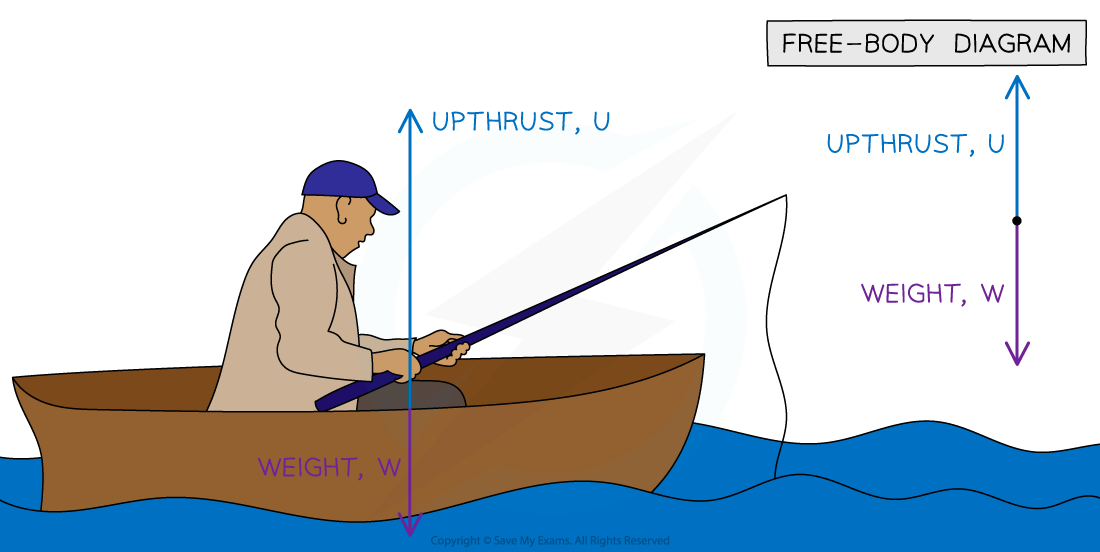
Factors affecting floating and sinking
The factors affecting floating and sinking are:
upthrust
density
If the force of upthrust on an object is:
equal to the object’s weight, then the object will float
less than the object’s weight, then the object will sink
If the density of the object is:
greater than the density of the fluid, then the object will sink
less than the density of the fluid, then the object will float
If the density of the object is greater than the density of the fluid, the object can never displace enough fluid to create an upthrust that will equal its weight (and therefore it sinks)
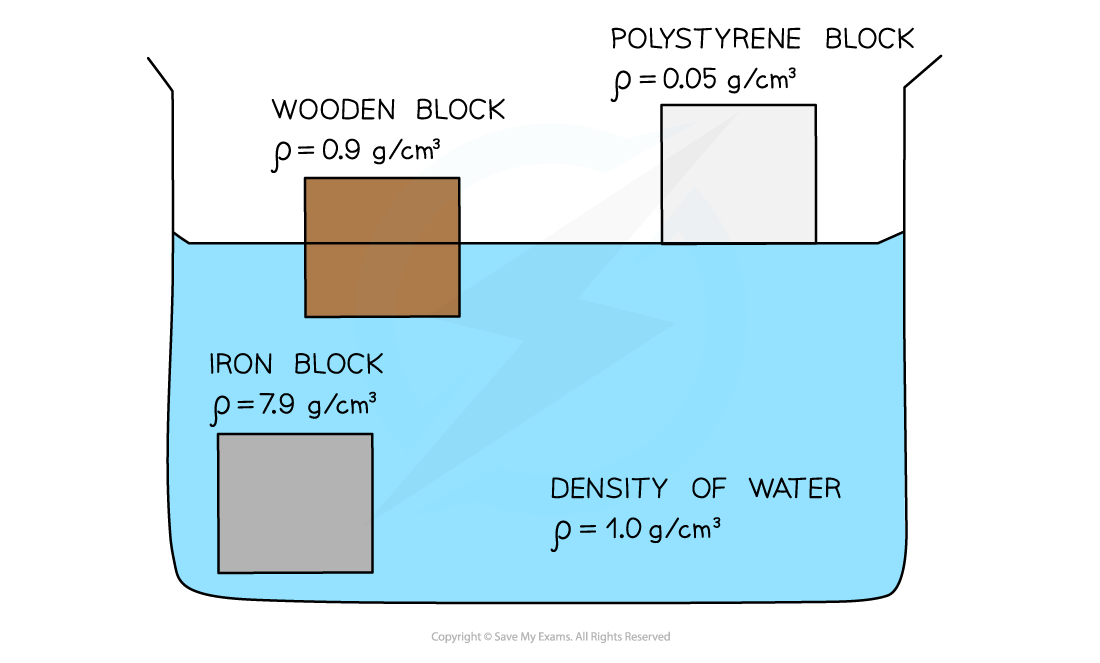
A polystyrene block will float in water
This is because polystyrene has a density of 0.05 g/cm3 which is much less than the density of water (1.0 g/cm3)
A wooden block will be partially submerged but will still float
This is because the density of a wooden block (0.9 g/cm3) is slightly less than the density of water
An iron block will sink
This is because iron has a density (7.9 g/cm3) that is much higher than the density of water
Worked Example
Potassium is an alkali metal that reacts with oxygen and water. Potassium is therefore stored in containers filled with mineral oil. The potassium must sink in the mineral oil to ensure it has no contact with any air in the container.
A science teacher has four different mineral oils in which they could store their potassium. Potassium has a density of 0.862 g/cm3.
Which mineral oil should the teacher choose?
A: White mineral oil,
B: Paraffin oil,
C: Liquid paraffin,
D: Food grade mineral oil,
[1]
Answer: C
An object will sink in a fluid if the density of the object is greater than the density of the fluid
Therefore, for the potassium to sink, the density of the oil must be less than the density of the potassium
Liquid paraffin is less dense than potassium
The only oil which is less dense than potassium is C [1 mark]
Examiner Tips and Tricks
The main thing to remember is that density is mass per unit volume. You need to be able to determine whether an object floats based on density data, while upthrust is supporting context.
In physics, mass is almost always measured in kg. But density is often given in g/cm3, so make sure to double check the units provided
Floating liquids
Extended Tier Only
A liquid with a lower density will float on a liquid with a higher density if the liquids do not mix

Worked Example
Liquid A has a density of 0.76 g/cm3 and liquid B has a density of 0.93 g/cm3.
If the two liquids do not mix, which liquid will float on top of the other?
[1]
Answer:
Step 1: List the known quantities
Liquid A = 0.76 g/cm3
Liquid B = 0.93 g/cm3
Step 2: Determine which liquid has the lower density
The liquid with the lower density will float on top of the liquid with the higher density
0.76 is less than 0.93
Therefore, liquid A has the lower density
Step 3: State your answer
Liquid A will float on top of liquid B [1 mark]

Unlock more, it's free!
Join the 100,000+ Students that ❤️ Save My Exams
the (exam) results speak for themselves:

Was this revision note helpful?
Build on this topic