Pressure in a Liquid (Cambridge (CIE) IGCSE Physics): Revision Note
Exam code: 0625 & 0972

Liquid pressure
Factors affecting pressure in a liquid
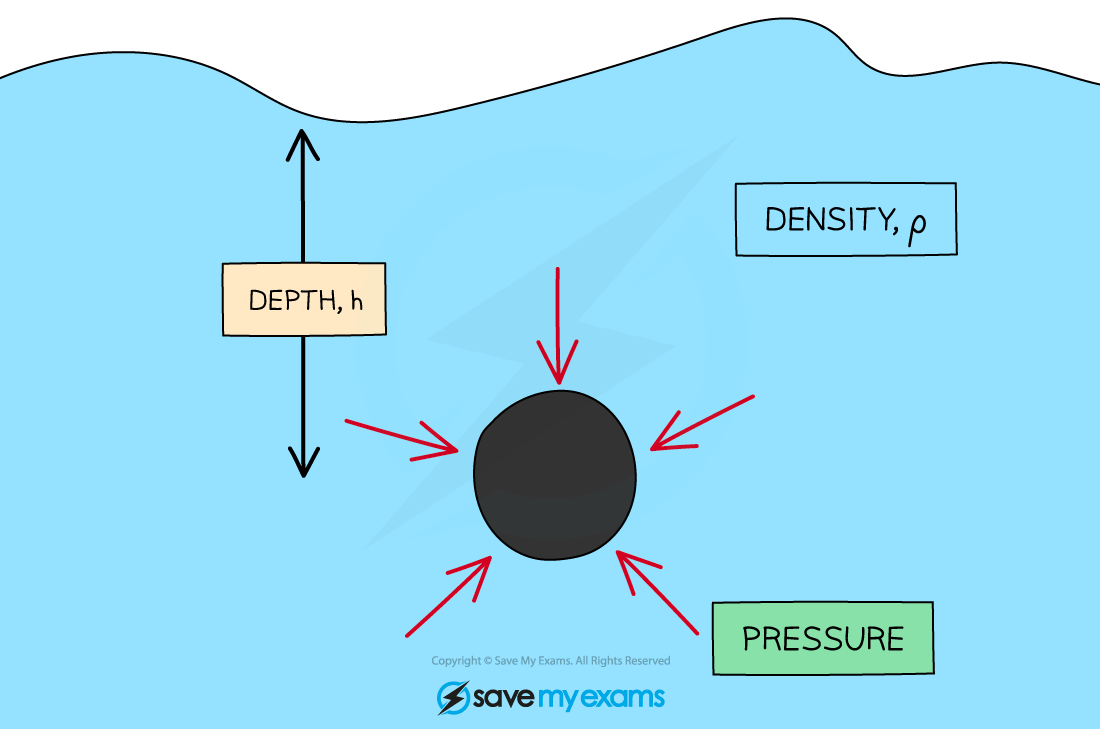
The pressure beneath the surface of a liquid will increase with the depth of the liquid
This is because the pressure in a liquid is caused by the force of the weight of the liquid above it
As the depth increases, there is more liquid above which causes the pressure to increase
Pressure in a liquid also depends on the density of the liquid
The more dense the liquid, the greater the pressure it exerts
Sea water is more dense than fresh water, so the pressure exerted on a object will be greater in sea water than in fresh water at the exact same depth
Pressure in a column of water
In a column of water, the highest pressure would be at the bottom
If a hole is made at the bottom of the column, the water will pour out with a large force
If a hole is made at the top of the column, the water will pour out with a small force
This is because of the difference in pressure in the column caused by the weight of the water
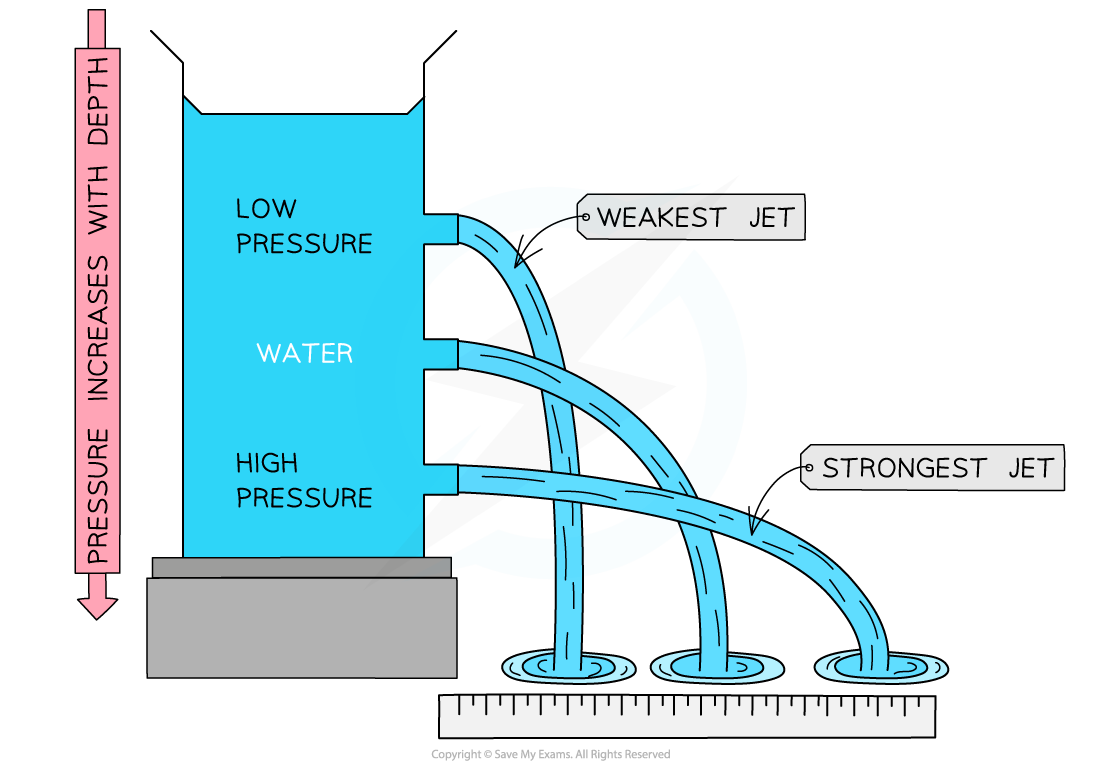
If several holes are made at the same height, the water would spurt out the same distance from each hole
This is because pressure at the same depth acts equally in all directions
Examiner Tips and Tricks
Remember, a fluid can be either a liquid or a gas. In all fluids, pressure is affected by depth and density.
Calculating liquid pressure
Extended Tier Only
The pressure acting on an object in a liquid changes with depth
The deeper the object, the higher the pressure exerted upon it and vice versa
The change in pressure with depth is given by:
Where:
Δp = change in pressure, measured in pascals (Pa)
Where 1 Pa = 1 N/m2
ρ = density of the liquid, measured in kilograms per metre cubed (kg/m3)
g = gravitational field strength, measured in newtons per kilogram (N/kg)
Δh = change in height of the column, measured in metres (m)
Worked Example
Calculate the depth of water in a swimming pool at which the pressure due to the water alone is 20 kPa. The density of water is 1000 kg/m3 and the gravitational field strength on Earth is 9.8 N/kg.
[3]
Answer:
Step 1: List the known quantities
Pressure,
Density of water,
Gravitational field strength,
Step 2: List the relevant equation
[1 mark]
Step 3: Rearrange for height, Δh
Step 4: Convert any units
Step 5: Substitute in the values
[1 mark]
[1 mark]
Examiner Tips and Tricks
You need to be able to recall the equation for the change in pressure and make sure you are comfortable rearranging it for the variable required in the question. With pressure in pascals, make sure the change in depth is measured in metres.
Some exam questions may ask about the total pressure exerted on an object or surface within the liquid; in this case, you need to account for the atmospheric pressure as well. Atmospheric pressure is approximately 100 kPa.
Make sure you add the atmospheric pressure when you are asked for total pressure, and subtract the atmospheric pressure when you are given the total and asked for depth or for the pressure due to the liquid alone.

Unlock more, it's free!
Join the 100,000+ Students that ❤️ Save My Exams
the (exam) results speak for themselves:

Was this revision note helpful?
Build on this topic