Pressure & Forces (Cambridge (CIE) IGCSE Physics): Revision Note
Exam code: 0625 & 0972

Pressure
What is pressure?
Pressure is defined as
The force per unit area
Pressure is measured in newtons per metre squared (N/m2)
1 newton per metre squared is equivalent to 1 pascal (Pa)
1 N/m2 = 1 Pa
It can be calculated using the following pressure equation:
Where:
p = pressure, measured in newtons per metre squared (N/m2) or pascals (Pa)
F = force, measured in newtons (N)
A = area, measured in metres squared (m2)
This equation tells us that:
If a force is spread over a large area it will result in a small pressure
If it is spread over a small area it will result in a large pressure
If an object rests on more than one point of contact, add their areas together to get the total area the force is spread over
Examiner Tips and Tricks
In this course, pressure may also be given in N/cm2. If a question provides an area in cm2, the pressure can be given in N/cm2.
Examples of applications of pressure
Example 1: Tractors
Tractors have large tyres
This spreads the weight (force) of the tractor over a large area
The weight of the tractor is unchanged, so this reduces the pressure and prevents the heavy tractor from sinking into the mud
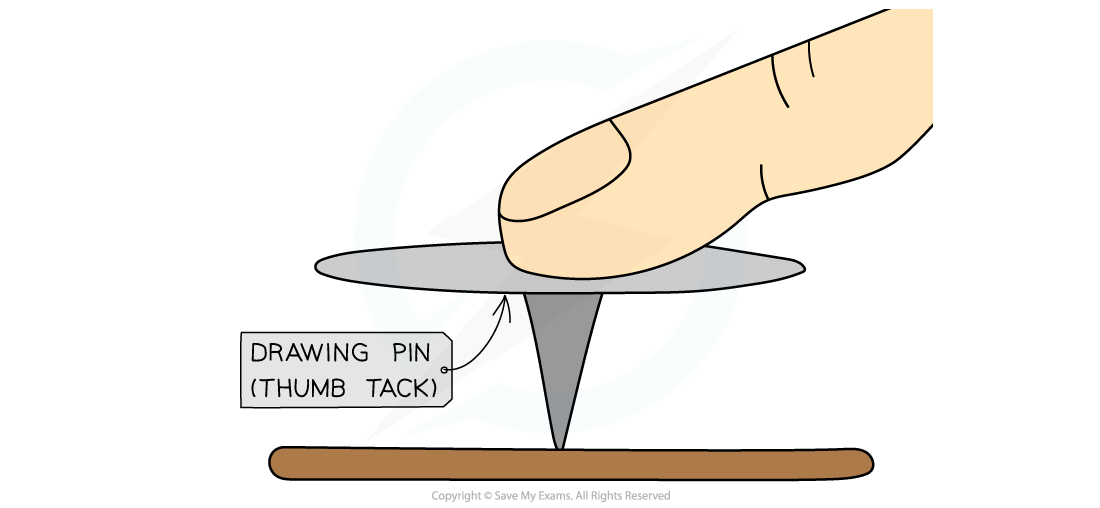
Example 2: Drawing pins
Drawing pins have sharp pointed ends with a very small area
This concentrates the force, creating a large pressure over a small area
This allows the drawing pin to be pushed into a wall
Applying a force to a drawing pin
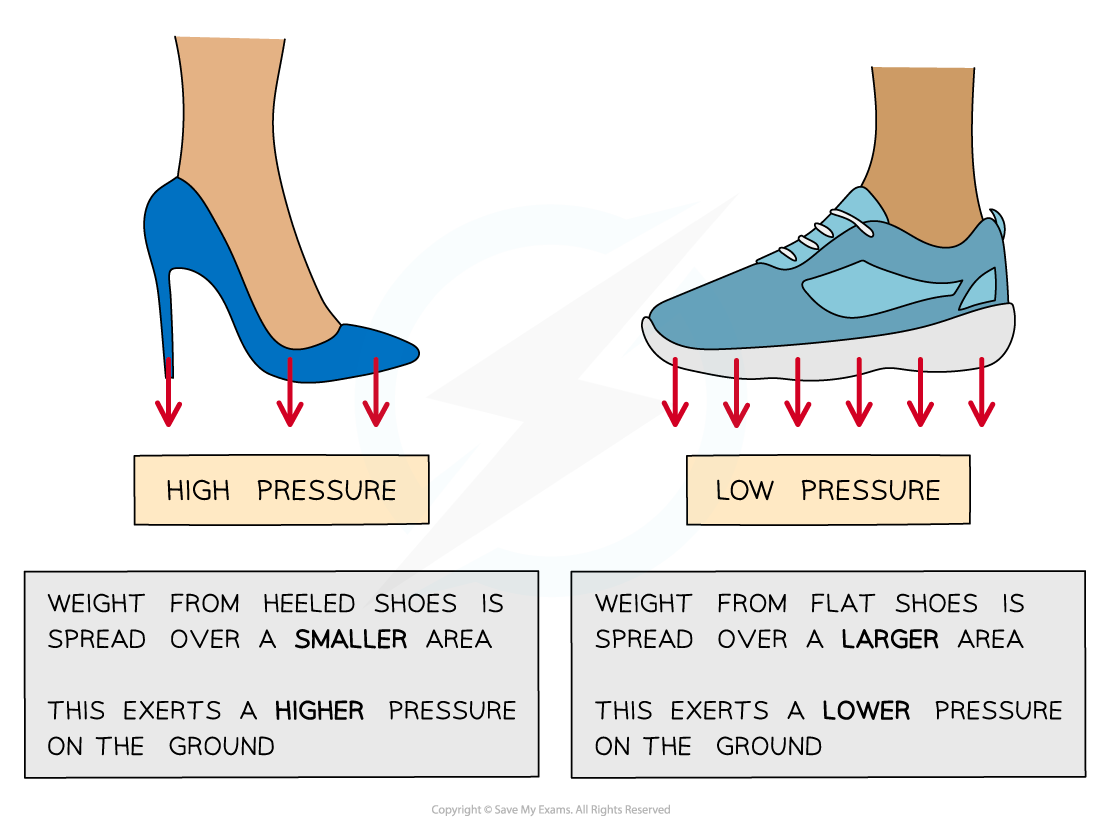
Example 3: High heels
High heels have small, sharp points with a small area
This concentrates the weight (force), creating a large pressure over a small area
Flat shoes have a larger area which the weight (force) is spread over resulting in a lower pressure
If the person's weight is the same in both shoes, this explains why high heels sink into soft surfaces more easily than flat shoes
The effect of surface area on pressure
Examiner Tips and Tricks
Note that answers about friction, balance or stability score nothing on a pressure question. Make sure to name the area, the equation and the resulting pressure.
Worked Example
The diagram below shows the parts of the lifting machine used to move the platform up and down.
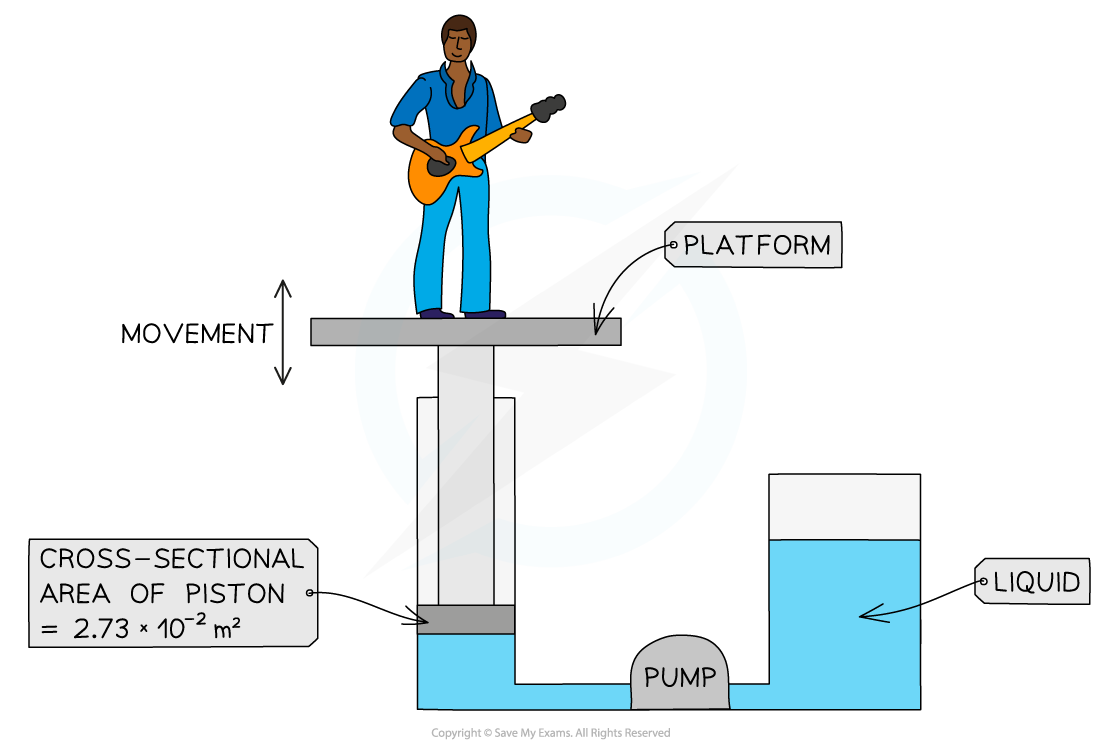
The pump creates pressure in the liquid of 5.28 × 10⁵ Pa to move the platform upwards. The cross-sectional area of the piston is 2.73 × 10⁻² m2.
Calculate the force that the liquid applies to the piston.
[2]
Answer:
Step 1: List the known quantities
Cross-sectional area = 2.73 × 10⁻² m2
Pressure = 5.28 × 10⁵ Pa
Step 2: Write down the relevant equation
Step 3: Rearrange for the force, F
Step 4: Substitute the values into the equation
[1 mark]
Step 5: Round to the appropriate number of significant figures and quote the correct unit
[1 mark]
Worked Example
A table stands on four legs, and each leg has an area of 100 cm2. The table has a weight of 120 N.
Calculate the pressure on the ground.
[4]
Answer:
Step 1: List the known quantities
Area of one table leg = 100 cm2
Weight = 120 N
Step 2: Write down the relevant equation
[1 mark]
Step 3: Calculate the total area of all four table legs
[1 mark]
Step 4: Substitute the values into the equation
[1 mark]
[1 mark]

Unlock more, it's free!
Join the 100,000+ Students that ❤️ Save My Exams
the (exam) results speak for themselves:

Was this revision note helpful?
Build on this topic