Molecular Matter (Cambridge (CIE) IGCSE Physics): Revision Note
Exam code: 0625 & 0972

Arrangement & motion of particles
All particles are in constant motion at any temperature
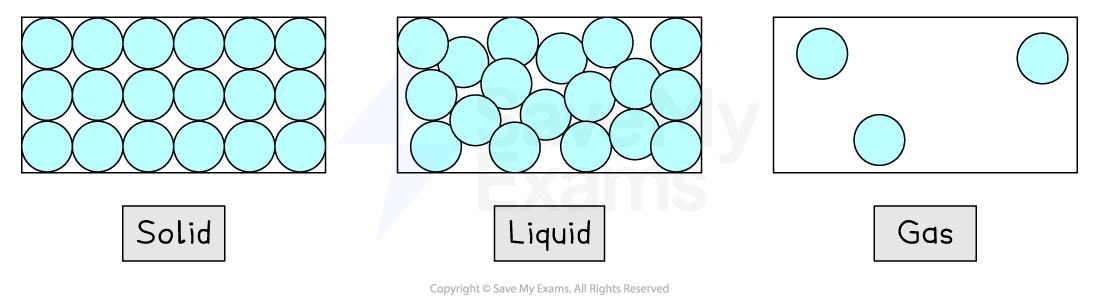
The motion and arrangement of particles are different for each state of matter
In a solid:
The particles are very close together and arranged in a regular pattern
The particles vibrate about fixed positions
In a liquid:
The particles are still close together (no gaps) but are no longer arranged in a regular pattern
The particles are able to slide past each other
In a gas:
The particles are widely separated, about 10 times further apart in each direction
The particles move about randomly at high speeds
Property | Solid | Liquid | Gas |
|---|---|---|---|
Density | High | Medium | Low |
Arrangement of particles | Regular pattern | Randomly arranged | Randomly arranged |
Separation of particles | Very close together | Close together but loosely packed | Widely spaced |
Movement of particles | Vibrate around a fixed position | Move around each other | Move quickly in all directions |
Energy of particles | Low energy | Higher energy | Highest energy |
Worked Example
Two states of matter are described below. Identify each of the states of matter.
Substance 1
particles are spaced very far apart
particles move very quickly at random
particles move in a straight line
Substance 2
particles are quite closely packed together
particles move about at random
particles do not have fixed positions
[2]
Answer:
Substance 1
Step 1: Identify the distances between the particles
The particles are spaced far apart
This can only describe a gas
Step 2: Identify the motion of the particles
The particles move quickly, at random and in a straight line
This confirms that substance 1 is a gas [1 mark]
Substance 2
Step 1: Identify the distances between the particles
The particles are closely packed
This could describe either a solid or a liquid
Step 2: Identify the motion of the particles
The particles move at random and do not have fixed positions
This confirms that substance 2 is a liquid [1 mark]
Examiner Tips and Tricks
The properties of particles must be known for each state of matter.
In comparison questions, you should name the property and give descriptions that compare the states of matter. Note that particles do not expand, only the average separation changes.
The forces & distances between particles
Extended Tier Only
Intermolecular forces and motion of particles
The forces between particles affect the state of matter
This is because the magnitude of the forces affects the relative distances and motion of the particles
This affects the ability of the substance to
Change shape
Change volume
Flow
The word particles can refer to:
Atoms
Molecules
Ions
Electrons
Solids
The particles in a solid are held in place by strong intermolecular forces
They only vibrate in position
The distance between them is fixed and is very small
This gives the solid its rigid shape and fixed volume
Liquids
The particles in a liquid have enough energy to move past one another, but not enough to escape the forces holding them together
They are still held close together
The liquid has a fixed volume, similar to that of the solid
Particles can move around (by sliding past each other)
This allows the liquid to change shape and flow
Liquids are difficult to compress because particles are close together and the repulsive forces between them are large
Gases
The particles in a gas have more energy and move randomly at high speeds
The particles have overcome the forces holding them close together
Because of the large spaces between the molecules
The gas can easily be compressed and is also able to expand
Gases flow freely
Temperature & energy of particles
As the temperature of a gas increases, so does the average speed of particles in the gas
At higher temperatures, the particles have more kinetic energy
Therefore, there must be a temperature at which the particles have the least kinetic energy
The temperature at which particles have the least kinetic energy is called absolute zero
This is the lowest possible temperature, and absolute zero has a value of −273 °C

Unlock more, it's free!
Join the 100,000+ Students that ❤️ Save My Exams
the (exam) results speak for themselves:

Was this revision note helpful?
Build on this topic