Resultant Forces (Cambridge (CIE) IGCSE Physics): Revision Note
Exam code: 0625 & 0972

Effects of forces
A force is defined as:
A push or a pull that acts on an object due to the interaction with another object
Forces can have a variety of effects on an object
Forces can change an object's
speed
direction
shape
size

The effects of forces on an object often depend on the type of force acting
The push force (thrust) of an engine can cause a car to speed up, whilst the force exerted by the brakes (friction) can cause it to slow down
The gravitational pull of the Sun on a comet causes the comet to change direction
When two opposing forces push on each end of a spring, the spring changes shape (it compresses)
Resultant forces on a straight line
What is a resultant force?
A resultant force is the single force that has the same effect as all the forces acting on an object
When multiple forces act on one object along the same straight line, the forces can be combined to produce one net force that describes the combined action of all of the forces
This single resultant force determines:
The direction in which the object will move as a result of all of the forces
The magnitude of the net force experienced by the object
Balanced and unbalanced forces
The forces acting on an object can be described as balanced or unbalanced
Forces are balanced if multiple forces along the same straight line act in opposing directions with an equal magnitude in each direction
The effects of the forces then cancel out
There is no resultant force along that straight line
Forces are unbalanced if the effects of the forces acting in each straight line do not cancel out
There is a resultant force in one or more lines of direction
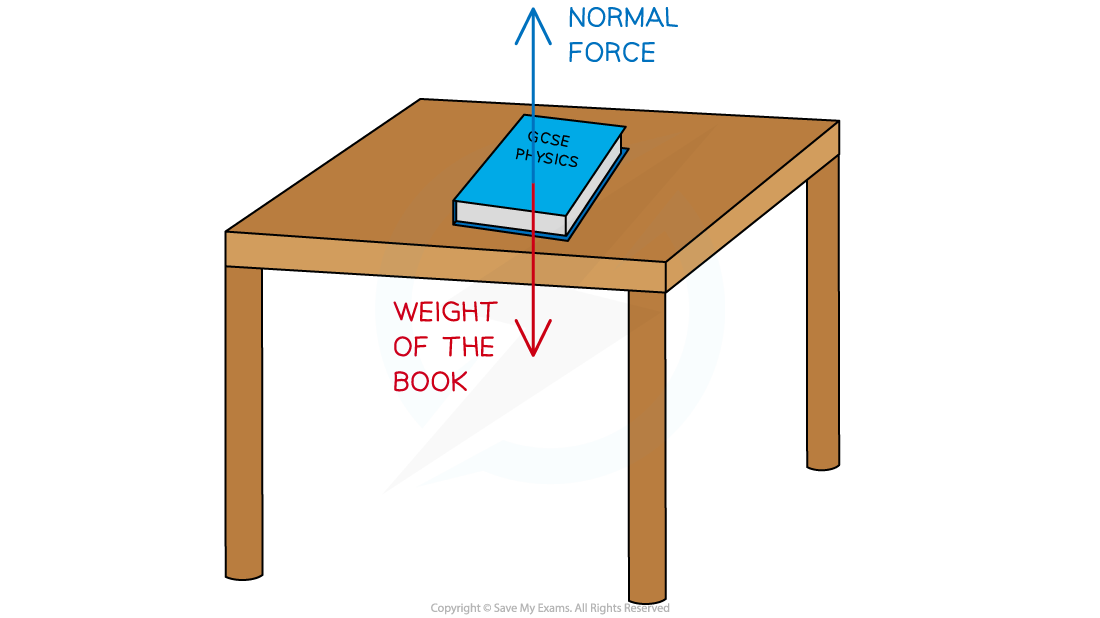
Consider the forces acting on a book at rest on a table:
The gravitational pull of the Earth on the book (weight) acts in a downward direction
The push force of the table on the book (normal contact force) acts in the upward direction
The forces are equal in magnitude and opposite in direction
The forces are therefore balanced
There is no resultant force acting on the book
Zero resultant force on a book resting on a table
Calculating resultant force
Force is a vector quantity; it has both magnitude and direction
When adding forces together, it is important to assign positive and negative values to show the direction in which the forces are acting
If a 5 N force acts to the right and a 5 N force acts to the left on an object, then one value is assigned as positive and one as negative
So the resultant force acting on the object is
The forces acting on the object are equal in magnitude and opposite in direction; therefore, they cancel one another out
This is like two people pushing a box with equal force from opposite sides; the box does not move
If two people push the box from the same side in the same direction, one with a 3 N force and one with a 7 N force, then the forces will add together, and the box will move in the direction of the resultant force
If two people push the box in opposite directions, one with a 7 N force to the left (negative) and one with a 3 N force to the right (positive), then the forces will add together and the box will move in the direction of the resultant force
In this case, the box will move to the left due to the resultant force of 4 N
Zero and non-zero resultant forces

Worked Example
Calculate the magnitude and direction of the resultant force in the diagram below.

[2]
Answer:
Step 1: Assign a direction to the forces
Forces acting to the right are positive
Forces acting to the left are negative
Step 2: Add together all the forces acting on the object
[1 mark]
Step 3: State the magnitude and direction of the resultant force
The resultant force is 2 N to the left [1 mark]
Examiner Tips and Tricks
Mathematically, it doesn't matter which direction you assign to be positive or negative, as long as you are consistent throughout your calculation.

Unlock more, it's free!
Join the 100,000+ Students that ❤️ Save My Exams
the (exam) results speak for themselves:

Was this revision note helpful?
Build on this topic