Newton's Second Law (Cambridge (CIE) IGCSE Physics): Revision Note
Exam code: 0625 & 0972

Newton's second law
Newton's second law of motion states:
The acceleration of an object is proportional to the resultant force acting on it and inversely proportional to the object's mass
Newton's second law of motion explains what happens when a non-zero resultant force (opens in a new tab)acts on an object
A resultant force occurs when the forces acting on an object are not balanced
A resultant force acting on an object will cause a change in the object's motion
This change in motion is an acceleration (opens in a new tab):
Speeding up
Slowing down
Changing direction
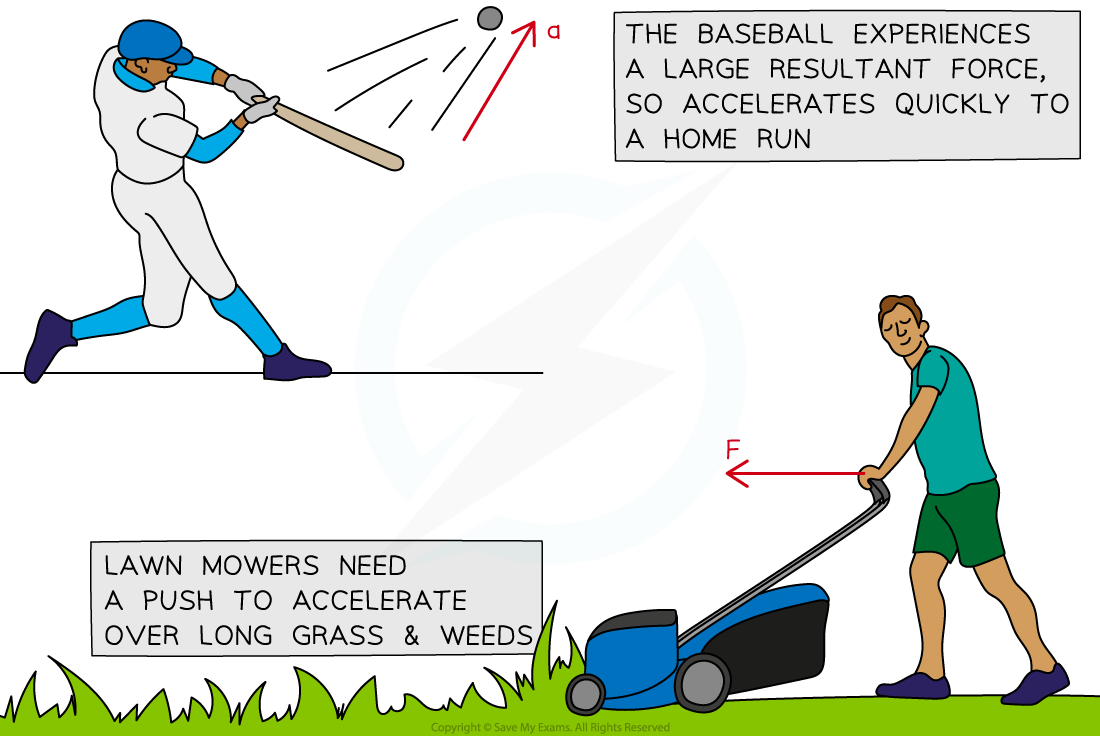
If the resultant force on an object is not zero, the object will accelerate in the direction of the resultant force
The bigger this resultant force, the larger the acceleration
For a given force, the greater the object's mass, the smaller the acceleration experienced
Calculations using Newton's second law
Extended Tier Only
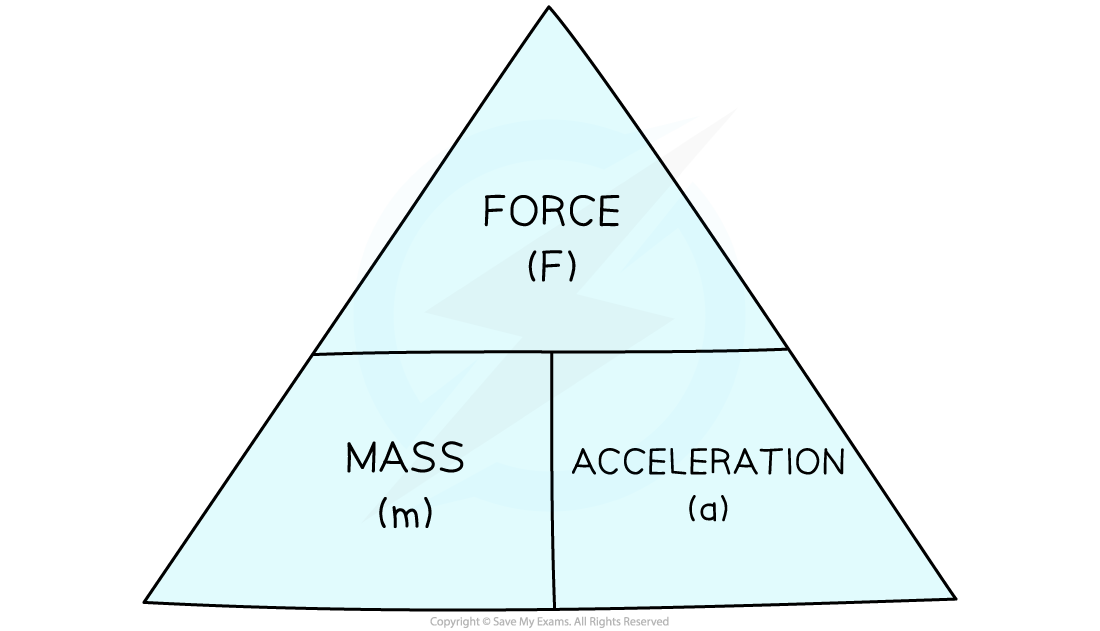
Newton's second law can be expressed as an equation:
Where:
F = resultant force on the object, measured in newtons (N)
m = mass of the object, measured in kilograms (kg)
a = acceleration of the object, measured in metres per second squared (m/s2)
The acceleration occurs in the same direction as the resultant force
Worked Example
A car salesperson says that their best car has a mass of 900 kg and can accelerate from 0 to 27 m/s in 3 seconds.
Calculate:
a) the acceleration of the car in the first 3 seconds. [2]
b) the force required to produce this acceleration. [2]
Answer:
Part (a)
Step 1: List the known quantities
Initial velocity,
Final velocity,
Time,
Step 2: State the equation for acceleration, in terms of change in velocity
[1 mark]
[1 mark]
Part (b)
Step 1: List the known quantities
Mass of the car,
Acceleration,
Step 2: Identify which law of motion to apply
The question involves quantities of force, mass and acceleration, so Newton's second law is required:
Step 3: Calculate the force required to accelerate the car
[1 mark]
[1 mark]
Worked Example
Three shopping trolleys, A, B and C, are being pushed using the same force. This force causes each trolley to accelerate.
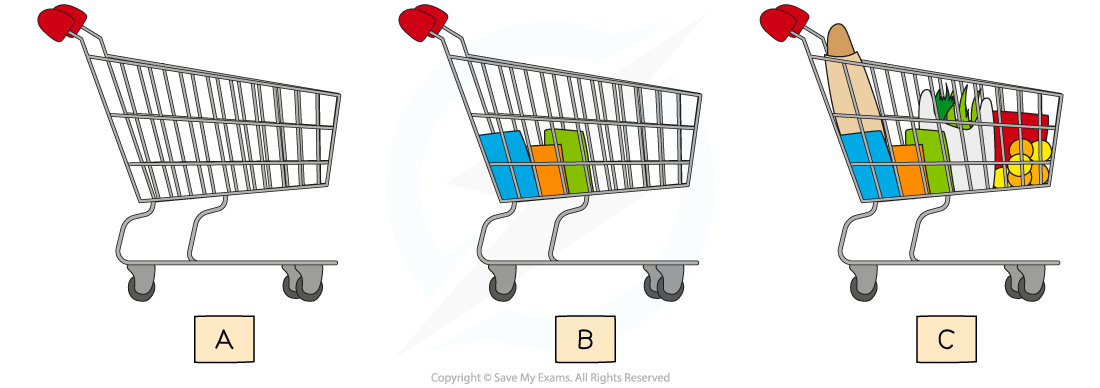
State which trolley would have the smallest acceleration. Explain your answer.
[3]
Answer:
Step 1: Identify which law of motion to apply
The question involves quantities of force and acceleration, and the image shows trolleys of different masses, so Newton's second law is required:
Step 2: Re-arrange the equation to make acceleration the subject
Step 3: Explain the inverse proportionality between acceleration and mass
Acceleration is inversely proportional to mass [1 mark]
This means that for the same amount of force, a large mass will experience a small acceleration [1 mark]
Therefore, trolley C will have the smallest acceleration because it has the largest mass [1 mark]
Examiner Tips and Tricks
Remember that in Newton's second law, F is the resultant force. An object can have several forces acting on it, but the object can only have one acceleration. So you must substitute the resultant force into to calculate the correct acceleration.

Unlock more, it's free!
Join the 100,000+ Students that ❤️ Save My Exams
the (exam) results speak for themselves:

Was this revision note helpful?
Build on this topic