Ultrasound (Cambridge (CIE) IGCSE Physics): Revision Note
Exam code: 0625 & 0972

Ultrasound
The approximate range of frequencies audible to humans is 20 Hz to 20 000 Hz
The human hearing range decreases with age

Ultrasound is defined as:
Sound with a frequency higher than 20 kHz
Uses of ultrasound
Extended Tier Only
Ultrasound is used in:
non-destructive testing of materials
medical scanning of soft tissue
sonar to calculate the depth or distance from time and wave speed
Measuring the depth of a boundary
When ultrasound signals reach a boundary between two media, some of the waves are partially reflected
The remainder of the waves are transmitted through the material
Ultrasound transducers:
emit and receive ultrasound
display the received signal on an oscilloscope screen
The depth of the boundary can be determined using:
time taken between the ultrasound being emitted and received
knowing the speed of the ultrasound through the material
The depth of the boundary is calculated using the equation:
Where:
depth = half the total distance travelled by the ultrasound, measured in metres (m)
speed = speed of the ultrasound in the medium, measured in metres per second (m/s)
time = total time from ultrasound emission to receipt, measured in seconds (s)
Ultrasound in material testing
In industry, ultrasound can be used to:
check for cracks inside metal objects
generate images from beneath surfaces
Ultrasound waves that reach a crack in an object, such as a metal bar, are reflected back from the crack earlier than the waves that continue to be absorbed through the object
The reflected waves are displayed as pulses on an oscilloscope trace
This allows engineers to assess the structure of an object
Oscilloscope display for material imperfection testing

Ultrasound in medicine
In medicine, ultrasound can be used:
to construct images of a foetus in the womb
to generate 2D images of organs and other internal structures (as long as they are not surrounded by bone)
as a medical treatment such as removing kidney stones
The ultrasound waves are reflected back to the transducer by boundaries between tissues in the path of the beam
Examples of boundaries are between fluid and soft tissue or tissue and bone
By taking a series of ultrasound measurements, sweeping across an area, the time measurements may be used to build up an image
Unlike many other medical imaging techniques, ultrasound is non-invasive and is believed to be harmless
Ultrasound image of a foetus in the womb

Sonar
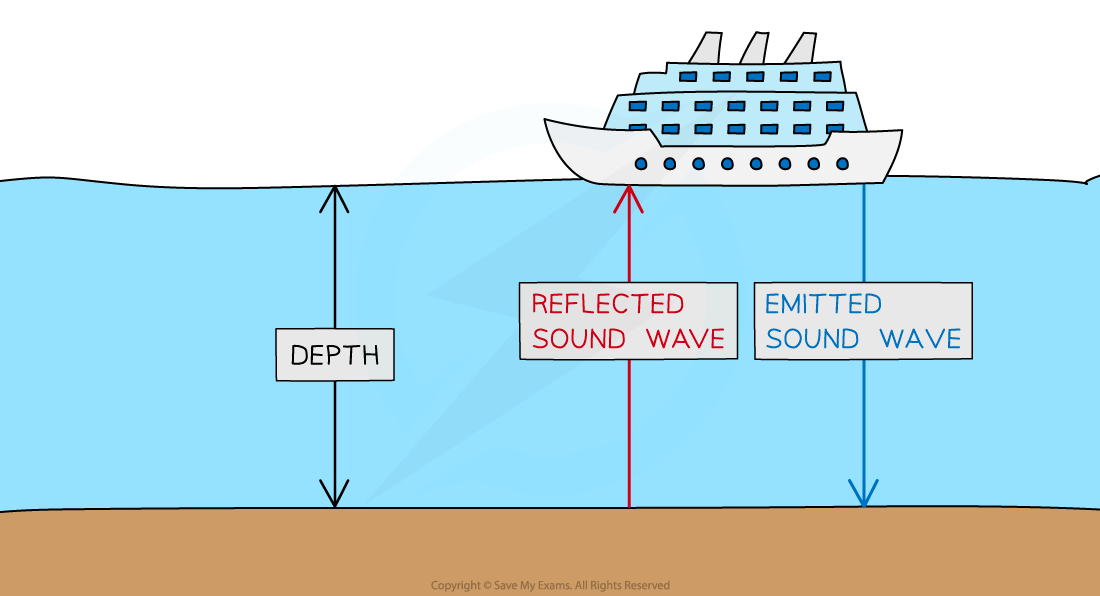
Echo sounding can be used to measure depth or to detect objects underwater
A sound wave can be transmitted from the surface of the water
The sound wave is reflected off the bottom of the ocean
The time it takes for the sound wave to return is used to calculate the depth of the water
The distance the wave travels is twice the depth of the ocean
This is the distance to the ocean floor plus the distance for the wave to return
Echo sounding

Worked Example

In the diagram above, a very high-frequency sound wave is used to check for internal cracks in a large steel bolt. The oscilloscope trace shows that the bolt does have an internal crack. Each division on the oscilloscope represents a time of 0.000002 s. The speed of sound through steel is 6000 m/s.
Calculate the distance, in cm, from the head of the bolt to the internal crack.
[4]
Answer:
Step 1: List the known quantities
Speed of ultrasound,
Time taken between emission and detection, [1 mark]
Step 2: Write down the equation relating speed, distance and time
Step 3: Calculate the total distance travelled by the sound wave
[1 mark]
Step 4: Calculate the distance travelled by the sound wave to the crack
[1 mark]
Step 5: Convert the distance to cm
[1 mark]

Unlock more, it's free!
Join the 100,000+ Students that ❤️ Save My Exams
the (exam) results speak for themselves:

Was this revision note helpful?
Build on this topic