Investigating Force & Extension (Cambridge (CIE) IGCSE Physics): Revision Note
Exam code: 0625 & 0972

Investigating springs
Aim of the experiment
The aim of this experiment is to investigate the relationship between the load applied to a spring and its extension
Variables
Independent variable = Load, (The force applied, , to the spring is referred to as the load)
Dependent variable = Extension,
Control variables:
The same spring throughout (so the spring constant, , does not change)
The same reference point on the spring for every reading
Equipment
Equipment list
Equipment | Purpose |
|---|---|
Clamp stand, boss and clamp | To apply an upward force on the spring |
Ruler | To measure the extension of the spring |
Spring | The elastic object being investigated; its extension is measured |
6 × 100 g masses | To apply a downward force on the spring |
100 g mass hanger | To hold the additional masses |
Pointer | To mark the bottom of the spring against the ruler scale and reduce parallax error |
Resolution of measuring equipment:
Ruler = 1 mm
Method
Equipment for investigating the extension of a spring
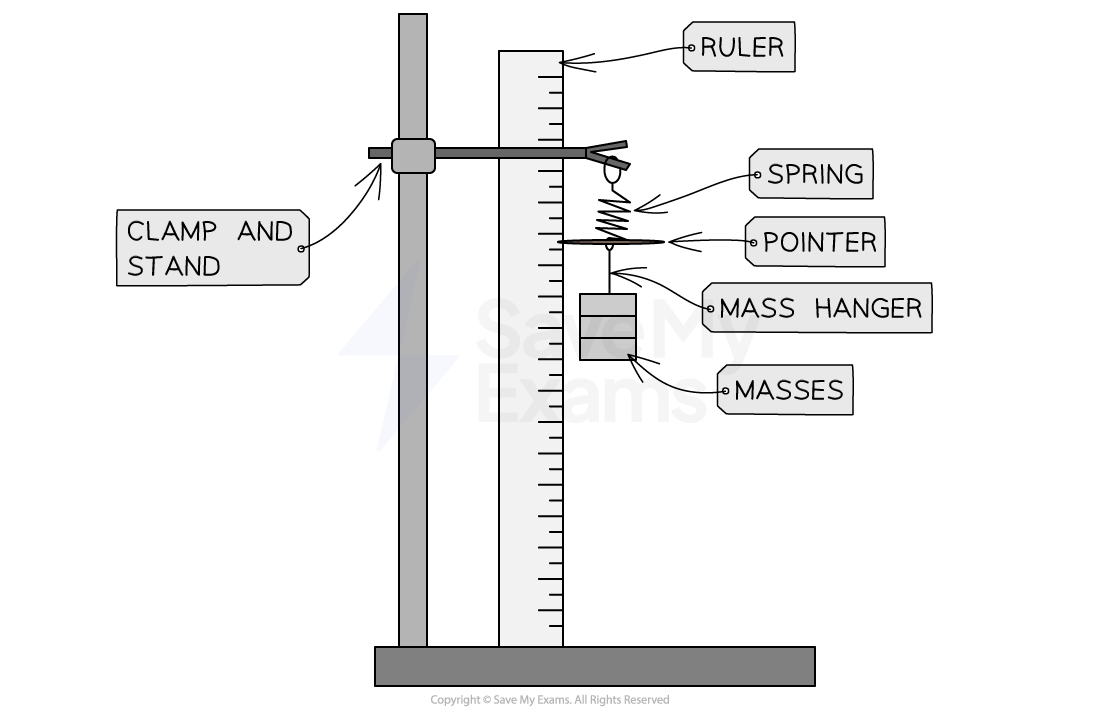
Align the pointer to a value on the ruler with no mass added to the spring, and record this initial length of the spring
Add the 100 g mass hanger onto the spring
Record the mass (in kg) and position (in cm) from the ruler now that the spring has extended
Add another 100 g to the mass hanger
Record the new mass and position from the ruler now that the spring has extended further
Repeat this process until all masses have been added
The masses are then removed and the entire process is repeated again until it has been carried out a total of three times, and an average length is calculated
Calculate the difference between the average length at each load and the original length of the spring to get the extension of the spring
Example results table
Mass / kg | Load / N | Length 1 / m | Length 2 / m | Length 3 / m | Average length / m | Extension / m |
|---|---|---|---|---|---|---|
0 | ||||||
0.1 | ||||||
0.2 | ||||||
0.3 | ||||||
0.4 | ||||||
0.5 | ||||||
0.6 |
A suitable table of results must contain space for the calculations of load and extension
Analysis of results
The load, , added to the spring is the weight exerted on the mass
The weight is calculated using the equation:
Where:
= weight, measured in newtons (N)
= mass, measured in kilograms (kg)
= gravitational field strength, measured in newtons per kilogram (N/kg)
Therefore, multiply each mass by gravitational field strength, g = 9.8 N/kg, to calculate the load,
The extension of the spring is calculated using the equation:
Where
= extension, measured in metres (m)
= average length of the spring with the load attached, measured in metres (m)
= original (unstretched) length of the spring when there were no masses, measured in metres (m)
Plot a graph of load (y-axis) against extension (x-axis), starting both axes at the origin
Draw the best-fit straight line
If the graph has a linear region (is a straight line), then the load is proportional to the extension in this region
Check that the spring has not gone past its limit of proportionality, otherwise it has been stretched too far and will no longer obey this relationship
Example load-extension graph

Examiner Tips and Tricks
If a question gives you a graph or table, check whether the axis or column is length or extension before you read a value off it.
You should be able to sketch the expected shape of a load–extension graph without plotting data: a straight line through the origin, curving away above the limit of proportionality. The point where the line stops being straight is the limit of proportionality.
Note that the elastic limit, where the deformation becomes permanent, is not a syllabus learning objective. It should not be confused with the limit of proportionality.
Evaluating the experiment
Systematic errors:
Make sure the measurements on the ruler are taken at eye level to avoid parallax error
Make sure the measurements are taken from the same point on the bottom of the spring every time
Check the ruler is vertical with its zero aligned to the pointer's starting position
Random errors:
Wait a few seconds for the mass to become stationary after it is added, before taking the readings for its length
Safety considerations
Wear goggles during this experiment in case the spring snaps
Stand up while carrying out the experiment, and make sure no feet are directly under the masses
Place a mat or a soft material below the masses to prevent any damage in case they fall
Use a G clamp to secure the clamp stand to the desk so that the clamp and masses do not fall over
As well as this, place each mass carefully on the hanger and do not pull the spring so hard that it breaks or pulls the apparatus over
Examiner Tips and Tricks
Remember, the extension measures how much the object has stretched by and can be found by subtracting the original length from each of the subsequent lengths.
A common mistake is to calculate the increase in length instead of the total extension. If each of your extensions is roughly the same, then you might have made this mistake.
This proportional relationship is Hooke's law. You may be asked to state it, so learn the full wording: the extension of an elastic object is proportional to the load applied, up to the limit of proportionality. Saying only that 'extension increases with load' will not earn the mark.

Unlock more, it's free!
Join the 100,000+ Students that ❤️ Save My Exams
the (exam) results speak for themselves:

Was this revision note helpful?
Build on this topic