Mass & Weight (Cambridge (CIE) IGCSE Physics): Revision Note
Exam code: 0625 & 0972

Mass & weight
Mass
Mass is defined as:
A measure of the quantity of matter in an object at rest relative to the observer
The greater the mass of an object, the more difficult it is to speed it up, slow it down, or change its direction
Mass is a scalar quantity that has magnitude but no direction
Mass is measured in kilograms (kg)
Sometimes mass may be given in grams (g) but this will need to be converted to kilograms when used in calculations
1000 g = 1 kg
1 g = 0.001 kg
To convert g to kg, divide the mass in g by 1000
To convert kg to g, multiply the mass in kg by 1000
Weight
Weight is a gravitational force on an object with mass
Since weight is a force, it is a vector quantity with both magnitude and direction
Weight is measured in newtons (N)
Worked Example
An object has a mass of 4.5 kg.
State the mass of the object in grams (g).
[1]
Answer:
Step 1: State the conversion between g and kg
1 kg = 1000 g
Step 2: Convert kg into g by multiplying
[1 mark]
Examiner Tips and Tricks
Students commonly confuse mass and weight because the terms are used interchangeably in everyday speech. In Physics, mass and weight mean very different things, and you must be confident that you can explain the difference.
Mass is the amount of matter an object has; it is a scalar quantity, and it is measured in kg.
Weight is a force; it is a vector quantity, and it is measured in N.
Weight & gravity
Extended Tier Only
Weight and gravitational field strength
Weight is the effect of a gravitational field on a mass
Weight is defined as:
The force acting on an object with mass when placed in a gravitational field
Planets have strong gravitational fields
Hence, they attract nearby masses with a strong gravitational force
Because of weight:
Objects stay firmly on the ground
Objects will always fall to the ground
Satellites are kept in orbit

Defining gravitational field strength
Gravitational field strength is defined as:
The force per unit mass acting on an object in a gravitational field
Near to the surface of the Earth, this is approximately equal to 9.8 N/kg
Where:
= gravitational field strength, measured in newtons per kilogram (N/kg)
= force of weight, measured in newtons (N)
= mass of object, measured in kilograms (kg)
An object in free fall in a vacuum, in a uniform gravitational field, will accelerate at a rate also known as
Where = acceleration of free fall
In this context, = 9.8 m/s2
Gravitational field strength and acceleration of free fall are equivalent quantities
Mass vs. weight
An object’s mass always remains the same, regardless of its location in the Universe
The weight force exerted on the object will differ depending on the strength of the gravitational field in its location
For example, the gravitational field strength on the Moon is 1.63 N/kg, meaning an object’s weight will be about 6 times less than on Earth
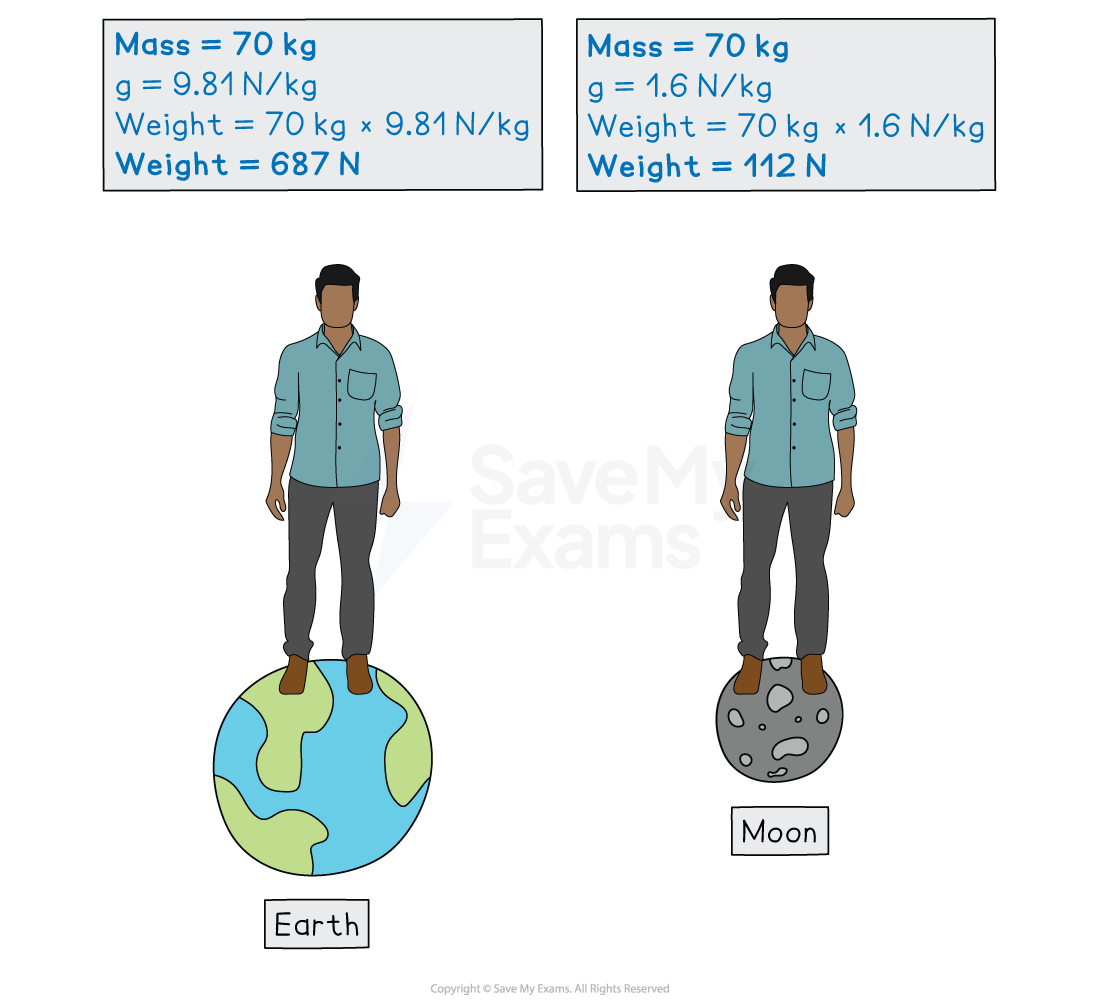
You can find more information about the gravitational field strength on different planets in the revision note Gravitational field strength
Worked Example
NASA's Artemis mission aims to send the first woman astronaut to the Moon. Isabelle hopes to one day become an astronaut. She has a mass of 42 kg.
Compare Isabelle's weight on Earth with her weight on the Moon.
Take the Earth's gravitational field strength as 9.8 N/kg, and the Moon's gravitational field strength as 1.6 N/kg.
[4]
Answer:
Step 1: List the known values
Mass,
Gravitational field strength on Earth,
Gravitational field strength on Moon,
Step 2: State the equation linking weight, mass and gravitational field strength
Step 3: Rearrange to make weight the subject
[1 mark]
Step 4: Calculate the weight force exerted on Isabelle on Earth
[1 mark]
Step 5: Calculate the weight force exerted on Isabelle on the Moon
[1 mark]
Step 6: Compare the two values of weight
The weight force is greater on Earth than on the Moon
This is because the Earth has a larger gravitational field strength than the Moon, so Isabelle's weight force is larger on Earth than on the Moon [1 mark]
Examiner Tips and Tricks
You will be expected to remember that g = 9.8 N/kg and use it in calculations
Using a balance
The weight of two objects can be compared using a balance
Because the gravitational field strength is approximately constant everywhere on Earth, this also allows us to measure the mass of an object

Balances can be digital or analogue
The object being measured is placed on the balance
The reading given is mass in kg or g
Force meters, or newton meters, consist of a spring and hook
The object being measured is hung from the hook
The reading given is weight in N

Unlock more, it's free!
Join the 100,000+ Students that ❤️ Save My Exams
the (exam) results speak for themselves:

Was this revision note helpful?
Build on this topic