Effects of Forces (Cambridge (CIE) IGCSE Physics): Exam Questions

Exam code: 0625 & 0972

3 hours50 questions

Smart practice available on this topic

Answer questions with adaptive difficulty and personalised feedback

Start practising
1
1 mark

Extended tier only

A planet orbits a star at a constant speed in a circular orbit.

Which of the statements below, about the force needed to maintain this motion, is correct?

  • No force is required to maintain this motion.

  • The force acts radially away from the centre of the circle.

  • The force is in the same direction as the planet's motion.

  • The force is directed to the centre of the circular orbit.

2
1 mark

Extended tier only

A car is driving around a circular track at a constant speed.

Which statement describes the motion of the car?

  • The car is accelerating because its speed is changing

  • The car is not accelerating as it is moving at a constant speed

  • The car is accelerating because its velocity is changing

  • The car is not accelerating, but its velocity is changing.

3
1 mark

In which of the following situations would no resultant force be required?

  • A motorbike travelling round a bend at a constant speed.

  • A rocket accelerating straight upwards into space.

  • A ship sailing at a constant speed across the ocean.

  • A Formula One car accelerating off the starting grid.

4
1 mark

Extended tier only

The Moon orbits the Earth at a constant speed.

q3-east-mcq-1-4--forces-cie-igcse-physics

Which of the arrows on the diagram shows the direction of the resultant force on the Moon?

    5
    1 mark

    A car starts from rest and rapidly increases speed.

    There is a forward acting force on the car from the engine, and a backward acting force on the car from air resistance and friction.

    Choose the force diagram and description that best describes the magnitude of the opposing forces.

    1-4-5-e-forces-on-a-car-mcq
      6
      1 mark

       The diagrams show the forces acting on four moving objects. 

      Which object is moving at a constant speed?

      Four diagrams labelled A to D, each showing a box with various upward and downward forces: A has 5N up, 3N down; B has 3N up, 5N down; C has 5N up, 3N and 2N down; D has 5N up, 2N and 3N down.
        7
        1 mark

        Extended Tier Only

        An object on the end of a string moves in a clockwise circular path at constant speed. The diagram shows the object as viewed from above. 

        What is the direction of the resultant force on the object when it is in the position shown?

        Diagram showing an object attached to a string, moving in a circular path. Arrows A, B, C, and D indicate different forces acting on the object.
          8
          1 mark

          The graph shows the load-extension graph for a spring.

          A load-extension graph showing a straight line from the origin that curves at the top. Point P is labelled where the line begins to curve away from the straight section.

          What does point P represent?

          • the maximum load the spring can withstand

          • the limit of proportionality of the spring

          • the maximum extension of the spring

          • the spring constant of the spring

          1
          1 mark

          The diagram shows four objects, each with the same mass. Each object is acted on by the forces shown.

          Which object will experience the largest acceleration to the left?

          q1-medium-mcq-1-4--forces-cie-igcse-physics
            2
            1 mark

            A motorbike travels at a constant speed along a flat road. Three horizontal forces act on the motorbike. Two of them are shown in the diagram below.

            q2-medium-mcq-1-4--forces-cie-igcse-physics

            What is the size and direction of the third force?

            • 2800 N forwards

            • 1200 N backwards

            • 1200 N forwards

            • 2800 N backwards

            3
            1 mark

            An object with three forces acting on it is shown below.

            q3-medium-mcq-1-4--forces-cie-igcse-physics

            What is the resultant force acting on the object?

            • 90 N downwards

            • 110 N upwards

            • 200 N downwards

            • 90 N upwards

            4
            1 mark

            Two students were discussing Newton's first law of motion. 

            Which statement correctly summarises this law?

            • An object will not change its speed or direction unless a resultant force acts upon it 

            • An object will not move unless a resultant force acts upon it

            • An object will not speed up unless a resultant force acts upon it 

            • An object will not change its direction unless a resultant force acts upon it

            5
            1 mark

            Extended tier only

            A car slows down as it approaches a traffic light. The car was traveling at 13.5 m/s and it takes 22 s to come to a stop. 

            The mass of the car is 950 kg.

            Calculate the force required to stop the car.

            • -580 N

            • 580 N

            • 618 N

            • 1548 N

            6
            1 mark

            A student hangs different loads on a spring.

            The diagrams show the lengths of the spring with different loads.

            Three springs hang from a ceiling. The first is unstretched at 3.0 cm. The second stretches to 6.0 cm with a 2.0 N weight. The third stretches to 9.0 cm with a 4.0 N weight.

            Which row gives the correct extensions of the spring?


            extension / cm when the load is 0 N

            extension / cm when the load is 2.0 N

            extension / cm when the load is 4.0 N

            A

            0

            3.0

            3.0

            B

            0

            3.0

            6.0

            C

            3.0

            3.0

            3.0

            D

            3.0

            6.0

            9.0

              7
              1 mark

              Which pieces of apparatus are the most appropriate for an experiment to plot an extension–load graph of a spring?

              • ruler, newton meter, clamp and stand

              •  balance, stop-watch, ruler

              • light gate, ruler, newton meter

              • stop-watch, balance, measuring cylinder

              8
              Sme Calculator
              1 mark

              Four objects are moving.

               Which object has a zero resultant force acting on it?

              • the object moving at a decreasing speed

              • the object moving at an increasing speed

              • the object moving at a constant speed in a circle

              • the object moving at a constant speed in a straight line

              9
              Sme Calculator
              1 mark

              A train is travelling horizontally in a straight line. A book is on a table in the train. The diagram shows all the forces acting on the book.

              diagram1

              How is the train moving?

              • accelerating to the left of the diagram

              • accelerating to the right of the diagram

              • moving at uniform speed to the left of the diagram

              • moving at uniform speed to the right of the diagram

              10
              1 mark

              A skydiver falls before opening her parachute.

              Which graph correctly shows how her speed changes with time?

              Four speed-time graphs labelled A to D. 
Graph A shows a straight line increasing over time from the origin. 
Graph B shows an upward curve starting at the origin with a decreasing gradient. 
Graph C shows a downward curve with speed decreasing over time. 
Graph D shows an upward curve starting at the origin with a decreasing gradient, the curve peaks before sloping downward.
                11
                1 mark

                An aeroplane flies horizontally at constant speed as shown.

                An aeroplane flying horizontally, showing an arrow indicating the direction of travel to the right.

                Which statement about the resultant force on the aeroplane is correct?

                • There is no resultant force on the aeroplane.

                • There is a resultant force on the aeroplane in the direction of travel.

                • There is a resultant force on the aeroplane in the opposite direction to the direction of travel.

                • There is a resultant force on the aeroplane vertically downwards.

                12
                1 mark

                An aeroplane flies horizontally at constant speed as shown.

                An aeroplane flying horizontally, showing an arrow indicating the direction of travel to the right.

                Which statement about the resultant force on the aeroplane is correct?

                • There is no resultant force on the aeroplane.

                • There is a resultant force on the aeroplane in the direction of travel.

                • There is a resultant force on the aeroplane in the opposite direction to the direction of travel.

                • There is a resultant force on the aeroplane vertically downwards.

                13
                1 mark

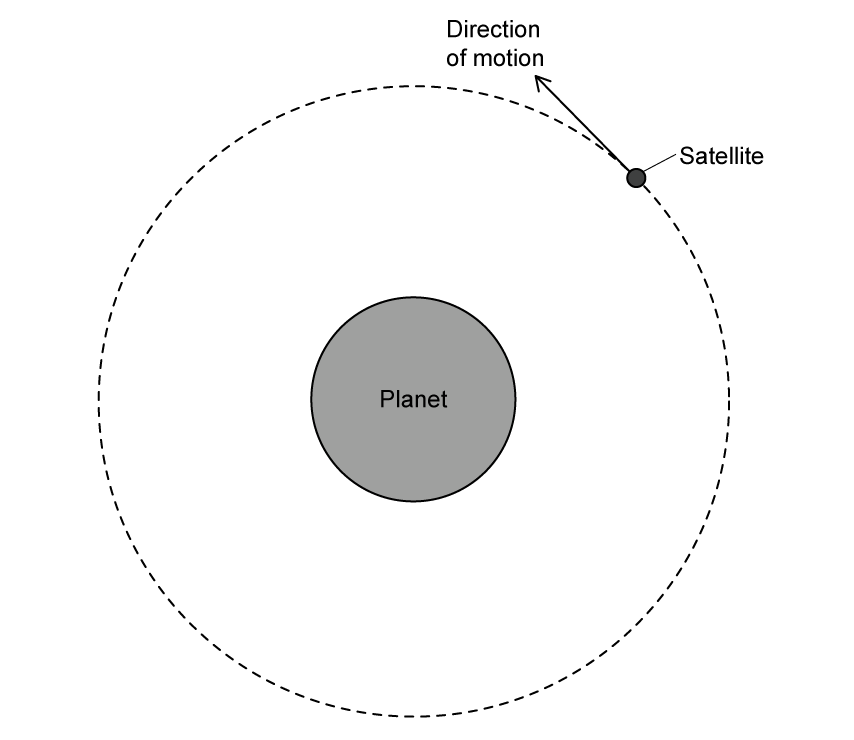
                A satellite orbits a planet in a circular path at constant speed.

                A planet shown at the centre. A satellite is shown at a point on a circular dashed orbit around the planet. An arrow shows the direction of motion of the satellite (tangent to the orbit).

                Which statement about the resultant force is correct?

                • No force acts because speed is constant.

                • The force is in the direction of motion.

                • The force is directed towards the centre of the orbit.

                • The force is directed away from the planet.

                1
                1 mark

                Extended tier only

                A skydiver is falling at terminal velocity. He has not yet opened his parachute.

                He opens his parachute.

                What is the direction of both the velocity of the skydiver, and his acceleration?


                Direction of the skydiver’s velocity

                Direction of the skydiver’s acceleration

                A

                upwards

                upwards

                B

                upwards

                downwards

                C

                downwards

                upwards

                D

                downwards

                downwards

                  2
                  1 mark

                  Extended tier only

                  A bus drives along a flat road. Its engine produces a forward driving force of 7000 N. Drag forces, D also act on the bus.

                  The bus has an acceleration of 1.2 m/s2 and a mass of 2500 kg.

                  q2-hard-mcq-1-4--forces-cie-igcse-physics

                  What is the value of D?

                  • 3000 N

                  • 4000 N

                  • 4500 N

                  • 5000 N

                  3
                  1 mark

                  The diagram shows four objects, each with a different mass. Each object is acted on by the forces shown.

                  Which object will experience the largest magnitude of acceleration?

                  I3zDzyPN_q3-hard-mcq-1-4--forces-cie-igcse-physics
                    4
                    1 mark

                    The graph below shows the journey of a truck along a straight, flat road.

                    q4-hard-mcq-1-4--forces-cie-igcse-physics

                    During which part of the journey is the resultant force on the truck equal to zero?

                      5
                      1 mark

                      A car is driving on a motorway at a constant speed of 70 miles per hour. 

                      The driver notices a queue of traffic up ahead and begins to slow down. 

                      Which diagram best describes the resultant force acting on the car as it slows down?

                      1-4-5-h-resultant-force-on-car-mcq
                        6
                        Sme Calculator
                        1 mark

                        On the Earth, a spring stretches by 5.0 cm when a mass of 3.0 kg is suspended from one end.

                         The gravitational field strength on the Moon is 1 over 6 of that on the Earth.

                        Which mass, on the Moon, would stretch the spring by the same extension?

                        • 0.50 kg

                        • 3.0 kg

                        • 5.0 kg

                        • 18 kg