Literacy Statistics 2026: Insights from 2,000+ UK Students

Written by: Emma Dow
Reviewed by: Holly Barrow
Published
Contents
- 1. Key Takeaways: Top Literacy Statistics
- 2. Literacy Levels Among UK Students (Primary Data)
- 3. The State of Literacy in the UK
- 4. The Teenage Reading Decline
- 5. Digital vs Traditional Literacy
- 6. Inequality in Literacy Outcomes
- 7. The Future of Literacy in Education
- 8. Appendix: Full List of Literacy Statistics
- 9. References
Save My Exams surveyed 2,303 UK students aged 14–18 - a mix of learners from across all four UK nations - to find out how literacy is really affecting their studies.
We asked about reading habits, exam confidence, vocabulary challenges, digital content, and access to support.
We then combined those original findings with the latest data from organisations including the National Literacy Trust, the Department for Education, and the OECD, to build a complete picture of teen literacy in the UK in 2026.
Key Takeaways: Top Literacy Statistics
Only 1 in 3 students (33%) read for pleasure regularly - at least a few times a week.
Nearly 1 in 3 (31%) barely read at all outside school, saying they read either rarely or never.
57% of students say reading speed has sometimes, often, or always affected their ability to finish exam papers on time.
Nearly half (49%) say their literacy skills affect their confidence going into exams.
39% of students have felt their reading or writing ability has held them back academically.
62% encounter unfamiliar vocabulary in their subjects at least sometimes.
More than 1 in 3 students (37%) wouldn't know where to go if they needed literacy support.
Literacy Levels Among UK Students (Primary Data)
Who We Surveyed: Student Demographics
Our survey captured responses from 2,303 UK-based students. Here's how the sample broke down:
Level of study:
50% GCSE
35% A Level
13% IGCSE
1% IB
Gender:
57% female
40% male
2% prefer not to say
1% non-binary or gender diverse
Region:
Students were based across all four UK nations, with England accounting for the majority of respondents
Reading Frequency & Habits
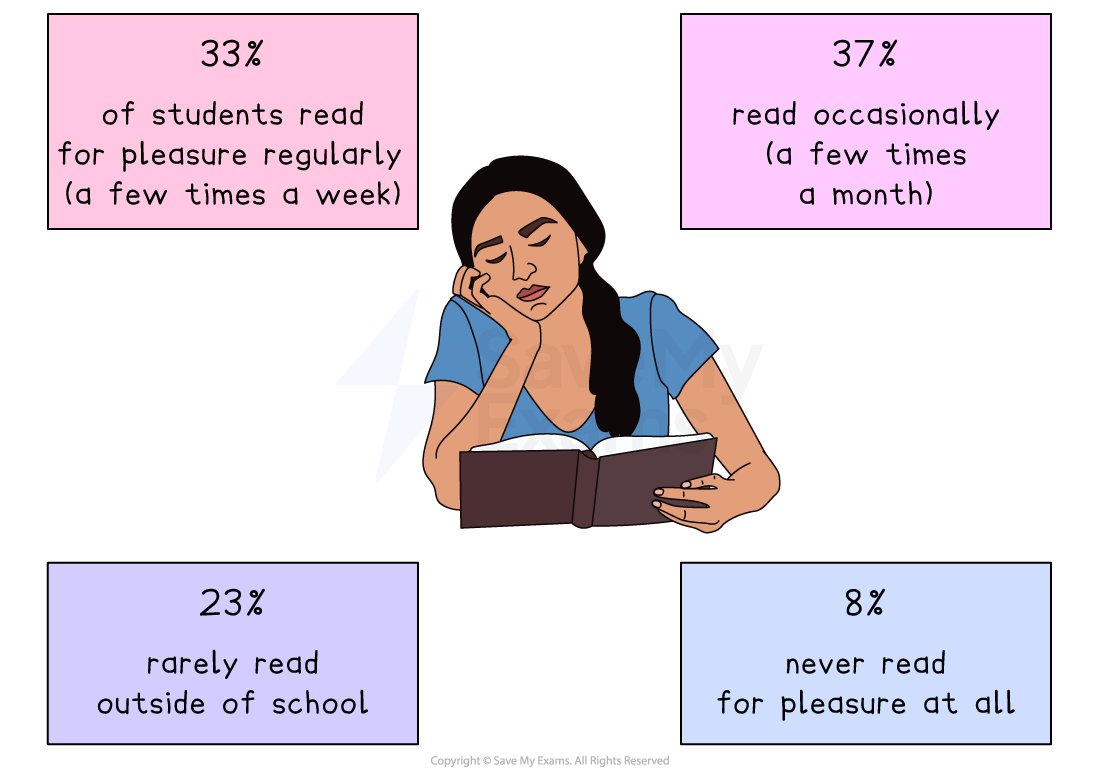
Reading for pleasure outside of school is far from universal among secondary school students, and for a significant minority, it's almost non-existent.
33% of students read for pleasure regularly (at least a few times a week).
37% read occasionally - a few times a month.
23% rarely read outside of school.
8% never read for pleasure at all.
Combined, nearly 1 in 3 students (31%) read either rarely or never outside of school.
The gender gap is notable too. Female students are significantly more likely to read regularly than their male peers:
38% of female students read for pleasure regularly.
Just 24% of male students say the same - a gap of 14 percentage points.
This mirrors national data showing that girls consistently outpace boys in reading frequency (45% vs 54%) (National Literacy Trust).
Impact of Literacy Skills on Exams & Academic Performance
Literacy isn't just about enjoying books. It affects how students perform under timed, pressured conditions.
57% of students say reading speed has sometimes, often, or always affected their ability to finish exam papers on time.
32% say it happens often or always, meaning roughly 1 in 3 students are regularly losing time (and marks) because of reading speed alone.
Nearly half of all respondents (49%) agree that their literacy skills affect their confidence going into exams.
39% have felt their reading or writing ability has held them back academically at some point, including 9% who say it has held them back significantly.
A student who struggles to read quickly and confidently can lose exam marks and confidence.
Reading Formats & Preferences
When it comes to revision and study, digital resources were the top choice.
43% of students prefer digital materials (websites, PDFs, e-books, apps) when studying or revising.
33% prefer print (textbooks, revision guides, printed notes).
22% have no preference.
Just 2% said they don't read for revision at all.
Vocabulary & Subject-Specific Challenges
Academic vocabulary is a barrier across the curriculum.
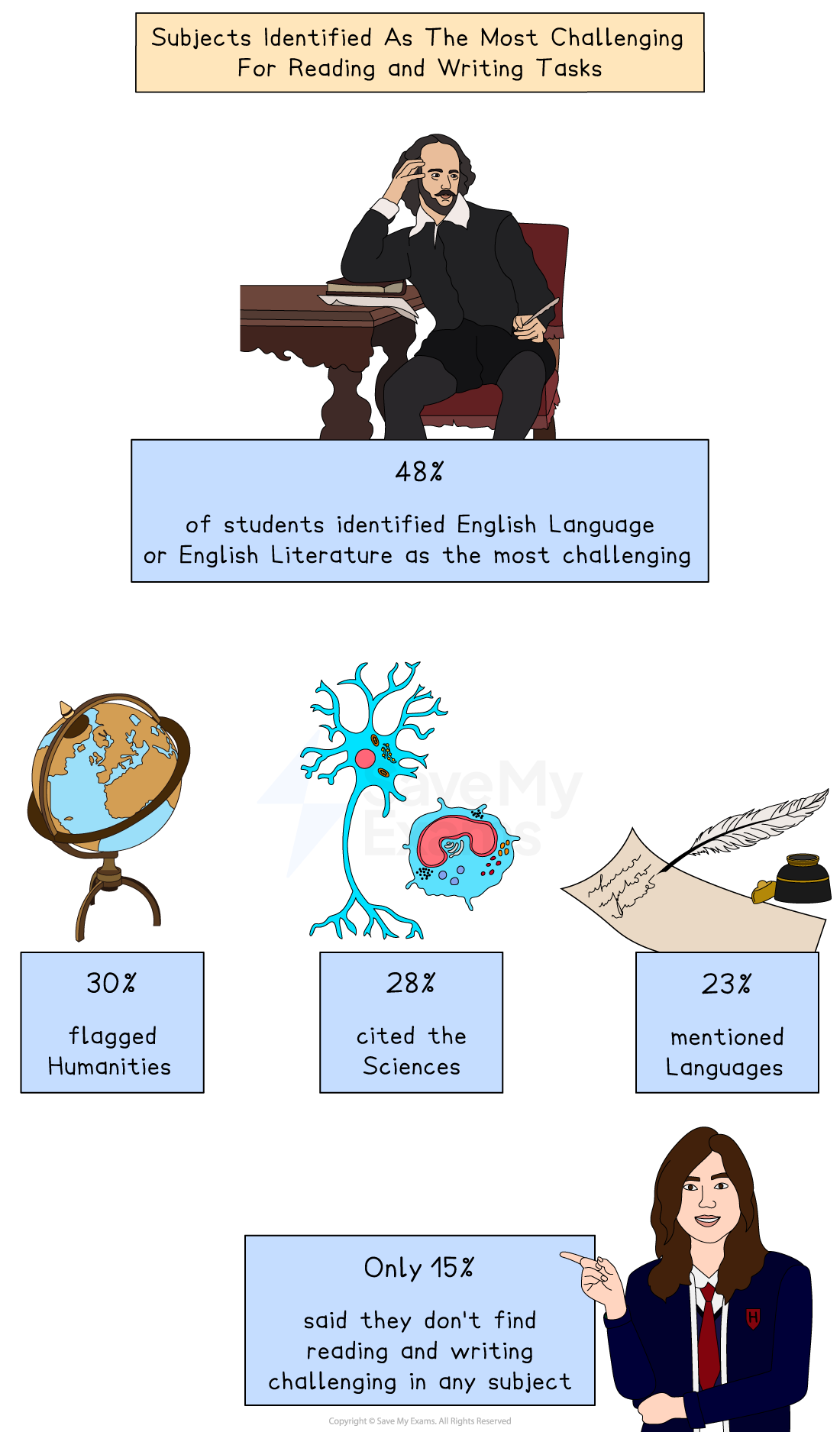
When we asked students which subjects they find reading and writing tasks most challenging, English Language and English Literature came out on top by a significant margin.
48% of students identified English Language or English Literature as the most challenging subject for reading and writing tasks.
30% flagged Humanities (History, Geography, Religious Studies).
28% cited the Sciences (Biology, Chemistry, Physics).
23% mentioned Languages (French, Spanish, etc.).
Only 15% said they don't find reading and writing challenging in any subject.
Vocabulary is a big part of the problem. When asked how often they encounter vocabulary or terminology in their subjects that they don't fully understand:
40% said sometimes.
17% said often (most weeks).
5% said very often (almost every lesson).
In total, 62% of students encounter unfamiliar vocabulary at least sometimes.
Impact of Digital Content on Literacy
Students are aware that how they communicate online isn't the same as how they're expected to write academically. But awareness doesn't always translate into easy switching.
63% of students said that the way they write in everyday life (texts, social media, DMs) has influenced how they write in a formal or academic context.
Of those, 52% said they can switch between the two styles easily.
But 12% said they actively find it harder to write formally because of how they communicate online.
Just 31% said they keep the two styles completely separate.
Access to Literacy Support
Perhaps the most actionable finding in this entire survey is the gap between students who might need literacy support and those who know how to access it.
45% of students said they'd know where to go for support, but haven't needed it.
16% said they have used literacy support before.
24% said they're not sure where they'd go.
14% said they wouldn't know at all.
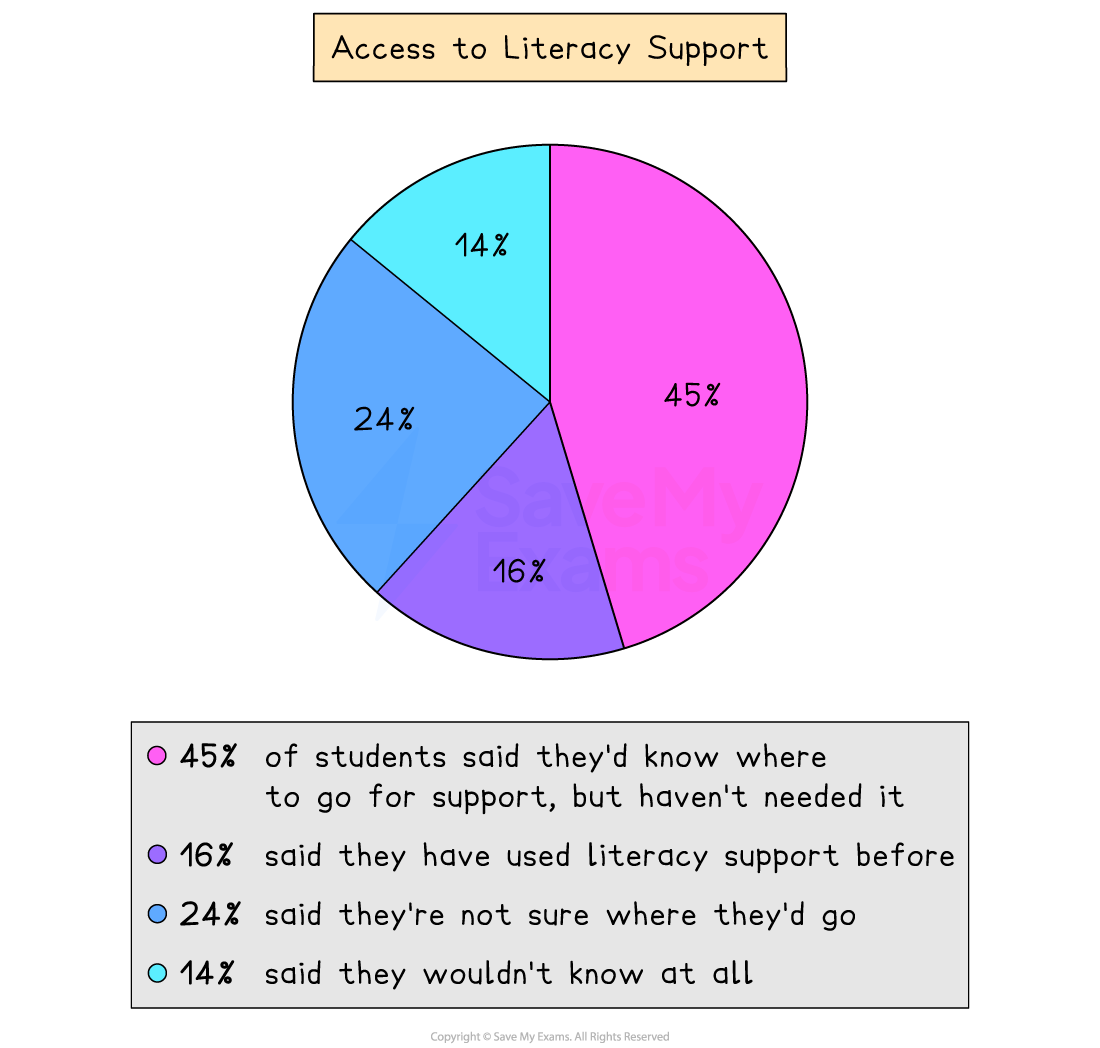
That means more than a third of students (38%) either don't know or aren't sure where to turn if they struggle with reading or writing.
For a skill as fundamental as literacy - one that affects performance in every subject - that's a significant gap.
The State of Literacy in the UK
National Literacy Rates
The UK's headline literacy rate sits at 99%, which sounds impressive (World Literacy Foundation). But that figure only measures the most basic ability to read and write.
The more meaningful measure is functional literacy. This is the ability to read and write confidently enough to access education, employment, and everyday life.
By that standard, the picture looks very different:
18% of Britons aged 16–65 can have low literacy proficiency (OECD).
Poor literacy costs the UK economy an estimated £40 billion per year (Big Issue).
57% of prisoners in the UK have literacy skills no higher than those expected of an 11-year-old (HM Inspectorate of Prisons).
Today's secondary school students are tomorrow's adults, and the habits, skills, and confidence they build now will shape those numbers in the years ahead.
UK vs Global Literacy Trends
The UK's position globally is solid, but there are some concerning statistics:
Around 1 in 4 children (24% in England, 25% in Northern Ireland) reported that they did not enjoy reading compared with 1 in 5 globally (National Literacy Trust).
Across OECD countries, literacy scores have largely stagnated or declined in the past decade, despite more people completing secondary education and earning degrees (OECD Newsroom).
Only 14% of adults in England scored at the highest literacy proficiency levels in the OECD's 2023 Survey of Adult Skills, slightly above the international average of 13% (OECD).
The Teenage Reading Decline
Daily Reading Rates Over Time
The long-term decline in teen reading is one of the most consistent trends in UK education research.
In 2005, roughly 2 in 5 children and young people aged 8–18 read daily in their free time. By 2025, that figure had fallen to fewer than 1 in 5 (19%) - a drop of nearly 20 percentage points in two decades (National Literacy Trust).
A quarter of primary school leavers haven’t reached the expected level of reading - this means many of them will struggle to keep up at secondary school (The Reading Agency).
By the age of 14, only 1 in 5 (19%) boys say they enjoy reading, compared with 2 in 5 (38%) girls (National Literacy Trust - Teenage Reading).
Our survey data fits this national picture, with 31% of students reading rarely or never, and only a third reading regularly (Save My Exams Survey, 2026).
Why Students Are Reading Less
There are a number of reasons why students might be reading less:
Libraries have closed in recent years, with the percentage of UK secondary schools having a library falling from 96% to 86% from 2019 and 2023 (Shout Out UK).
The government is concerned that parents reading less may have an impact on their children’s reading habits, so they have launched 2026 as the National Year of Reading to try and boost parental involvement in reading (gov.uk (opens in a new tab)).
There was a 4% decrease in the number of books children were reading between 2022 and 2023 (Renaissance UK).
For secondary school students specifically, it’s important to remember that many things compete with reading, such as:
Screen-based entertainment
The pull of social media
Coursework and revision
Digital vs Traditional Literacy
Rise of Digital Reading
In the United States, in the early 1990s, around 1 in 3 tenth-graders read a newspaper almost every day. Fast forward to 2016, and that number had collapsed to just 1 in 50 (American Psychological Association).
22% of 8-18-year-olds reported reading fiction digitally, increasing to 29% for 16-18-year-olds (National Literacy Trust Blog).
Short-Form Content & Attention Spans
Social media, messaging apps, and short-form video platforms train users to expect quick, bite-sized content.
Our data shows that 63% of students believe online communication has influenced how they write formally or academically and 12% said it has actively made formal writing harder (Save My Exams Survey, 2026).
The fact that the majority can code-switch between styles is reassuring. But for a meaningful minority - just over 1 in 10 - the boundary between informal and academic language has become blurred.
Inequality in Literacy Outcomes
Differences in Confidence & Attainment
Literacy doesn't affect all students equally. Gaps tied to gender, socioeconomic background, and geography are persistent — and in some cases widening.
Among pupils eligible for Free School Meals (FSM), 31% stated that they enjoyed reading, compared to 33% for non-FSM pupils (National Literacy Trust).
83% of Pupil Premium strategy statements connect literacy attainment challenges to achievement struggles (Education Endowment Fund).
Early intervention, parental involvement, access to resources, and teacher training have been suggested as tools to close the literacy attainment gap (Bookmark Reading Charity).
Access to Support & Resources
More than 1 in 3 students (37%) in our survey said they either wouldn't know or weren't sure where to go for literacy support (Save My Exams, 2026).
1 in 10 children and young people aged 5–18 said they had no book of their own at home in 2024 (National Literacy Trust).
Wales had the lowest daily reading rate of any UK nation at just 12.5% in 2025 (National Literacy Trust).
Impact on Academic Progression
Poor literacy in secondary school affects exam grades and can have long-term consequences that follow students into adult life.
In 2025, 25% of primary school pupils did not meet the expected standard in reading at KS2 (Department for Education, 2025).
Adult workers with poor literacy earn an average of 60% less than their peers with basic literacy (Adult Literacy Trust).
The Future of Literacy in Education
Reading habits are falling, confidence gaps are widening, and too many students are sitting exams without the skills they need to show what they actually know. However, the right support can make a real difference.
That's where Save My Exams comes in.
We know that behind every set of results is a real student - someone who's working hard, trying their best, and deserving of every tool available to help them succeed.
Whether you're struggling to get through a long exam paper, finding it hard to decode subject-specific language, or just looking to feel more confident in your written answers, our resources support every student.
Literacy is about understanding, confidence, and life chances, as much as it’s about reading. Regardless of background, school, or starting point, every young person deserves a fair shot at the grades they’ve worked so hard for.
Appendix: Full List of Literacy Statistics
Here's every statistic referenced in this article, in one place.
33% of students read for pleasure regularly (at least a few times a week) (Save My Exams Survey, 2026)
37% read for pleasure occasionally (a few times a month) (Save My Exams Survey, 2026)
23% rarely read for pleasure outside of school (Save My Exams Survey, 2026)
8% never read for pleasure at all (Save My Exams Survey, 2026)
31% of students read either rarely or never outside of school (Save My Exams Survey, 2026)
38% of female students read regularly, compared to 24% of male students (Save My Exams Survey, 2026)
34% of students spend 15–30 minutes reading per day outside of schoolwork (Save My Exams Survey, 2026)
34% of students spend less than 15 minutes reading per day, or don't read at all outside school (Save My Exams Survey, 2026)
43% of students prefer digital materials when revising; 33.0% prefer print (Save My Exams Survey, 2026)
48% of students find English Language or English Literature the most challenging subject for reading and writing (Save My Exams Survey, 2026)
30% find Humanities (History, Geography, Religious Studies) most challenging (Save My Exams Survey, 2026)
28% find the Sciences (Biology, Chemistry, Physics) most challenging (Save My Exams Survey, 2026)
23% find Languages (French, Spanish, etc.) most challenging (Save My Exams Survey, 2026)
15% say they don't find reading and writing challenging in any subject (Save My Exams Survey, 2026)
57% say reading speed has sometimes, often, or always affected their ability to finish exam papers on time (Save My Exams Survey, 2026)
32% say it happens often or always (Save My Exams Survey, 2026)
49% agree (strongly or somewhat) that their literacy skills affect their confidence going into exams (Save My Exams Survey, 2026)
39% have felt their reading or writing ability has held them back academically (Save My Exams Survey, 2026)
9% say it has held them back significantly (Save My Exams Survey, 2026)
62% encounter unfamiliar vocabulary in their subjects at least sometimes (Save My Exams Survey, 2026)
21% encounter unfamiliar vocabulary often or very often (Save My Exams Survey, 2026)
63% say online communication has influenced how they write in a formal or academic context (Save My Exams Survey, 2026)
52% say they can switch between informal and formal writing styles easily (Save My Exams Survey, 2026)
12% say online habits have made formal writing harder (Save My Exams Survey, 2026)
37% would not know or are unsure where to go for literacy support (Save My Exams Survey, 2026)
16% have used literacy support before (Save My Exams Survey, 2026)
45% would know where to go but haven't needed support (Save My Exams Survey, 2026)
National data shows that girls consistently outpace boys in reading frequency (45% vs 54%) (National Literacy Trust)
The UK's headline literacy rate sits at 99% (World Literacy Foundation)
18% of Britons aged 16–65 can have low literacy proficiency (OECD)
Poor literacy costs the UK economy an estimated £40 billion per year (Big Issue)
57% of prisoners in the UK have literacy skills no higher than those expected of an 11-year-old (HM Inspectorate of Prisons)
Around 1 in 4 children (24% in England, 25% in Northern Ireland) reported not enjoying reading compared with 1 in 5 globally (National Literacy Trust)
Across OECD countries, literacy scores have largely stagnated or declined in the past decade, despite more people completing secondary education and earning degrees (OECD Newsroom)
Only 14% of adults in England scored at the highest literacy proficiency levels in the OECD's 2023 Survey of Adult Skills, slightly above the international average of 13% (OECD)
In 2005, roughly 2 in 5 children and young people aged 8–18 read daily in their free time. By 2025, that figure had fallen to fewer than 1 in 5 (19%) - a drop of nearly 20 percentage points in two decades (National Literacy Trust)
A quarter of primary school leavers haven’t reached the expected level of reading - this means many of them will struggle to keep up at secondary school (The Reading Agency)
By the age of 14, only 1 in 5 (19%) boys say they enjoy reading, compared with 2 in 5 (38%) girls (National Literacy Trust - Teenage Reading)
Libraries have closed in recent years, with the percentage of UK secondary schools having a library falling from 96% to 86% from 2019 and 2023 (Shout Out UK)
The government is concerned that parents reading less may have an impact on their children’s reading habits, so they have launched 2026 as the National Year of Reading to try and boost parental involvement in reading (gov.uk (opens in a new tab))
There was a 4% decrease in the number of books children were reading between 2022 and 2023 (Renaissance UK)
In the United States, in the early 1990s, around 1 in 3 tenth-graders read a newspaper almost every day. Fast forward to 2016, and that number had collapsed to just 1 in 50 (American Psychological Association)
22% of 8-18-year-olds reported reading fiction digitally, increasing to 29% for 16-18-year-olds (National Literacy Trust Blog)
Among pupils eligible for Free School Meals (FSM), 31% stated that they enjoyed reading, compared to 33% for non-FSM pupils (National Literacy Trust)
83% of Pupil Premium strategy statements connect literacy attainment challenges to achievement struggles (Education Endowment Fund)
Early intervention, parental involvement, access to resources, and teacher training have been suggested as tools to close the literacy attainment gap (Bookmark Reading Charity)
1 in 10 children and young people aged 5–18 said they had no book of their own at home in 2024 (National Literacy Trust)
Wales had the lowest daily reading rate of any UK nation at just 12.5% in 2025 (National Literacy Trust)
In 2025, 25% of primary school pupils did not meet the expected standard in reading at KS2 (Department for Education, 2025)
Adult workers with poor literacy earn an average of 60% less than their peers with basic literacy (Adult Literacy Trust)
References
Primary Research
Save My Exams Student Literacy Survey (2026) - 2,303 UK students
Secondary Research
National Literacy Trust (opens in a new tab)
World Literacy Foundation (opens in a new tab)
OECD (opens in a new tab)
Big Issue (opens in a new tab)
HM Inspectorate of Prisons (opens in a new tab)
National Literacy Trust - Young People’s Reading (opens in a new tab)
OECD Newsroom (opens in a new tab)
Reading Agency (opens in a new tab)
National Literacy Trust - Teenage Reading (opens in a new tab)
Shout Out UK (opens in a new tab)
gov.uk (opens in a new tab)
Renaissance UK (opens in a new tab)
American Psychological Association (opens in a new tab)
National Literacy Trust Blog (opens in a new tab)
Education Endowment Fund (opens in a new tab)
Bookmark Reading Charity (opens in a new tab)
National Literacy Trust - Book Ownership (opens in a new tab)
Department of Education (opens in a new tab)
Adult Literacy Trust (opens in a new tab)
Was this article helpful?
Sign up for articles sent directly to your inbox
Receive news, articles and guides directly from our team of experts.

Share this article





 written revision resources that improve your