11 mark
What are the rectangular coordinates of the point with polar coordinates ?
Was this exam question helpful?
What are the rectangular coordinates of the point with polar coordinates ?
Was this exam question helpful?
What are the real part and the imaginary part of the complex number ?
Real: , Imaginary:
Real: , Imaginary:
Real: , Imaginary:
Real: , Imaginary:
Was this exam question helpful?
The polar function is given by . What is the average rate of change of with respect to on the interval ?
Was this exam question helpful?
The table gives values for the polar function at selected values of . Assume that between any two consecutive values of listed in the table, is either always increasing or always decreasing.
Based on the table, at which value of does the graph of have a point that is relatively closest to the origin?
Was this exam question helpful?
What are the rectangular coordinates of the point with polar coordinates ?
Was this exam question helpful?
A complex number is given by and is represented by a point in the complex plane. What is the distance between this point and the origin?
Was this exam question helpful?
The table gives values for a polar function at selected values of .
What is the average rate of change of with respect to on the interval ?
Was this exam question helpful?
Which of the following polar equations represents a circle of radius centered at the origin?
Was this exam question helpful?
The polar function has values and . Use the average rate of change of on the interval to estimate the value of .
Was this exam question helpful?
A complex number is represented by a point in the complex plane. The complex number has the rectangular coordinates . Which of the following is one way to express the complex number using its polar coordinates ?
Was this exam question helpful?
The figure shows the graph of the polar function , where , in the polar coordinate system for . There are five points labeled , , , , and . If the domain of is restricted to , the portion of the given graph that remains consists of two pieces. One of those pieces is the portion of the graph in Quadrant I from through and back to . Which of the following describes the other remaining piece?
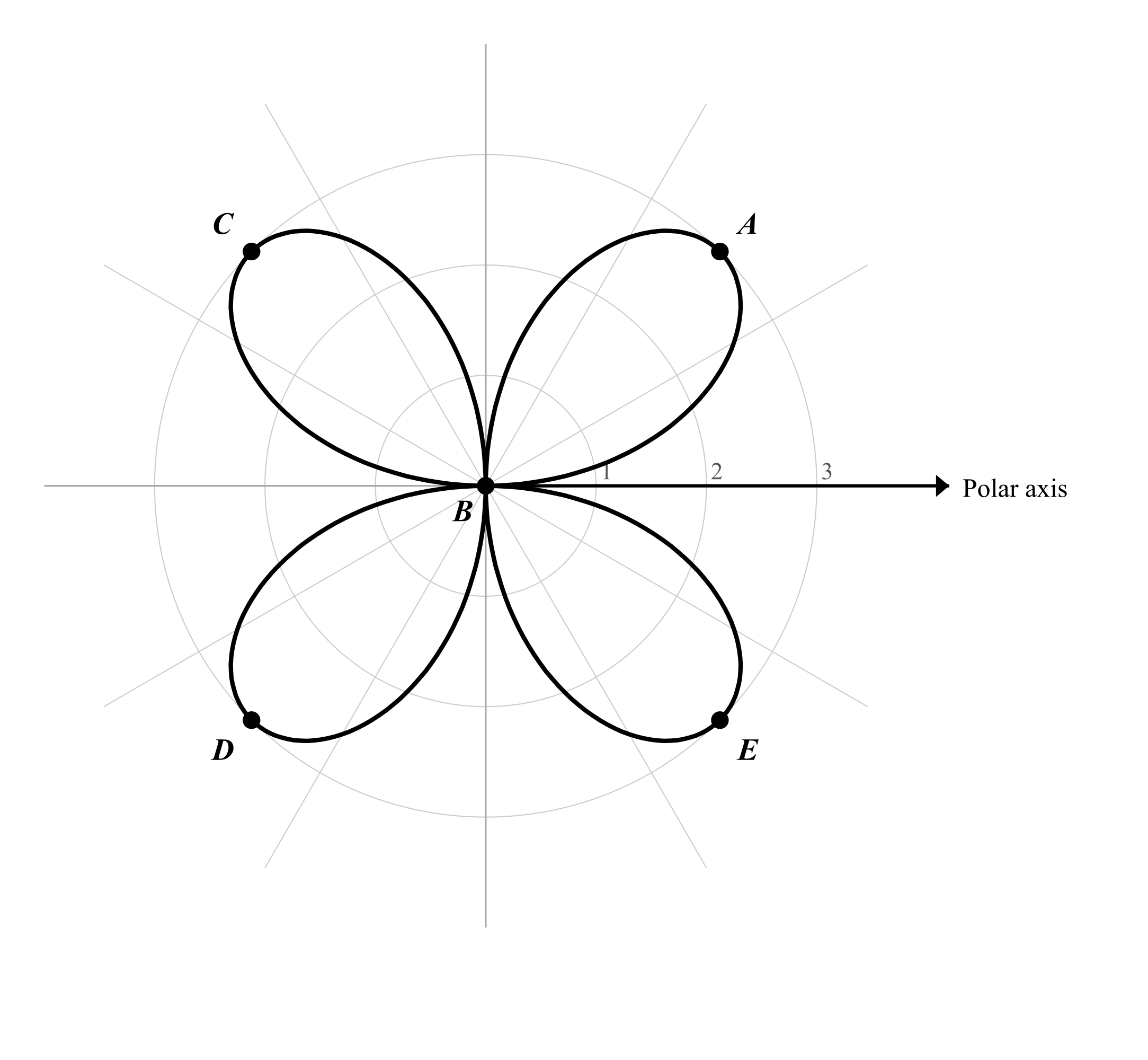
The portion of the graph in Quadrant II from through and back to
The portion of the graph in Quadrant III from through and back to
The portion of the graph in Quadrant IV from through and back to
The portions of the graph in Quadrants II and III from through and back to , and from through and back to
Was this exam question helpful?
Consider the graph of the polar function , where , in the polar coordinate system for . Which of the following statements is true about the distance between the point with polar coordinates and the origin?
The distance is decreasing for , because is negative and increasing on the interval.
The distance is increasing for , because is negative and decreasing on the interval.
The distance is decreasing for , because is positive and decreasing on the interval.
The distance is decreasing for , because is negative and decreasing on the interval.
Was this exam question helpful?
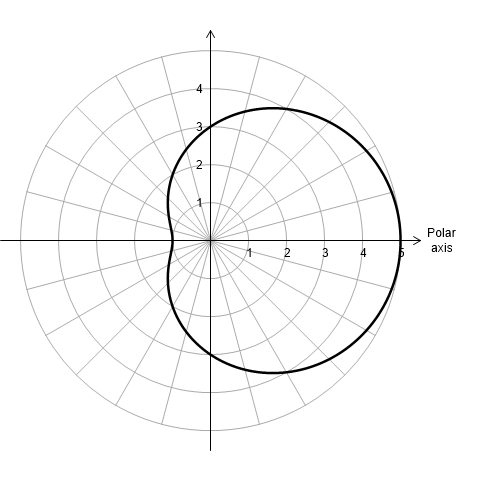
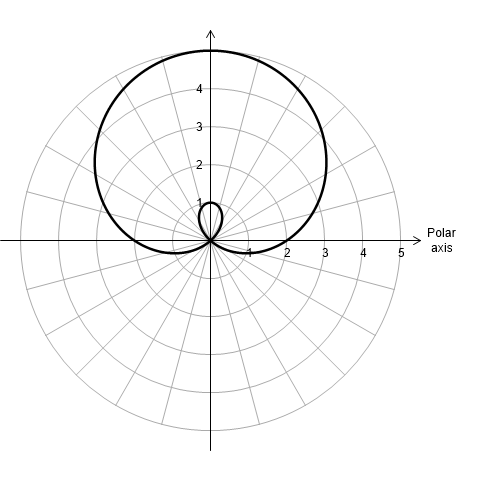
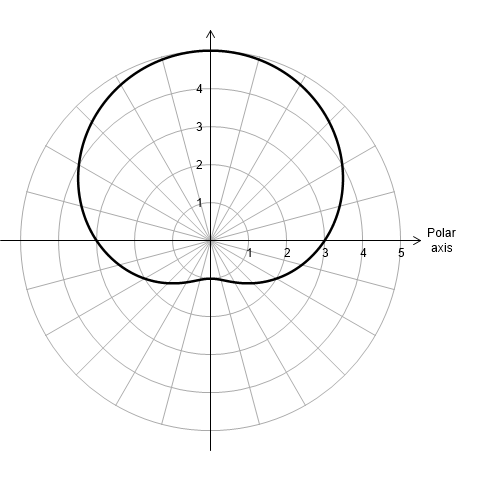
Which of the following could be the graph of the polar curve with equation in the polar coordinate plane?
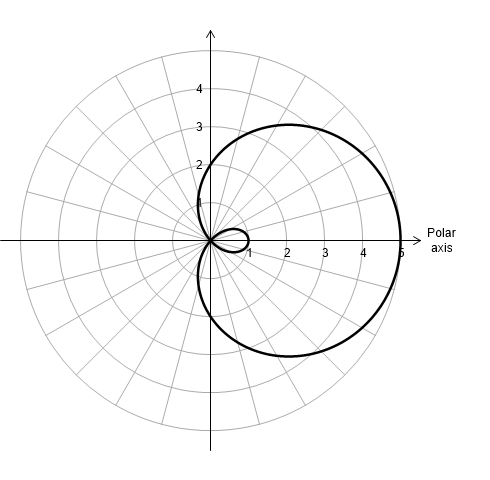
Was this exam question helpful?
A polar function is given by . As increases over the interval , which of the following describes the behavior of the distance from the pole and the position of the corresponding points relative to the polar axis?
The distance from the pole decreases, and the corresponding points are above the polar axis.
The distance from the pole decreases, and the corresponding points are below the polar axis.
The distance from the pole increases, and the corresponding points are above the polar axis.
The distance from the pole increases, and the corresponding points are below the polar axis.
Was this exam question helpful?
A complex number is represented by a point in the complex plane. The complex number has the rectangular coordinates . Which of the following is one way to express the complex number using its polar coordinates ?
Was this exam question helpful?
A point has polar coordinates . Which of the following is also a polar representation of ?
Was this exam question helpful?
A complex number is given in polar form by . What is the rectangular form of ?
Was this exam question helpful?
The polar function is given by . Which of the following is true about the graph of on the interval ?
The minimum distance from the origin is , and the maximum distance from the origin is .
The minimum distance from the origin is , and the maximum distance from the origin is .
The minimum distance from the origin is , and the maximum distance from the origin is .
The minimum distance from the origin is , and the maximum distance from the origin is .
Was this exam question helpful?
The figure shows the graph of a polar function in the polar coordinate system for .
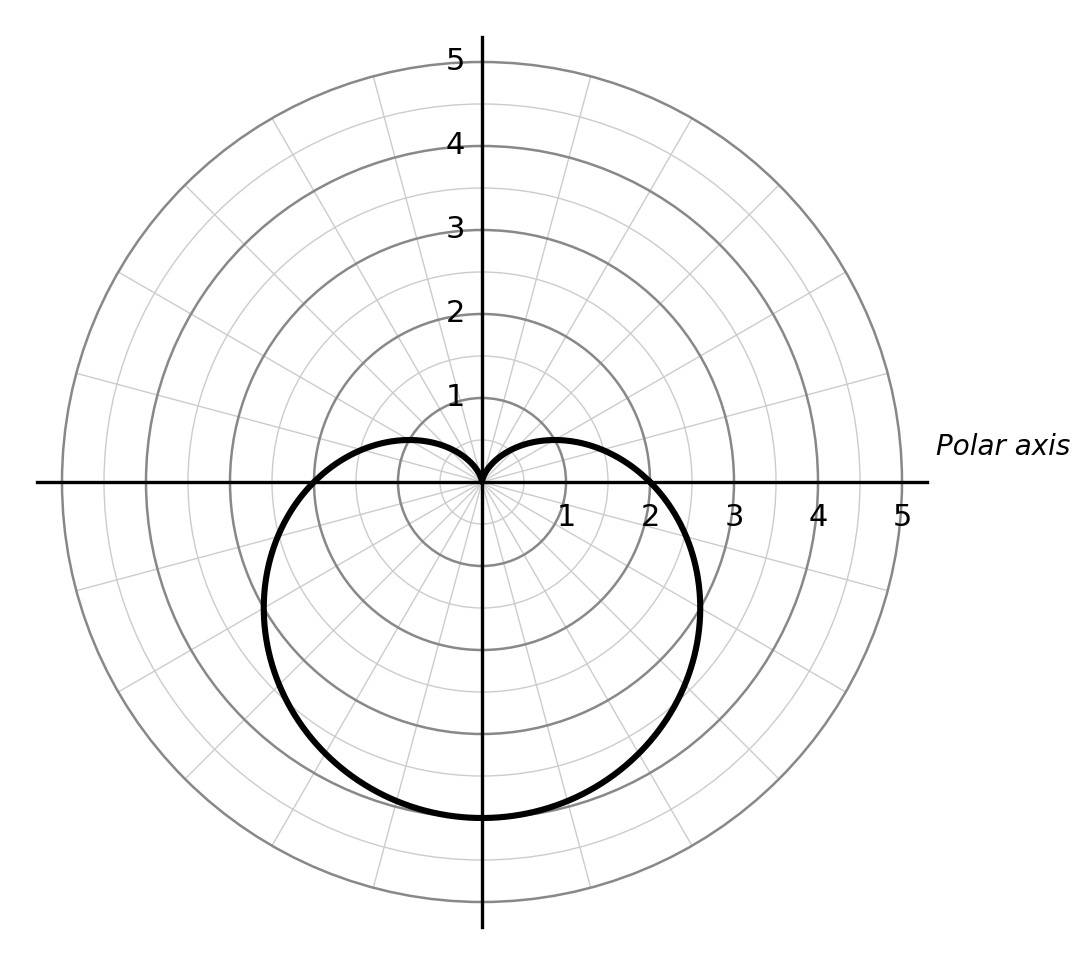
Which of the following could be an expression for ?
Was this exam question helpful?
The figure shows the graph of , where , in the polar coordinate system for .
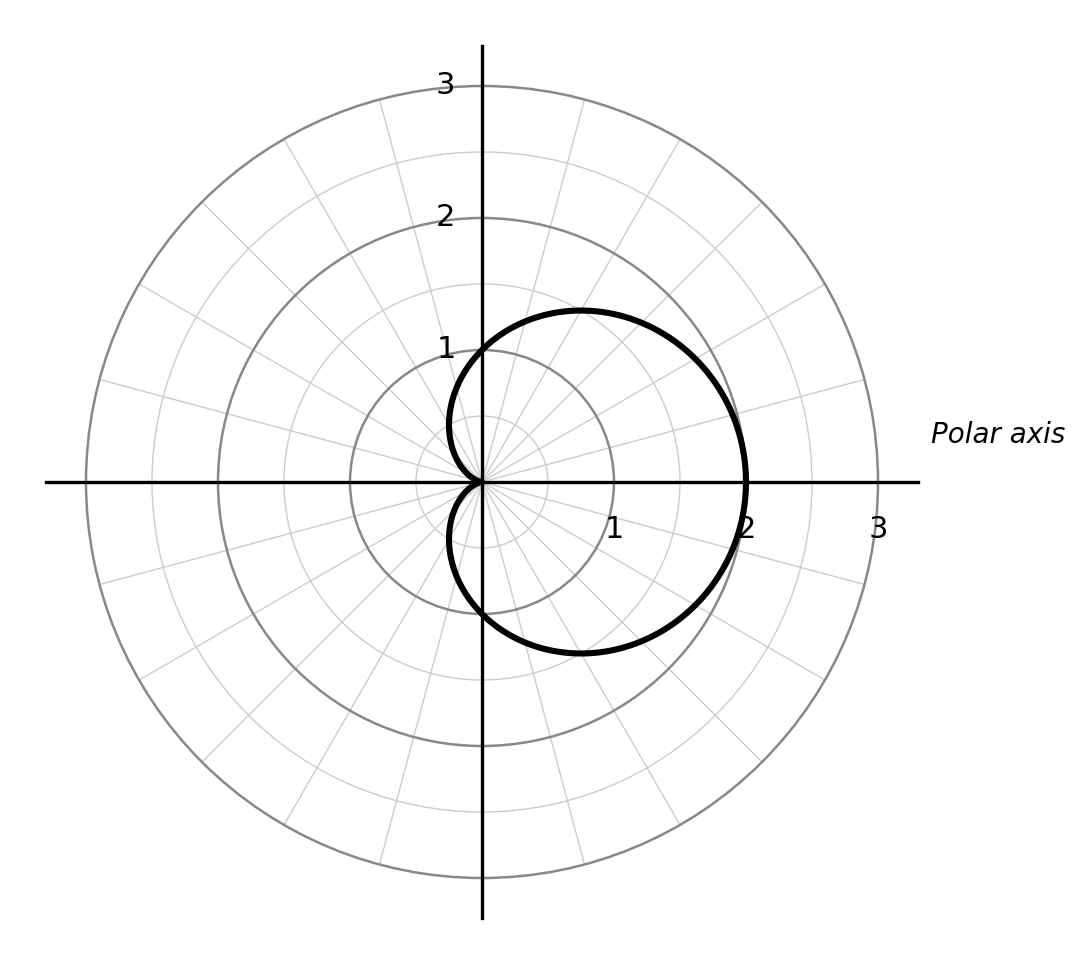
On which of the following intervals does the graph appear in Quadrant IV?
Was this exam question helpful?
The figure shows the graph of , where , in the polar coordinate system for .
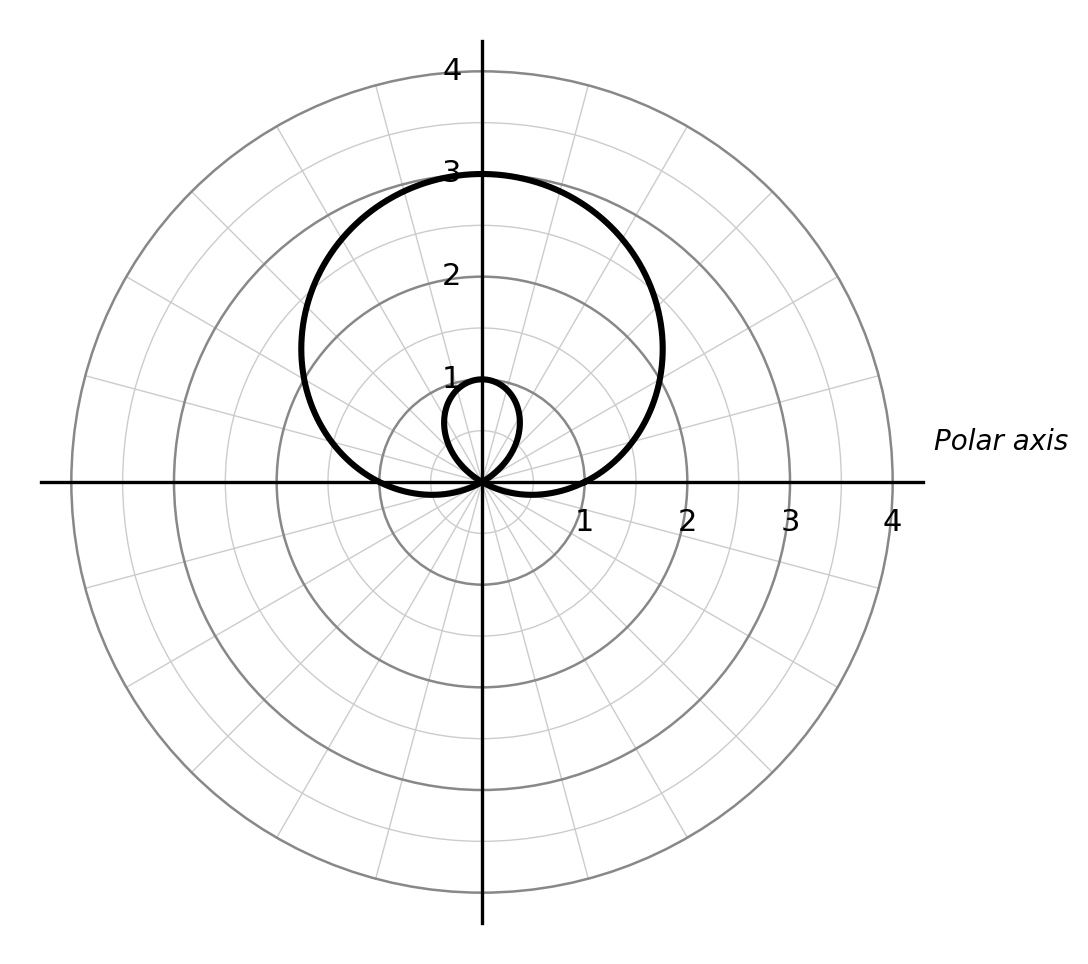
Which of the following statements is true about the distance between the point with polar coordinates and the origin?
The distance is increasing for , because is positive and increasing on the interval.
The distance is increasing for , because is positive and increasing on the interval.
The distance is decreasing for , because is negative and decreasing on the interval.
The distance is decreasing for , because is positive and decreasing on the interval.
Was this exam question helpful?
The polar function is given by for . At which value of does the graph of have a point that is relatively closest to the origin?
Was this exam question helpful?
A point has polar coordinates . What are the rectangular coordinates of ?
Was this exam question helpful?
A complex number is represented by a point in the complex plane. The complex number has the rectangular coordinates . Which of the following is one way to express the complex number using its polar coordinates ?
Was this exam question helpful?
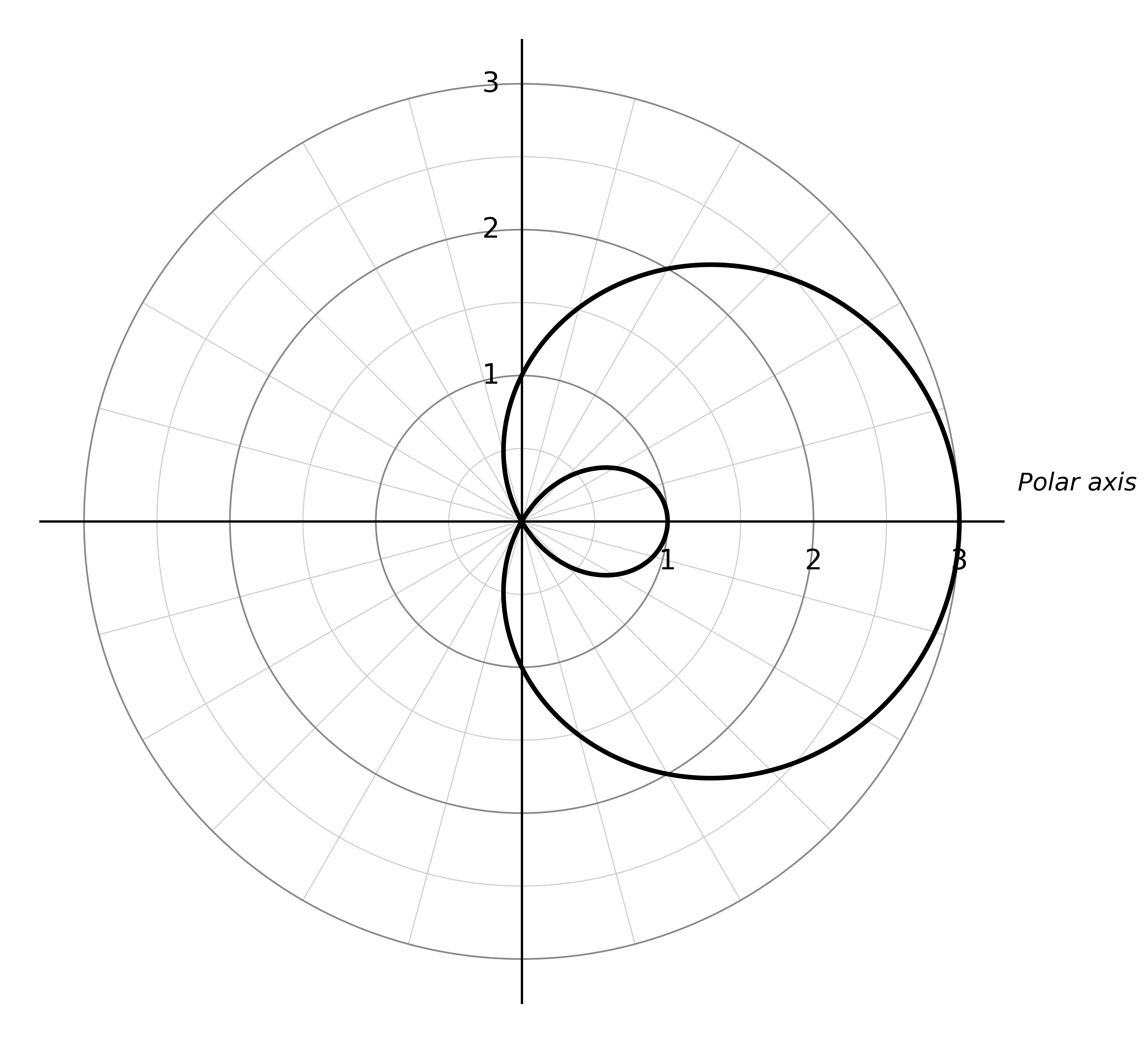
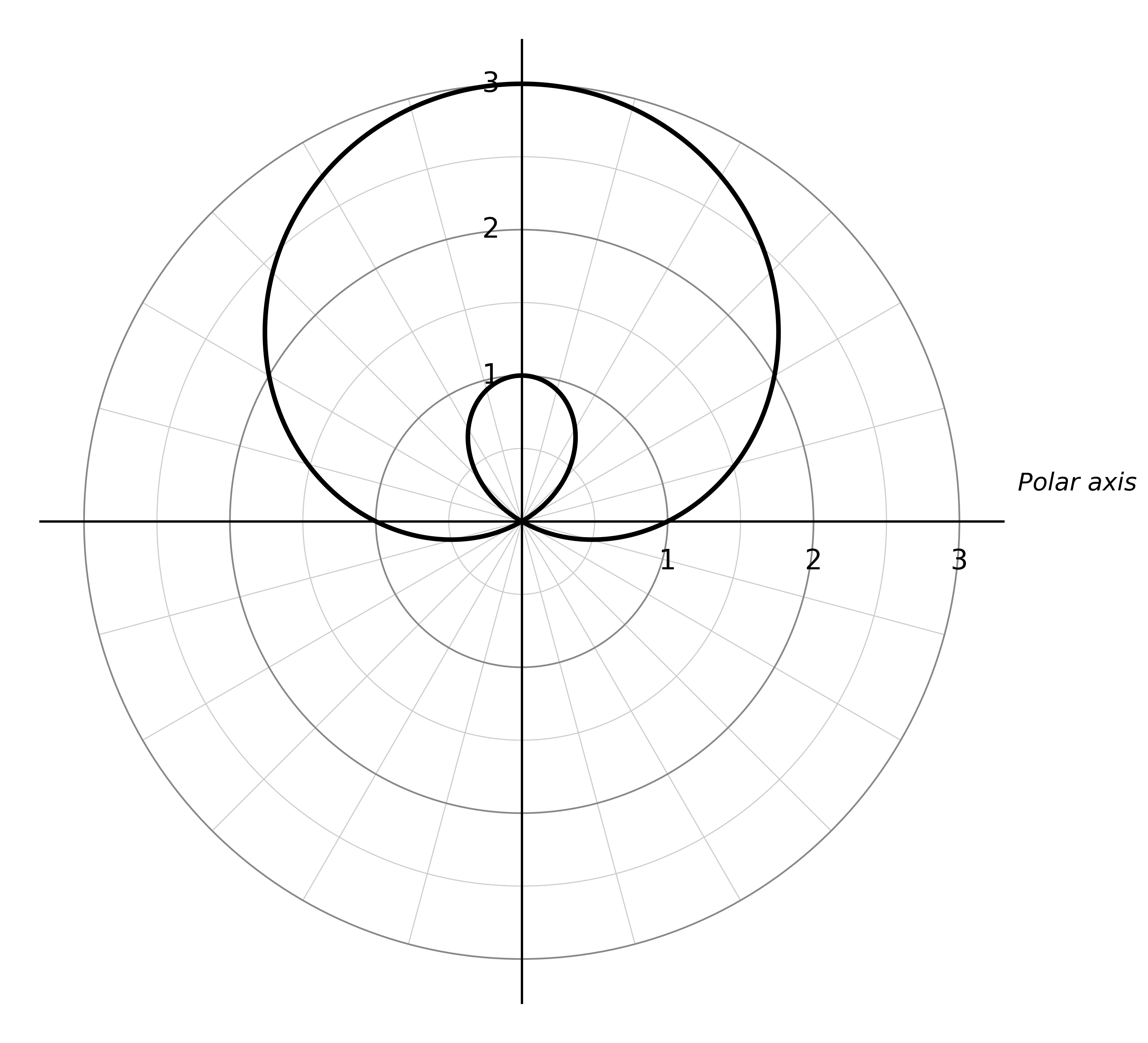
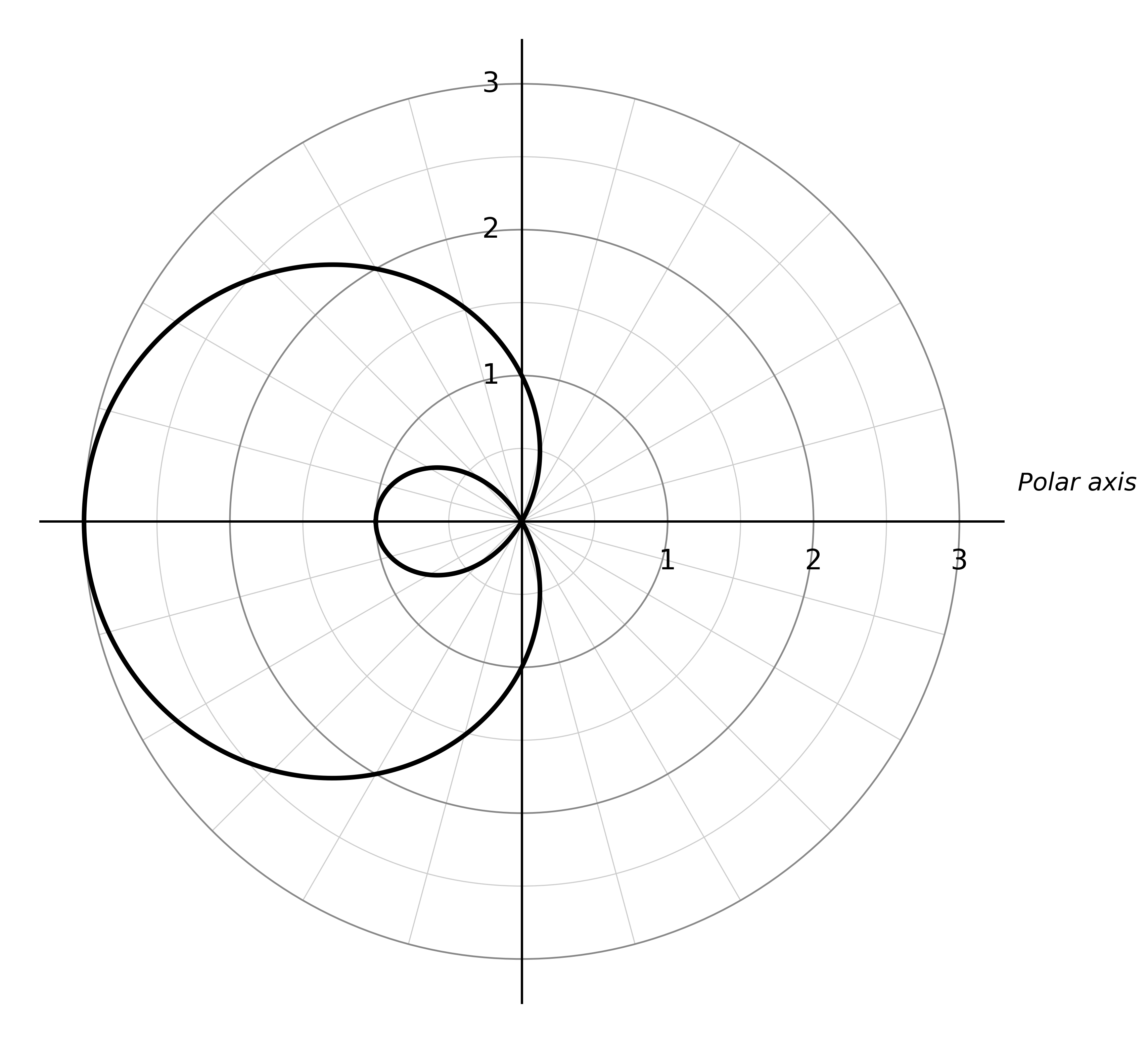
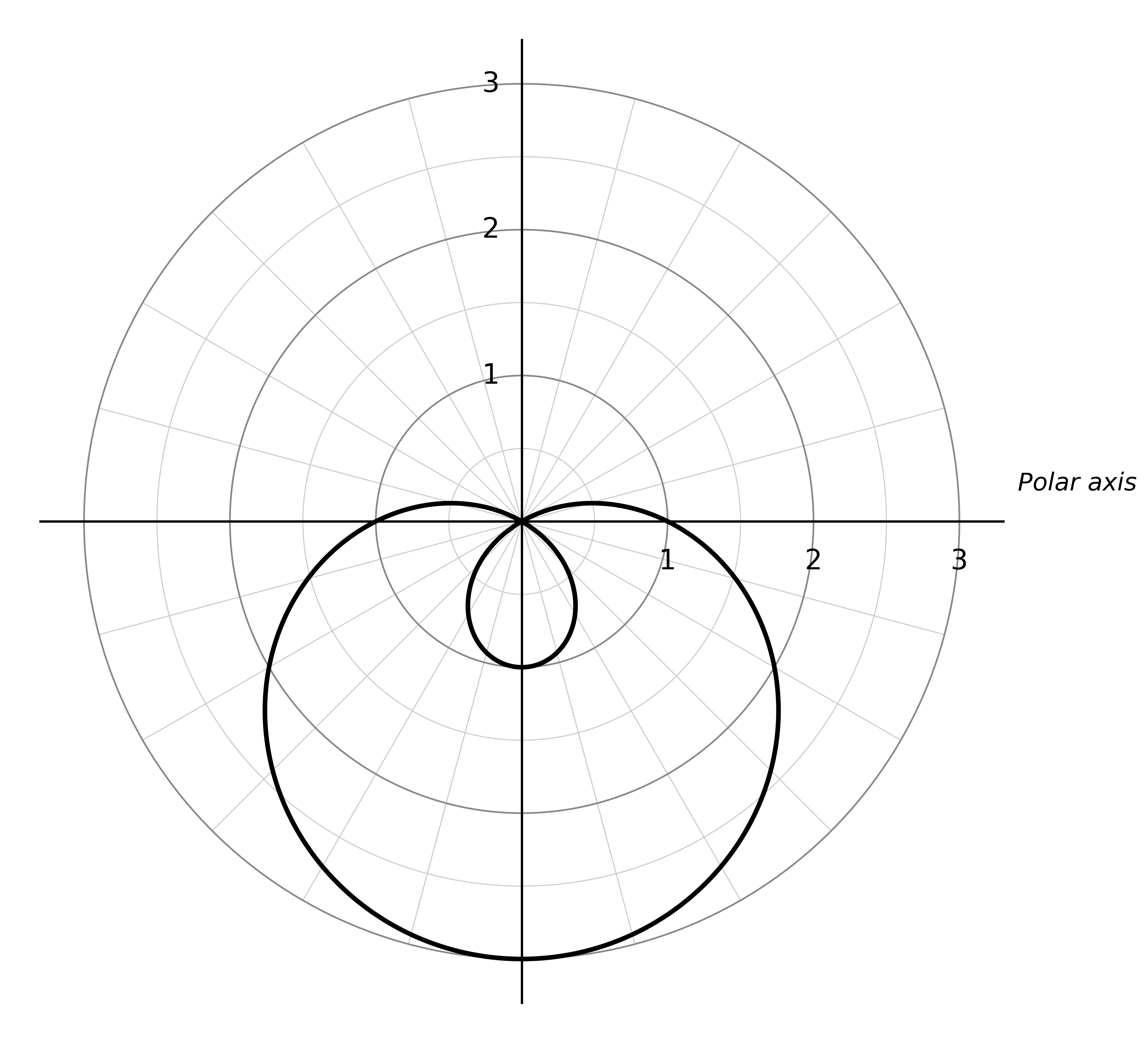
Which of the following is the graph of the polar function , where , in the polar coordinate system for ?
Was this exam question helpful?
Two complex numbers and are represented by points in the complex plane. Which of the following correctly compares the distance from to the origin and the distance from to the origin?
The distance from to the origin equals the distance from to the origin.
The distance from to the origin is less than the distance from to the origin.
The distance from to the origin is greater than the distance from to the origin.
The relative distances cannot be determined without additional information.
Was this exam question helpful?
A polar function is given by for . At which value of is the distance between the point with polar coordinates and the origin the greatest?
Was this exam question helpful?
Consider the graph of , where , in the polar coordinate system for . On which of the following intervals does the value of increase while the distance between the point with polar coordinates and the origin decreases?
Was this exam question helpful?
A polar function is given by , where , in the polar coordinate system for . On which of the following intervals is the average rate of change of with respect to equal to ?
Was this exam question helpful?
A polar function is given by , in the polar coordinate system for . The graph is a rose curve. Which of the following describes the graph?
The graph consists of petals, each of length .
The graph consists of petals, each of length .
The graph consists of petals, each of length .
The graph consists of petals, each of length .
Was this exam question helpful?
The complex number is written in polar form as , where and . What is the value of ?
Was this exam question helpful?
Consider the polar function . On which of the following intervals is the distance between the graph of the function and the origin decreasing?
Was this exam question helpful?