The Polar Coordinate System (College Board AP® Precalculus): Revision Note

Polar coordinates
What are polar coordinates?
The polar coordinate system is an alternative to the rectangular (Cartesian) coordinate system for locating points in the plane
It is built on a grid of
circles centered at the origin
and lines passing through the origin
The positive -axis is called the polar axis
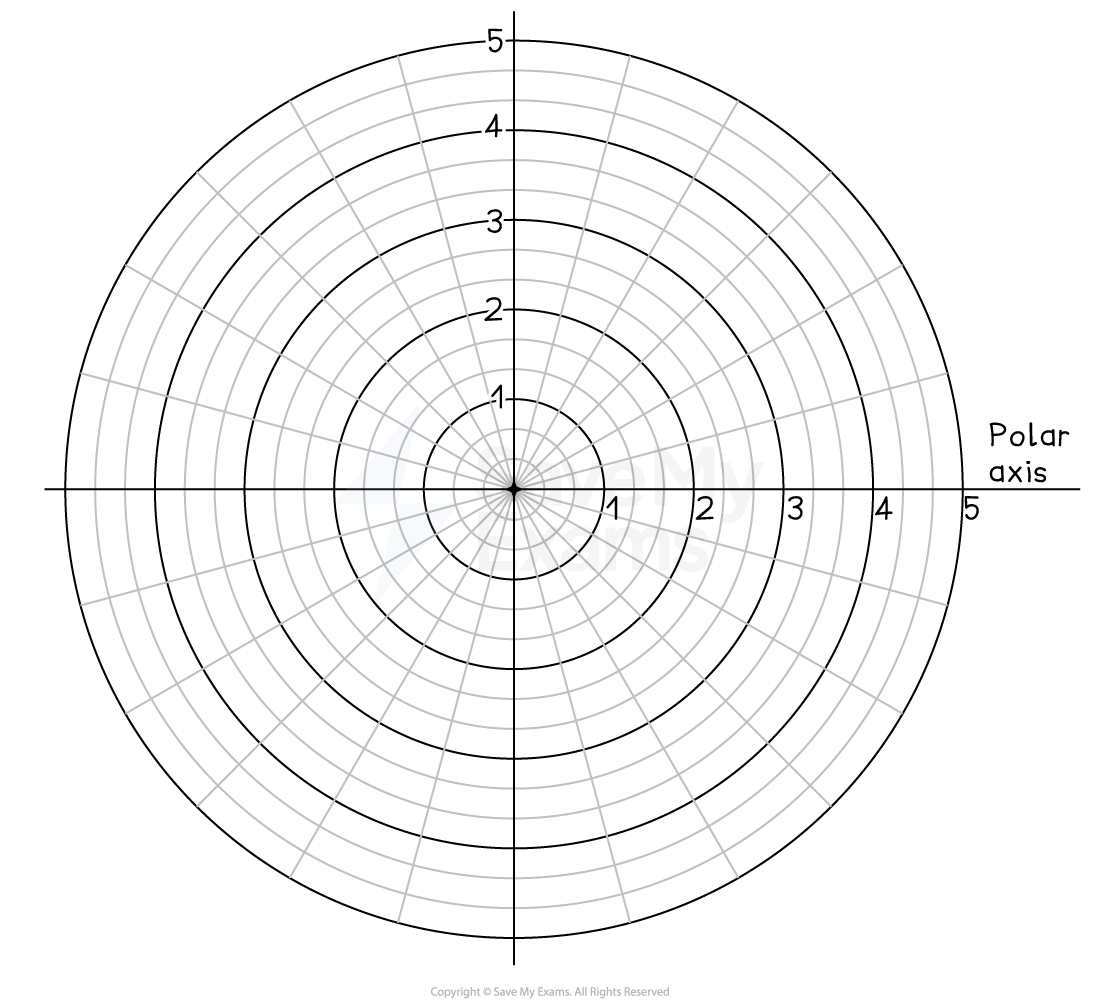
A point in the polar coordinate system is described by an ordered pair
is the radius
This is a signed value related to the distance of the point from the origin
It can be positive or negative (see the next section below for details)
The numbers on the above grid (1, 2, 3, 4, 5) correspond to distances from the origin
is the angle in standard position whose terminal ray includes the point
Remember that angles are usually measured in radians in AP® Precalculus
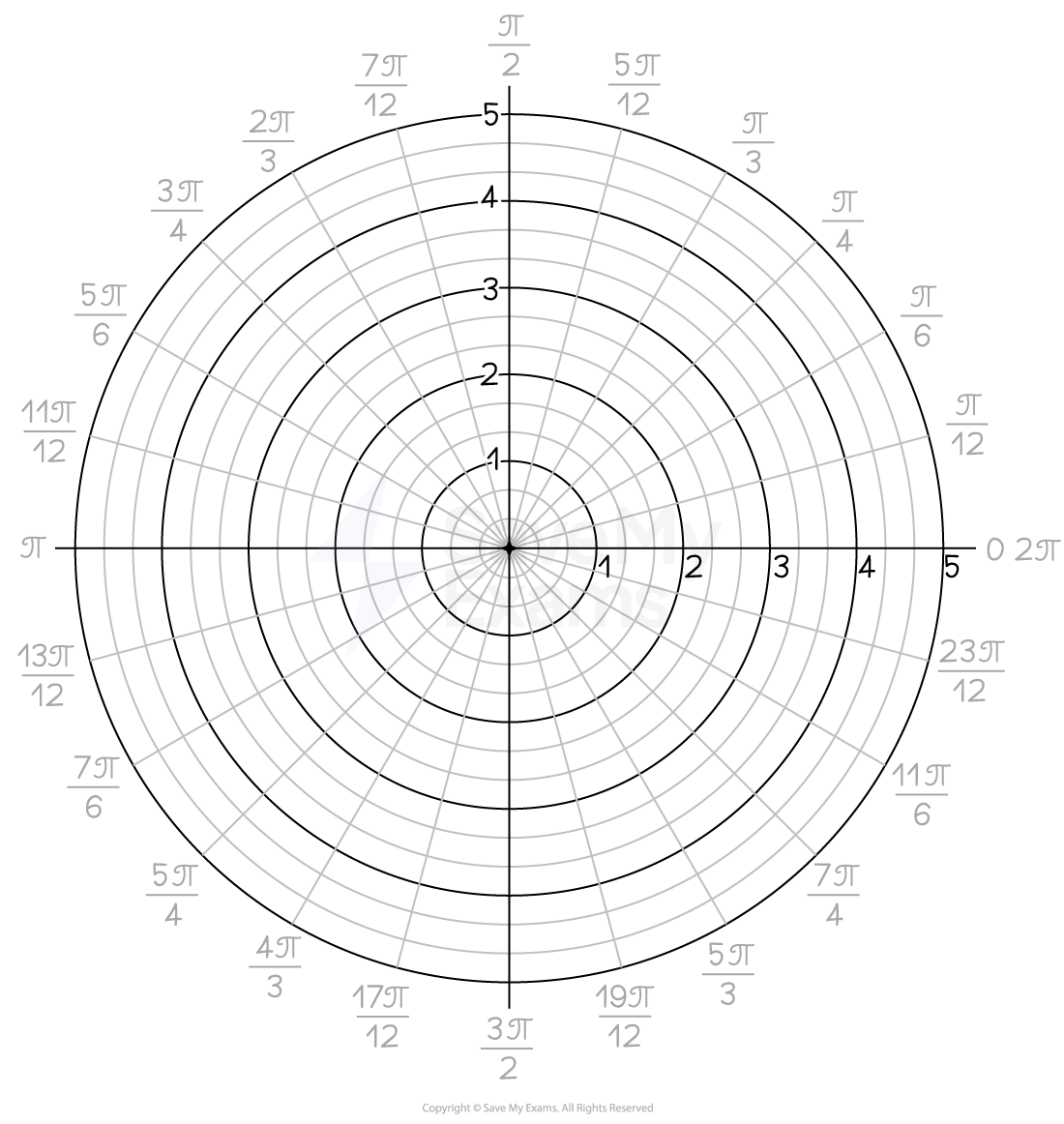
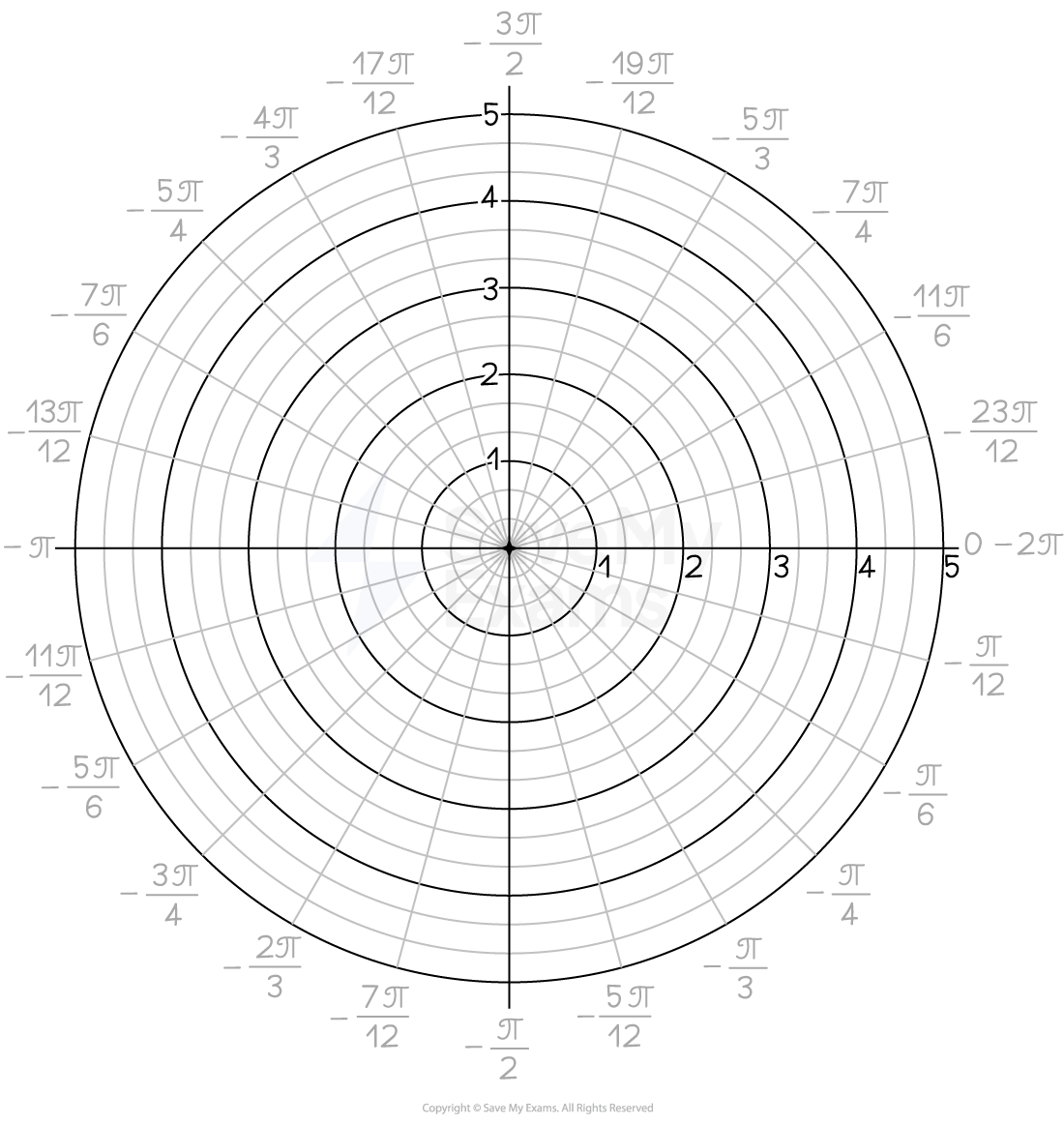
Values of for the radial lines on the grid can vary just as the same angle in standard position can be represented by different values
The radial lines on the grid above divide the circle into 24 parts
so each line is radians away from the ones on either side
Starting from zero at the polar axis, the values
increase counter-clockwise
etc.
up to (which is in the same position as 0)
and decrease clockwise
etc.
down to (which is in the same position as 0)
These angular values can also go beyond or
E.g. continuing to go counter-clockwise from
the line becomes
the line becomes
etc.
Or continuing to go clockwise from
the line becomes
the line becomes
etc.
How do I interpret the radius value r?
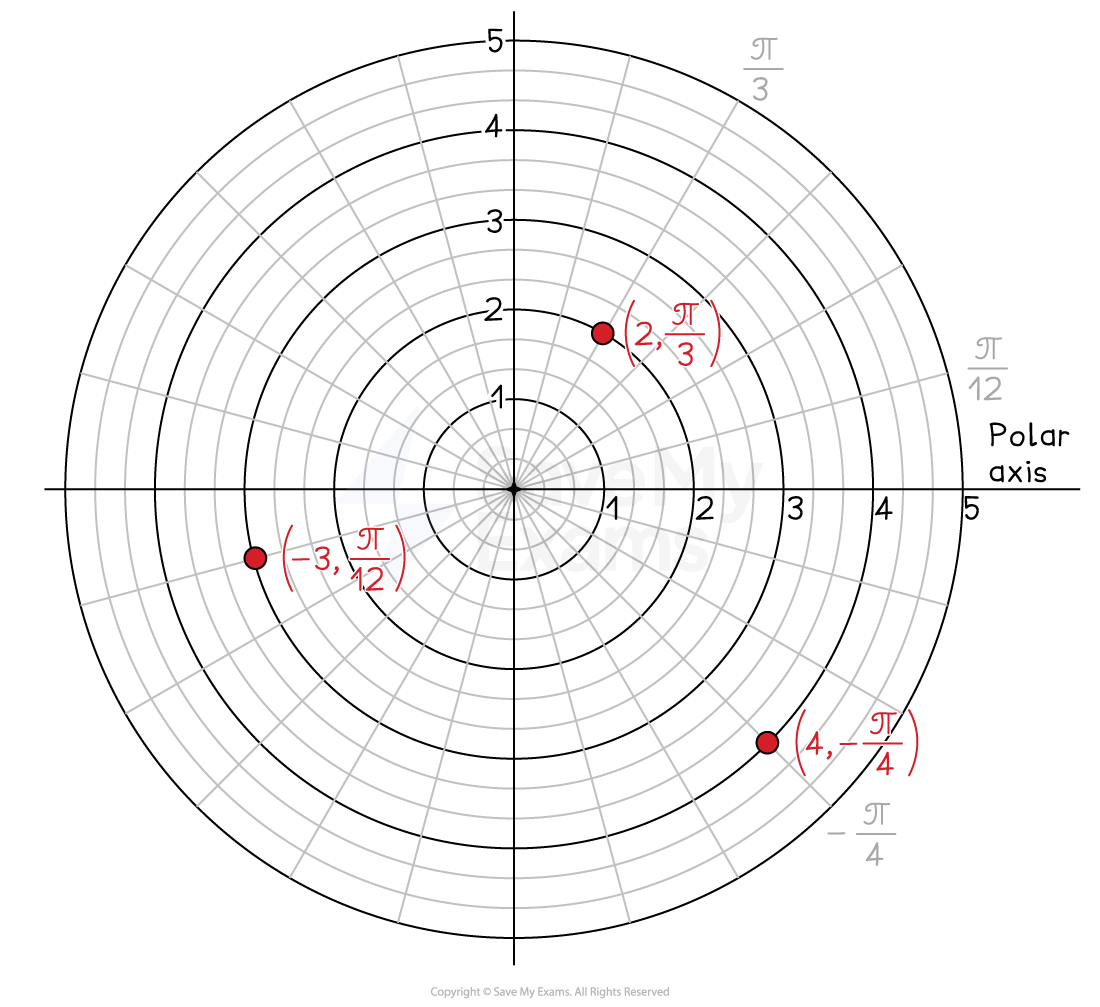
For a point with polar coordinates
Draw the angle in standard position
This gives the terminal ray
If , the point lies on the terminal ray
at distance from the origin
If , the point lies on the opposite ray (the ray pointing in the reverse direction)
at distance from the origin
If , the point is at the origin, regardless of the value of
Because of its behavior, is called a signed radius value
It behaves like a coordinate on a number line laid along the terminal ray
where the positive direction is the direction of the terminal ray itself
Can the same point have more than one set of polar coordinates?
Yes, unlike with rectangular coordinates, a single point in the plane can be represented by many different polar coordinate pairs
This happens for two reasons
Adding full revolutions to the angle
the coordinates and represent the same point
More generally, for any integer gives the same point
Using a negative radius
the coordinates and represent the same point
Rotating the terminal ray by an extra reverses its direction
and making negative reverses it back
E.g. the point with polar coordinates can also be written as
or as
or in infinitely many other ways
How do I convert from polar coordinates to rectangular coordinates?
Given a point with polar coordinates , the rectangular coordinates can be found using
These formulas come directly from the right-triangle definitions of sine and cosine
and they work for all values of and (including negative )
E.g. to convert to rectangular coordinates
So the rectangular coordinates are
How do I convert from rectangular coordinates to polar coordinates?
Given a point with rectangular coordinates , the polar coordinates can be found using:
for
for
The adjustment by when is needed because the function only returns angles in the interval
This range corresponds to terminal rays in the right half-plane (Quadrants I and IV)
For points in the left half-plane (Quadrants II and III), adding rotates the terminal ray to the correct side
E.g. to convert to polar coordinates:
Since ,
So one set of polar coordinates is
Examiner Tips and Tricks
When converting from rectangular to polar, always check which quadrant the point is in before picking your angle.
A common error is to apply without the adjustment when is negative, which puts the point in the wrong half-plane
When a question asks for one valid set of polar coordinates, any equivalent representation is usually acceptable.
But if the question specifies a range like , make sure your answer falls in that range
Worked Example
A point in the plane has rectangular coordinates .
(a) Find the value of , where , and the value of , where , for a polar coordinate representation of point .
(b) Give a second polar coordinate representation of point , different from the answer to part (a), with and any real number. Justify why your answer represents the same point.
(c) A second point has polar coordinates . Find the rectangular coordinates of , giving exact values.
Answer:
(a)
Use the conversion formulas from rectangular to polar
Because the -coordinate is negative and the -coordinate is positive, point lies in Quadrant II
so use the version of the angle formula:
So the polar coordinates are
(b)
Adding to the angle gives another valid representation with the same (positive) radius
Adding or subtracting any other multiple of would also give an equivalent point
represents the same point because adding to the angle corresponds to a full revolution, which returns the terminal ray to its original position. With the same and the same terminal ray, the point is unchanged.
(c)
Use the conversion formulas from polar to rectangular
So the rectangular coordinates of are

Unlock more, it's free!
Join the 100,000+ Students that ❤️ Save My Exams
the (exam) results speak for themselves:

Was this revision note helpful?
Build on this topic