Sine, Cosine & Tangent in Terms of Standard Position (College Board AP® Precalculus): Revision Note

Sine, cosine & tangent in terms of standard position
How are sine, cosine, and tangent connected to right triangle trigonometry?
From previous courses, you may have learned sine, cosine, and tangent as ratios of side lengths in a right triangle (SOHCAHTOA)
, ,
In this course, these definitions are extended
using angles in standard position
and circles centered at the origin
This more general approach allows sine, cosine, and tangent to be defined for any angle
not just acute angles in a right triangle
However the two approaches are fully consistent
The right triangle definitions are a special case of the standard position definitions
What is the sine of an angle in standard position?
Given an angle in standard position and a circle centered at the origin
the terminal ray of the angle
intersects the circle at a point
The sine of the angle is the ratio of
the vertical displacement of from the -axis
to the distance between the origin and :
For a circle of radius , this means
where is the -coordinate of point
and is the radius of the circle
For a unit circle (where ), this simplifies to:
i.e. the sine of the angle is simply the -coordinate of the point where the terminal ray meets the unit circle
What is the cosine of an angle in standard position?
For the same angle in standard position, the cosine of the angle is the ratio of
the horizontal displacement of from the -axis
to the distance between the origin and :
For a circle of radius
where is the -coordinate of point
and is the radius of the circle
For a unit circle (where )
i.e. the cosine of the angle is simply the -coordinate of the point where the terminal ray meets the unit circle
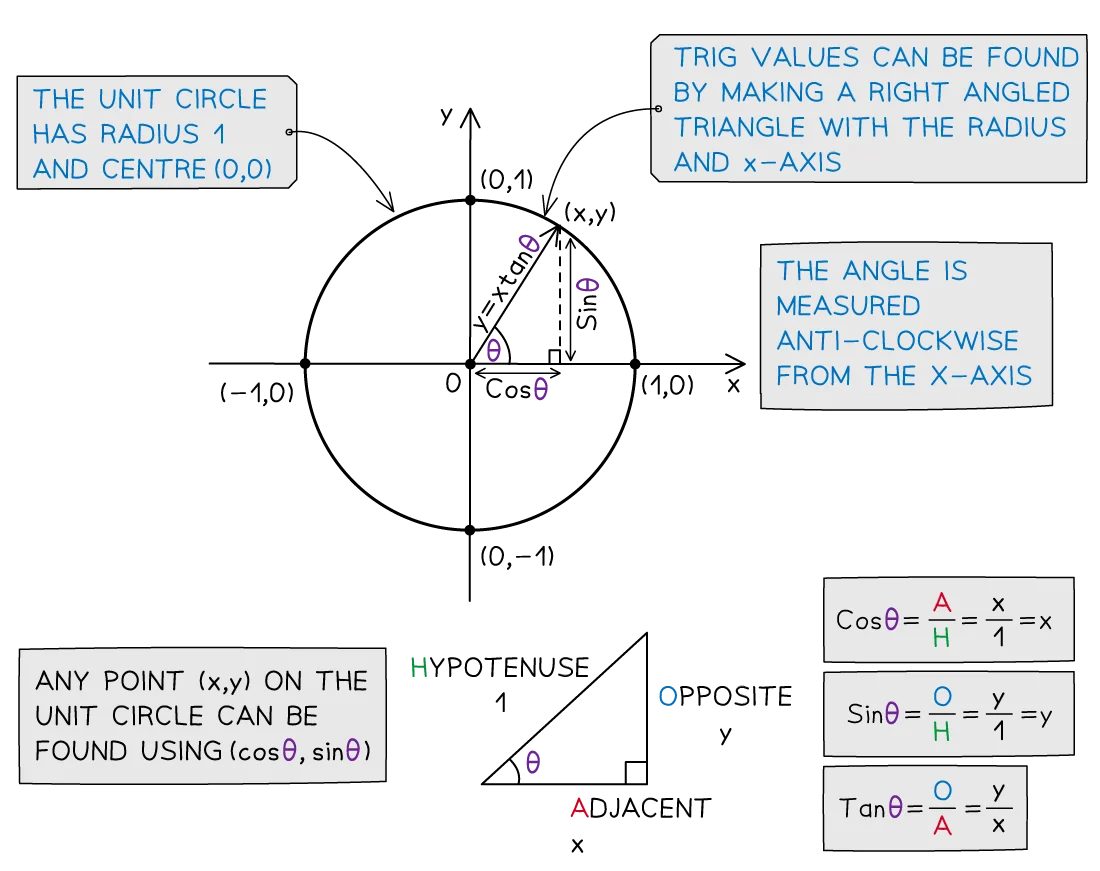
What is the tangent of an angle in standard position?
The tangent of an angle in standard position is the slope of the terminal ray
when the slope exists
Because the slope of a line through the origin is the ratio of the -coordinate to the -coordinate for any point on the line
where is any point on the terminal ray (other than the origin)
This is equivalent to:
provided that
The tangent is undefined when the terminal ray is vertical (i.e. when )
This occurs at for integer values of
I.e. when is equal to
How do the signs of sine, cosine, and tangent depend on the quadrant?
The signs of the - and -coordinates of point change depending on which quadrant the terminal ray lies in
This means the signs of sine, cosine, and tangent also vary by quadrant
Quadrant | |||||
|---|---|---|---|---|---|
I | |||||
II | |||||
III | |||||
IV |
A common mnemonic for remembering which trig ratios are positive in each quadrant is "All Students Take Calculus"
Quadrant I: All are positive
Quadrant II: Sine is positive
Quadrant III: Tangent is positive
Quadrant IV: Cosine is positive
How does this relate to right triangle trigonometry?
When the terminal ray is in the first quadrant a right triangle can be formed by drawing a vertical line from down to the -axis
The horizontal leg has length
the vertical leg has length
and the hypotenuse has length
The standard position definitions produce the same ratios as SOH CAH TOA
The advantage of the standard position approach is that it works for any angle
including angles in the second, third, and fourth quadrants
as well as angles greater than or negative angles
The signs of the coordinates automatically account for the signs of sine, cosine and tangent
Examiner Tips and Tricks
Pay close attention to whether a question uses the unit circle (radius ) or a circle with a different radius.
On the unit circle, is the -coordinate and is the -coordinate directly.
For any other circle of radius , you need to divide by — that is
I.e. and
Confusing these is a common source of errors.
Worked Example
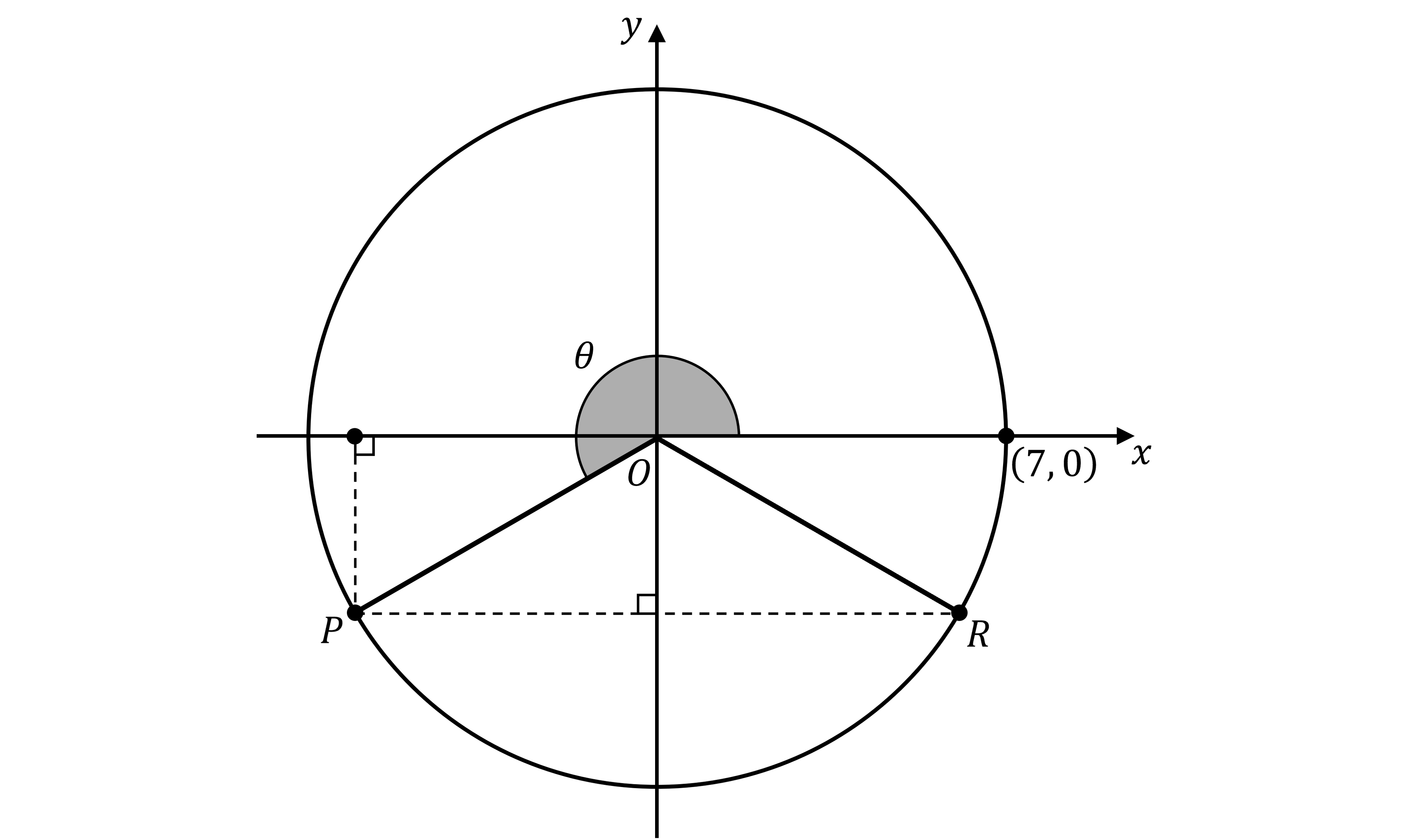
The figure shows a circle centered at the origin with radius 7, and an angle of measure radians in standard position. The terminal ray of the angle intersects the circle at point , and point also lies on the circle. The coordinates of are , and the coordinates of are . Which of the following is true about the cosine of ?
(A) , because it is the ratio of the horizontal displacement of from the -axis to the distance between the origin and .
(B) , because it is the ratio of the horizontal displacement of from the -axis to the distance between the origin and .
(C) , because it is the ratio of the vertical displacement of from the -axis to the distance between the origin and .
(D) , because it is the ratio of the vertical displacement of from the -axis to the distance between the origin and .
Answer
The cosine of an angle is the ratio of
the horizontal displacement of the point where the terminal ray intersects the circle (point )
to the distance from the origin to that point (the radius, )
Since has coordinates , the horizontal displacement of from the -axis is
Therefore
Note that because is in the third quadrant, is negative, so the cosine is negative
This is consistent with cosine being negative in the third quadrant.
(B) , because it is the ratio of the horizontal displacement
of from the -axis to the distance between the origin and
Examiner Tips and Tricks
Make sure you are clear about the distinction between distance and displacement in the definitions.
Distance is always positive
Displacement can be positive or negative
A point with a negative -coordinate has a negative horizontal displacement from the -axis
A point with a negative -coordinate has a negative vertical displacement from the -axis

Unlock more, it's free!
Join the 100,000+ Students that ❤️ Save My Exams
the (exam) results speak for themselves:

Was this revision note helpful?
Build on this topic