The Complex Plane (College Board AP® Precalculus): Study Guide

Complex numbers & rectangular coordinates
What is a complex number?
A complex number is a number of the form , where
and are real numbers
is the imaginary unit, defined by
or equivalently,
The real number is called the real part of the complex number
The real number is called the imaginary part of the complex number
E.g. the complex number has real part and imaginary part
Every real number is also a complex number
A real number can be written as
i.e. with real part and imaginary part
Examiner Tips and Tricks
Familiarity with complex numbers is a prerequisite for the AP® Precalculus course.
How are complex numbers represented using rectangular coordinates?
A complex number can be represented as a point in a plane, called the complex plane
The horizontal axis is the real axis (Re)
The vertical axis is the imaginary axis (Im)
The complex number is represented by the point with rectangular coordinates
The real part gives the horizontal coordinate
The imaginary part gives the vertical coordinate
E.g. the complex number corresponds to the point in the complex plane
or going the other way, the point with rectangular coordinates in the complex plane corresponds to the complex number
Note that a real number like is located on the real axis
and a purely imaginary number like is located on the imaginary axis

Complex numbers & polar coordinates
How are complex numbers represented using polar coordinates?
Since a complex number corresponds to a point in the complex plane, it can also be described using polar coordinates
is the signed radius value
is the angle in standard position whose terminal ray includes the point
If a complex number has polar coordinates
then its rectangular coordinates are
This follows directly from the standard conversion formulas
and
Substituting into the form gives the polar form of the complex number:
E.g. the complex number with polar coordinates can be written as
which simplifies to in the form
i.e. because and
Going the other way, to convert a complex number to polar form
use the same rectangular-to-polar conversion formulas from the polar coordinate system
for
for
E.g. to convert to polar form
Since
So the polar form is
with polar coordinates
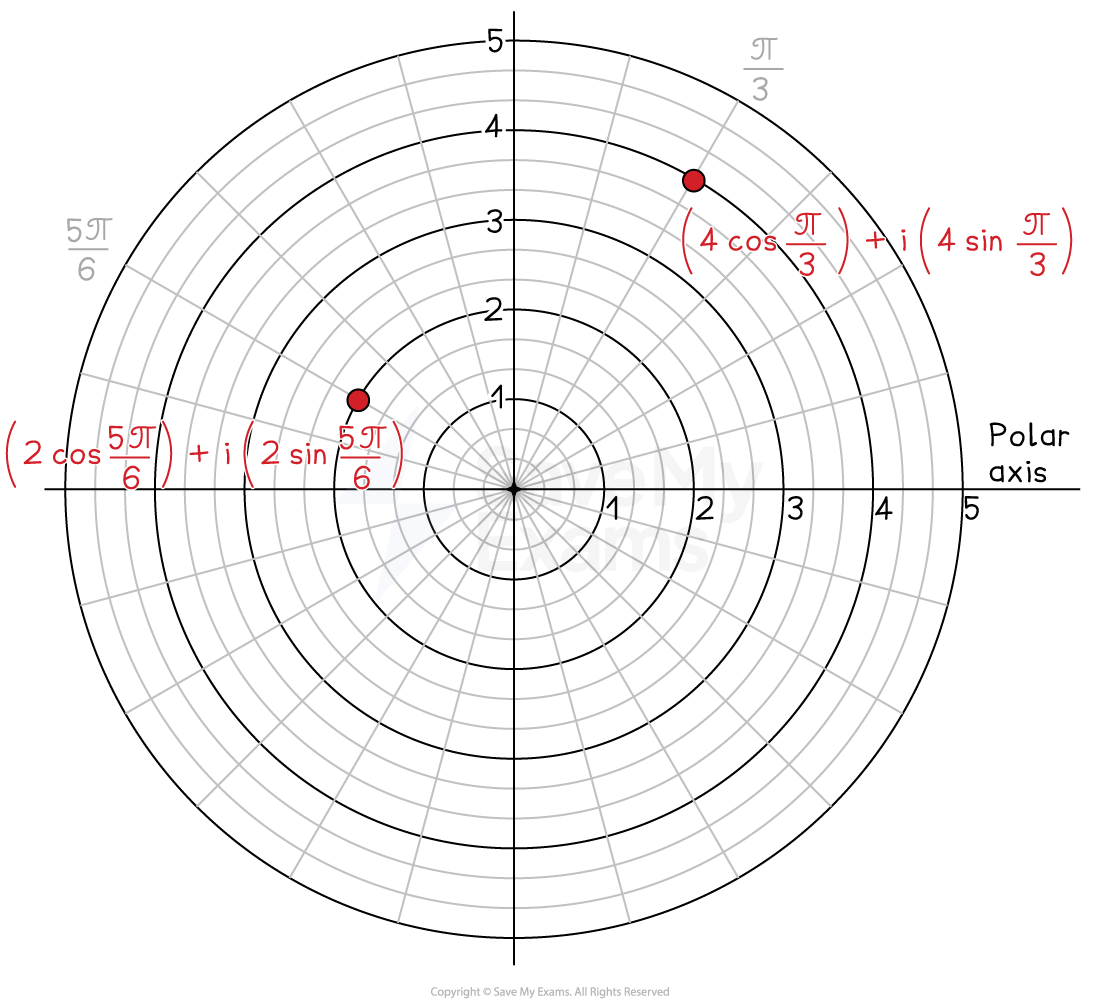
Examiner Tips and Tricks
The polar form of a complex number is written with two factors of , one multiplying the cosine and one multiplying the sine.
A common error is to leave the out and write , which only works when
When converting from to polar form, treat it exactly like converting the rectangular coordinates to polar coordinates.
The only difference is in how the final answer is written
Worked Example
A complex number is represented by a point in the complex plane. The complex number has the rectangular coordinates . Which of the following is one way to express the complex number using its polar coordinates ?
(A)
(B)
(C)
(D)
Answer:
Start by finding from the rectangular coordinates
Since the polar form of a complex number is , this rules out options (B) and (C)
The point lies in Quadrant II (negative real part, positive imaginary part)
so use the version of the angle formula:
The polar form is therefore
which is option (A)
Note that option (C) is what you would get if you forgot to use the version of the angle formula for
I.e. if you used directly without adjusting by because the real part is negative
is a number in Quadrant IV (positive real part, negative imaginary part) instead of Quadrant II
(A)
Examiner Tips and Tricks
Note that the worked example question says "Which of the following is one way to express the complex number...".
That is because, as with regular polar coordinates, there are an infinite number of ways to represent a complex number in polar form, i.e. by adding or subtracting an integer multiple of to the angle .
E.g. , and
So the complex number could equivalently be written as or

Unlock more, it's free!
Join the 100,000+ Students that ❤️ Save My Exams
the (exam) results speak for themselves:

Was this revision note helpful?
Build on this topic