Polynomial Long Division (College Board AP® Precalculus): Study Guide

Polynomial long division
What is polynomial long division?
Polynomial long division is a method for splitting polynomials into factor pairs (with or without an accompanying remainder term)
You can use it to factor polynomials
to help simplify algebraic fractions
or to find the equation of the slant asymptote for a rational function
If a polynomial is divided by a polynomial then can be rewritten as
where
is the quotient
is the remainder
The degree of is less than the degree of
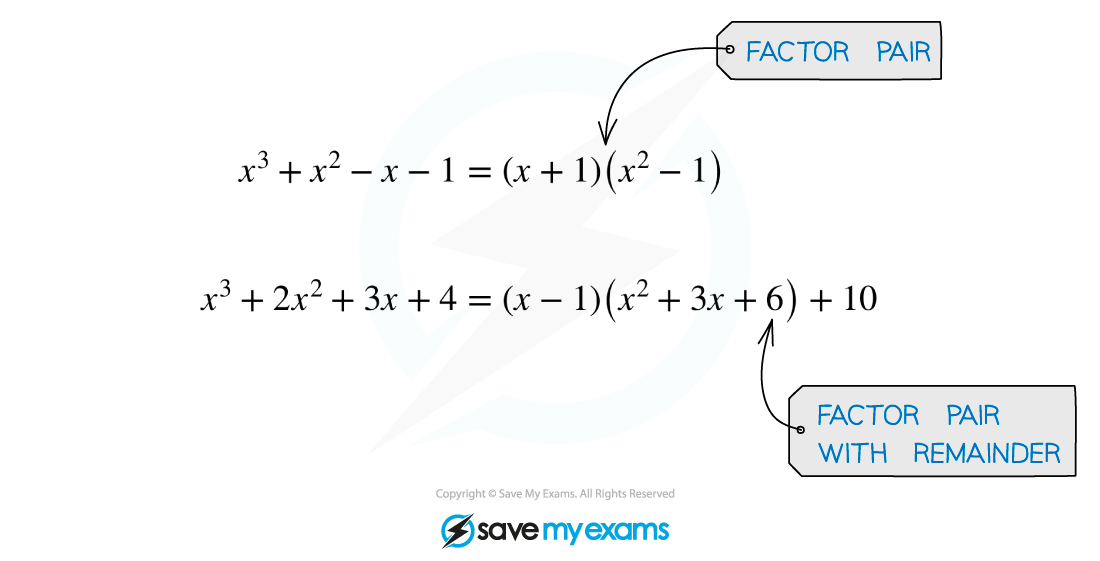
How do I perform polynomial long division?
The method used for polynomial long division is just like the method used to divide regular numbers
i.e. the long division method (sometimes called 'bus stop division')
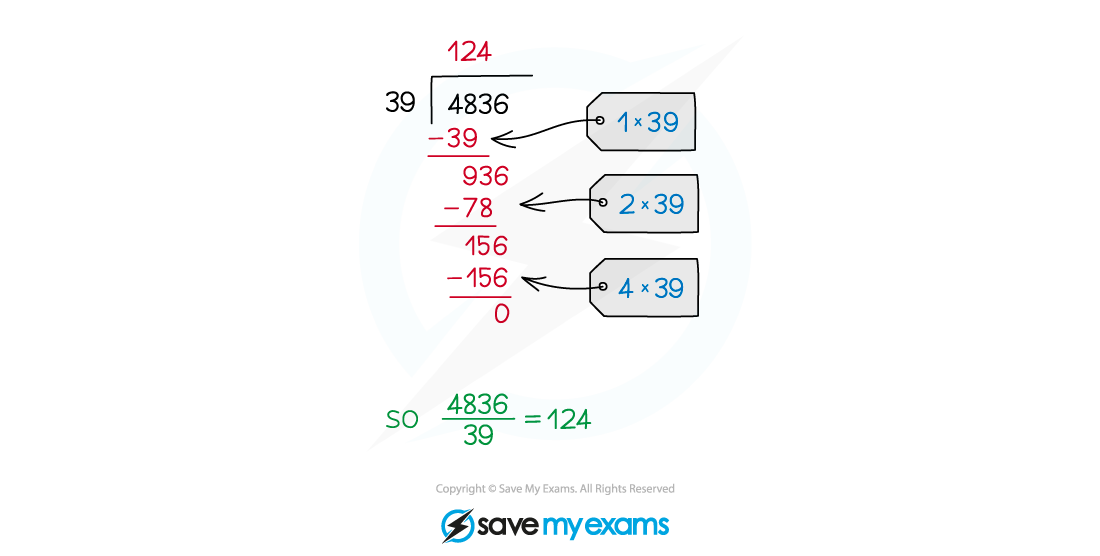
The answer to a polynomial long division question is built up term by term
Working downwards in powers of the variable (usually x)
E.g. to divide by
Start with the highest power term of the answer
Write out this multiplied by the divisor
and subtract
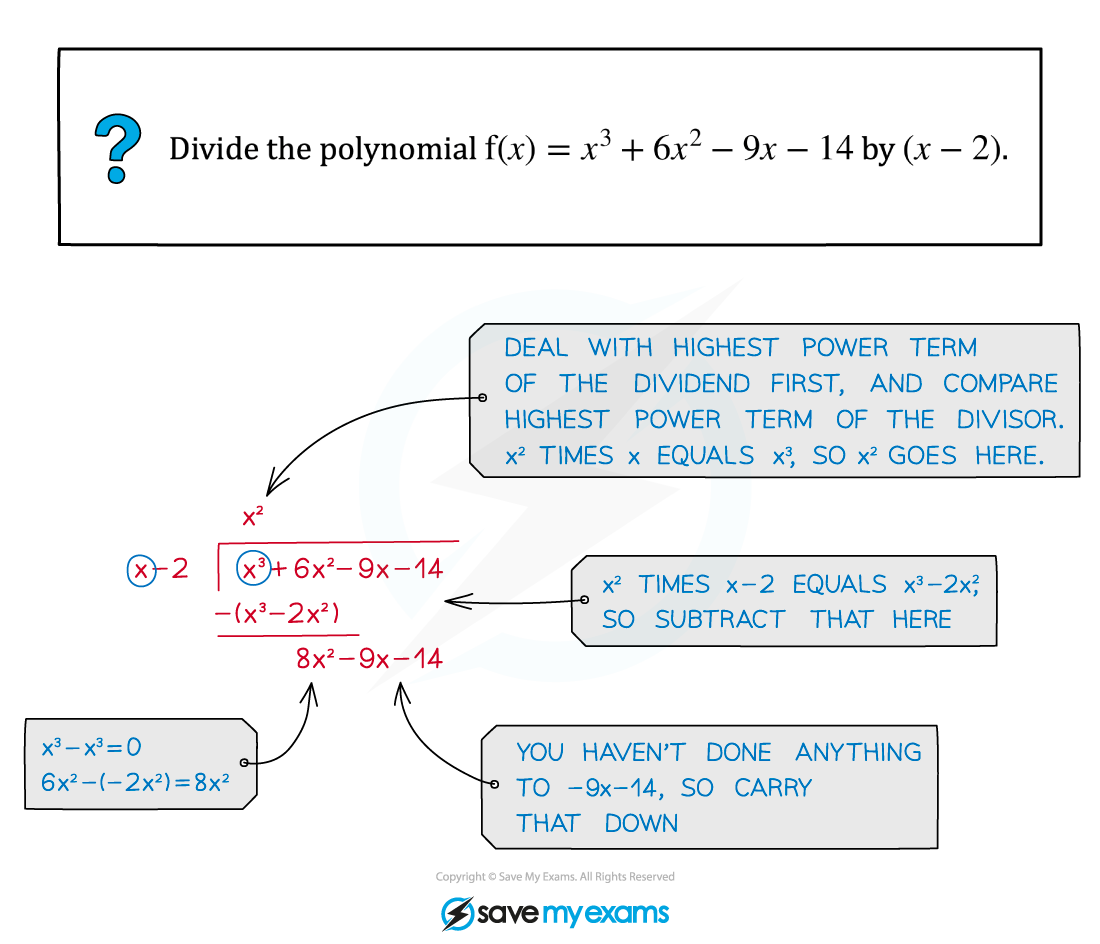
Continue the process for each decreasing power term
multiplying by the divisor and subtracting each time
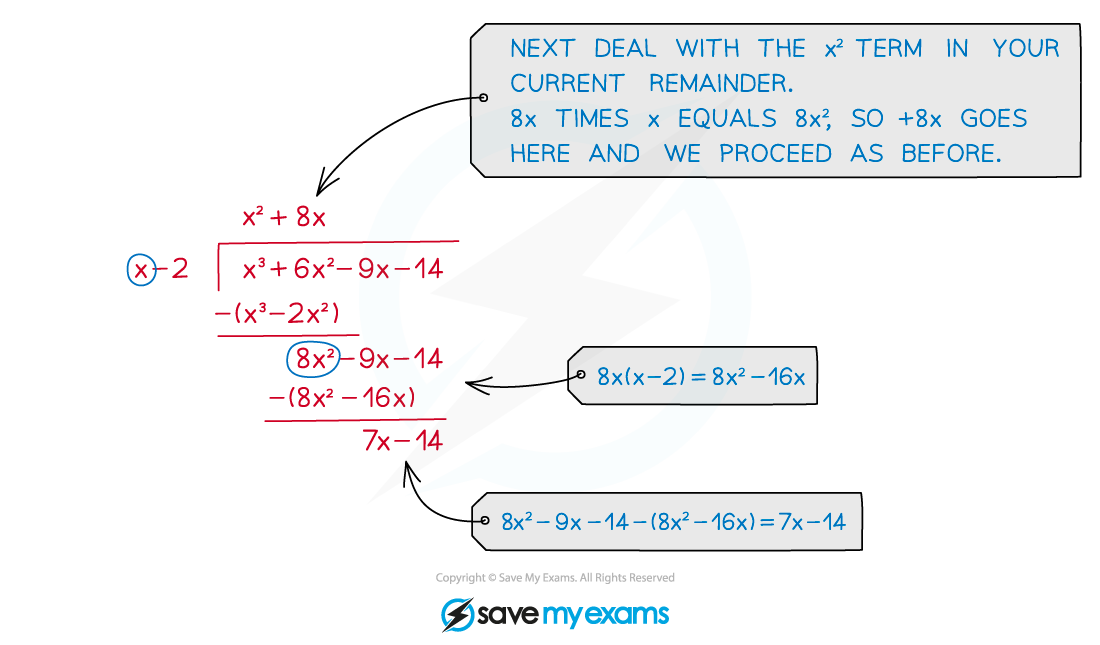
Continue until what you are left with has a lower degree than what you are dividing by
Then what you are left with will be the remainder
If the divisor is a factor of the polynomial, the remainder will be zero
In this case is degree 1
So you need to continue until you have only a constant term left
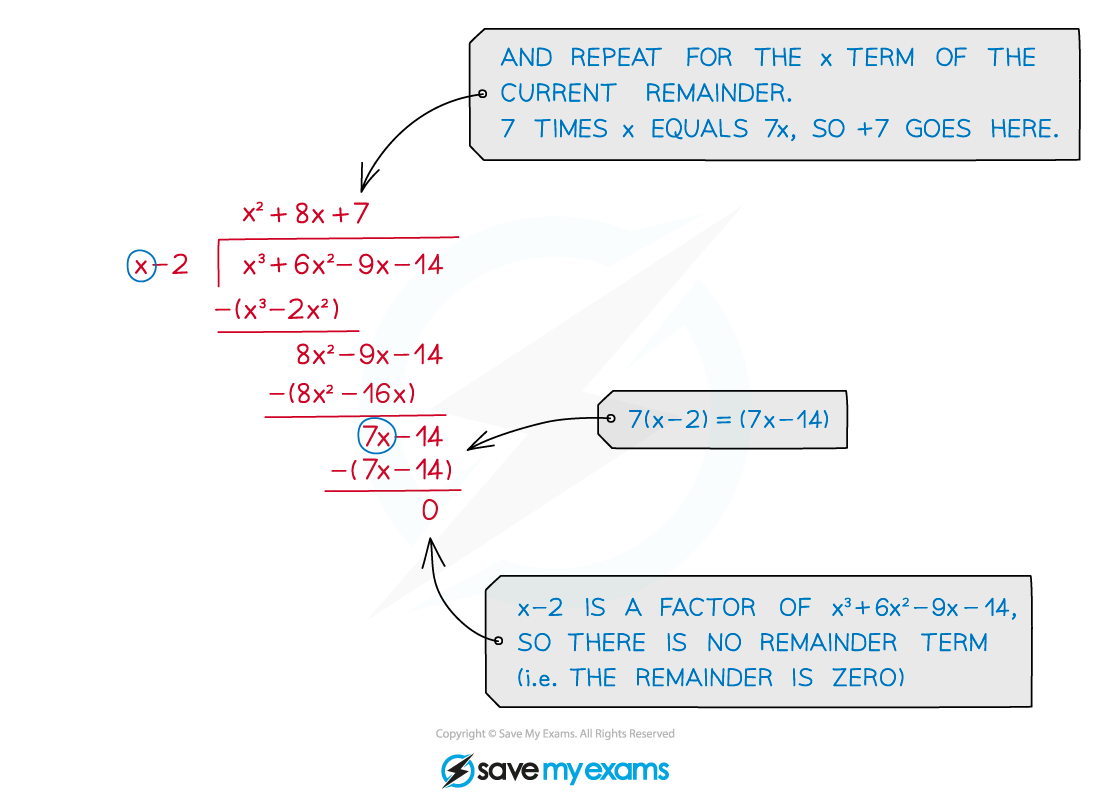
In this case the remainder is zero, so is a factor of
So can be written in the form as
Examiner Tips and Tricks
Don't rush when doing algebraic division.
Finding and fixing a mistake can take longer than taking the time to do it right the first time!
How can I use polynomial long division to find the equation of the slant asymptote of a rational function?
For a rational function, if the degree of the numerator exceeds the degree of the denominator by exactly 1
then the graph of the rational function has a slant asymptote
To find the equation of the slant asymptote for a rational function
Use polynomial long division to carry out the division
That will give an answer in the form
so
has a higher degree than
so
So as increases or decreases without bound
gets closer and closer to the quotient
is the equation of the slant asymptote
E.g. consider the rational function
Polynomial long division shows that
Therefore
Considering the end behavior,
So as increases or decreases without bound
gets closer and closer to
is the equation of the slant asymptote
Worked Example
The function is given by .
Find the equation of the slant asymptote on the graph of .
Answer:
Carry out polynomial long division to find the quotient and remainder when the numerator is divided by the denominator

Therefore
and
Consider the end behavior
So as increases or decreases without limit, gets closer and closer to
The slant asymptote has equation

Unlock more, it's free!
Join the 100,000+ Students that ❤️ Save My Exams
the (exam) results speak for themselves:

Was this revision note helpful?
Build on this topic