Combined Transformations of Sinusoidal Functions (College Board AP® Precalculus): Study Guide

Combined transformations of sinusoidal functions
How do all four transformations work together?
The general form of a sinusoidal function with all transformations combined is
The parameters and describe the following characteristics of the graph
Parameter | Characteristic | How to find it from the graph |
|---|---|---|
Amplitude | ||
Vertical shift (midline at ) | ||
Period | Horizontal distance between two consecutive maxima (or minima) | |
Phase shift | Horizontal displacement from the base function's starting position |
If , the function oscillates normally
If , the graph is reflected over the midline
peaks and troughs are swapped
How can the amplitude and vertical shift be found from a graph?
Read the maximum and minimum output values from the graph
The amplitude is
The vertical shift (midline) is
For example, if a sinusoidal graph has a maximum of and a minimum of
Amplitude:
Vertical shift:
so the midline is
How can the period and the value of b be found from a graph?
The period is the horizontal distance between
two consecutive maxima
two consecutive minima
or any two consecutive corresponding points on the graph
Once the period is known, the value of can be found using:
For example, if consecutive maxima occur at and
Period:
How can the phase shift be determined?
The phase shift describes the horizontal displacement of the graph
compared to the base sine or cosine function
For a cosine model ()
The base cosine function has its maximum at
If the graph's first maximum occurs at
then the phase shift is units to the right
which means
or equivalently, the shift is
For a sine model ()
The base sine function crosses the midline (going upward) at
If the graph first crosses the midline going upward at
then the phase shift is units to the right
which means
or equivalently, the shift is
The phase shift is often the trickiest parameter to determine
It helps to first decide whether to use a sine or cosine model (a question may decide this for you)
and then identify the appropriate reference point on the graph
Examiner Tips and Tricks
When reading a graph to determine the phase shift, be careful about the difference between the shift in the -value and the value of in the equation.
If a cosine graph reaches its first maximum at , then the equation has inside the cosine, which means .
A common error is to write instead
Always verify your equation by substituting a known point from the graph
What is the systematic process for finding the equation from a graph?
Start by reading the maximum and minimum values from the graph
Use these to find the amplitude () and vertical shift ()
Unless a question specifies otherwise, you can assume that is positive
in which case is simply equal to the amplitude
Next identify two consecutive maxima (or minima)
Use these to find the period
then calculate
Unless a question specifies otherwise, you can assume that is positive
in which case is simply equal to
At this point you need to decide whether to use a sine or cosine model
Cosine is often convenient when a maximum or minimum is clearly visible
Sine is convenient when a midline crossing (going upward) is clearly visible
Often a question will tell you whether a sine or cosine model is to be used
Now you can identify the phase shift
by comparing the graph's reference point
to where the base function would normally have that feature
Finally write the equation
and verify by checking that the function matches at least one or two key points on the graph
Examiner Tips and Tricks
Remember that the same graph can be described by either a sine or cosine model. A cosine function is just a phase-shifted sine function, and vice versa
However on the exam, if you are given a specific form to use (e.g. ), make sure you use it
even if a different model might feel more natural to you
Also note that the parameters and will almost always be positive in exam questions.
It is always possible to write a model using and
The difference between that and a model with negative values for and can always be represented instead as an appropriate phase shift
Worked Example
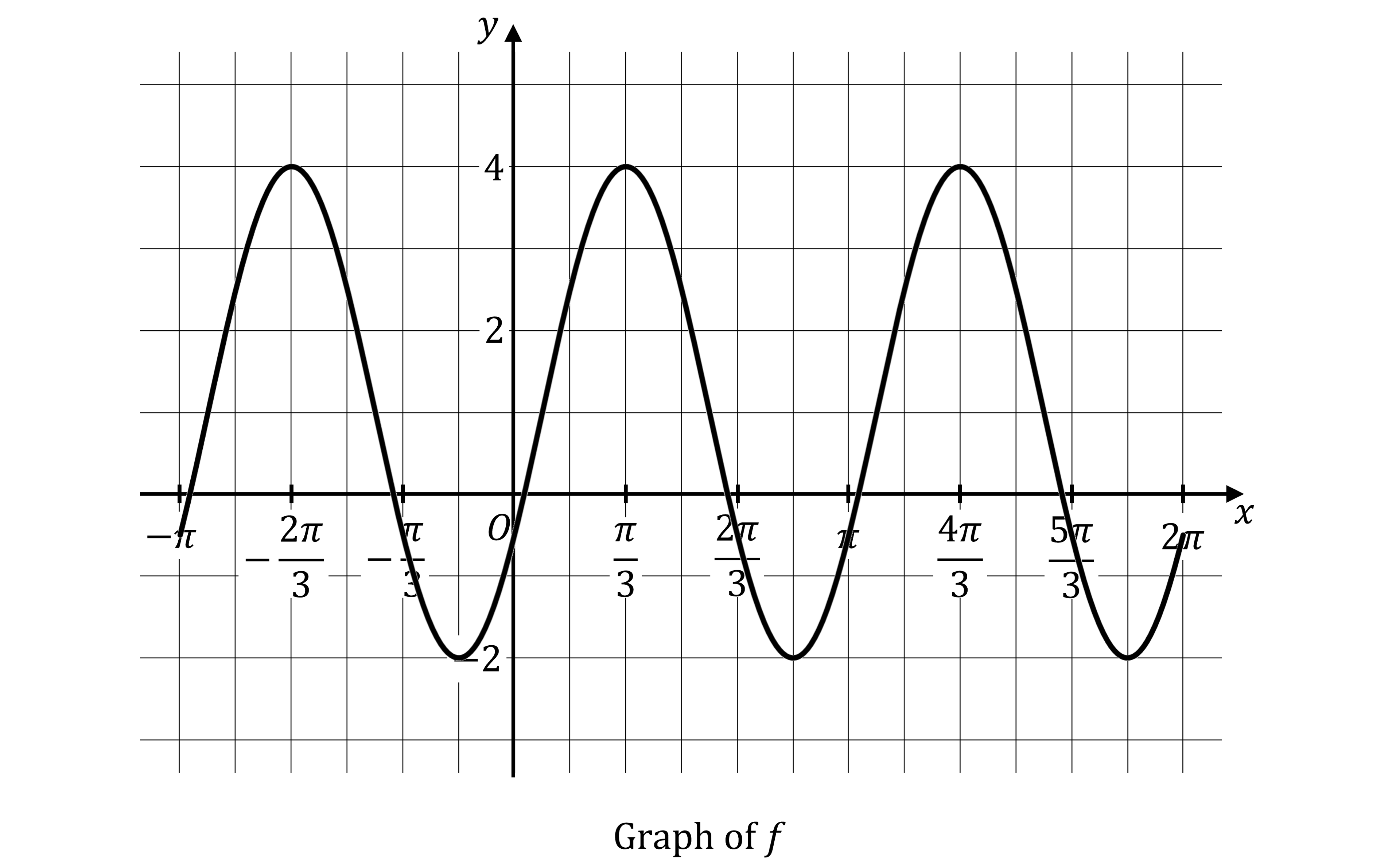
The figure shows the graph of a trigonometric function . Which of the following could be an expression for ?
(A)
(B)
(C)
(D)
Answer:
Start by finding the amplitude and vertical shift
The maximum value is and the minimum value is
So the amplitude is and the midline is at
This is consistent with all four answer options
Next find the period and
Consecutive maxima appear at and
This is also consistent with all four options.
To distinguish between the models, determine the phase shift
The graph reaches a maximum at
For a cosine model, the maximum of the base function occurs at , so the maximum has been shifted right to
This means
This gives option (A) as the correct answer,
You can verify this by checking a couple of points
At :
✓
At :
✓
It's worth looking at why the other options are incorrect
Option (B) uses instead of
This function would have a maximum at instead of at
Option (C) uses a sine function,
That particular model would have a midline crossing at , not a maximum point
Option (D) also uses a sine function,
That particular model would have a midline crossing at , and a maximum point at
(A)

Unlock more, it's free!
Join the 100,000+ Students that ❤️ Save My Exams
the (exam) results speak for themselves:

Was this revision note helpful?
Build on this topic