Equations with Transformed Trigonometric Functions (College Board AP® Precalculus): Study Guide

Equations with transformed trigonometric functions
What is a transformed trigonometric equation?
A transformed trigonometric equation is one in which the trigonometric function is applied to a more complex argument than just
For example
The argument inside the trigonometric function is itself a function of the variable
Compare transformed sinusoidal functions like
Equations involving transformed arguments with the reciprocal trig functions (, , ) or inverse trig functions (, , )
can also be converted to this form
How can I solve a transformed trigonometric equation?
The most reliable approach is to
transform the solution interval to match the new variable
solve the simpler equation in the transformed interval
then convert all solutions back
Start by identifying the inner expression (the argument of the trigonometric function)
and setting it equal to a new variable
E.g. if the equation is
then let
Next transform the original solution interval
into the corresponding interval for
by applying the same operations to all parts of the inequality
E.g. if is to be solved on the interval
So is the transformed interval
Note that the transformed interval is often wider (or narrower) than the original interval
This is important because it determines how many solutions exist
Solve the simpler equation in the transformed interval
finding all solutions for
E.g. has the following solutions in
Finally, convert each solution back to a value of the original variable
by reversing the substitution
E.g. for
The full set of solutions can be found by the same method of reversing the substitution
This method is more reliable than trying to apply trigonometric identities or guess solutions directly
especially when the interval is non-standard or the solutions are not exact angles
Examiner Tips and Tricks
The "transform the interval, solve, convert back" approach is the most reliable method for handling transformed arguments.
It works for any equation regardless of the specific values involved
A common error is to find the principal solution for the transformed variable but forget to look for additional solutions within the (often wider) transformed interval.
Another common error is forgetting to convert back to the original variable at the end.
Writing out the substitution clearly at the start helps avoid both mistakes
How do I write general solutions when no interval is specified?
If no solution interval is specified
a trigonometric equation has infinitely many solutions
because trigonometric functions are periodic
General solutions are written using an integer parameter (typically or ) to represent all possible solutions
For solutions to
or
where is the initial solution
and is any integer
For solutions to
or
where is the initial solution
and is any integer
For solutions to
where is the initial solution
and is any integer
After finding the general solutions for , you can convert each one back to the original variable by reversing the substitution
E.g. for converted to
The initial solution is
So the general solution in terms of is
or
To convert the first part
To convert the second part
So the general solution in terms of is
or
Examiner Tips and Tricks
When a question asks for "all input values" without specifying an interval, the answer should be in general solution form using an integer parameter.
Make sure your general solution form correctly captures every solution, not just a few of them
You can use any letter you want for the integer parameter in the general solution, as long as that letter is not being used for something else in the question
E.g. if the variable in the equation is , then you would lose points on the exam if you also used as the integer parameter
How do contextual restrictions affect the solution set?
In trigonometric equations and inequalities arising from a contextual scenario
there is often a domain restriction implied by the context
E.g. if represents time in hours after midnight
then might be restricted to
Or if represents height above the ground
then values where is negative might not make physical sense
These contextual restrictions can limit the number of solutions to a finite set
even when the underlying equation has infinitely many solutions
Examiner Tips and Tricks
Always check whether all the solutions you find make sense in the context of a question, and discard any that do not.
How are equations with composed inverse and trigonometric functions solved?
On the exam, some equations may involve a composition of
an inverse trigonometric function
with a trigonometric function
E.g.
The strategy is to work from the outside in
Start by applying the inverse of the outermost function to both sides
E.g.
This gets rid of the outer inverse trig function
and converts the equation into a simpler equation involving the inner trig function
Then you can solve the resulting trigonometric equation using the methods described above
Worked Example
The function is given by . The function is given by . Find the zeros of on the interval .
Answer:
Method 1
Start by setting
Isolate the cosine function on one side of the equation
Define the substitution
Let
So the equation becomes
You also need to transform the solution interval
Solve in the transformed interval
noting that
The initial solution is
By the symmetry of cosine, another solution is
That is not in the solution interval, but adding to it gives another solution that is
Both and are within the transformed interval
Convert the solutions back to
Therefore
Round the answers to 3 decimal places
Method 2
If you do not need to show your working to earn full marks (e.g. if a question like this were presented instead as a multiple choice question), you can also solve this sort of equation using your graphing calculator
Graph the function
And identify the -axis crossings in the interval
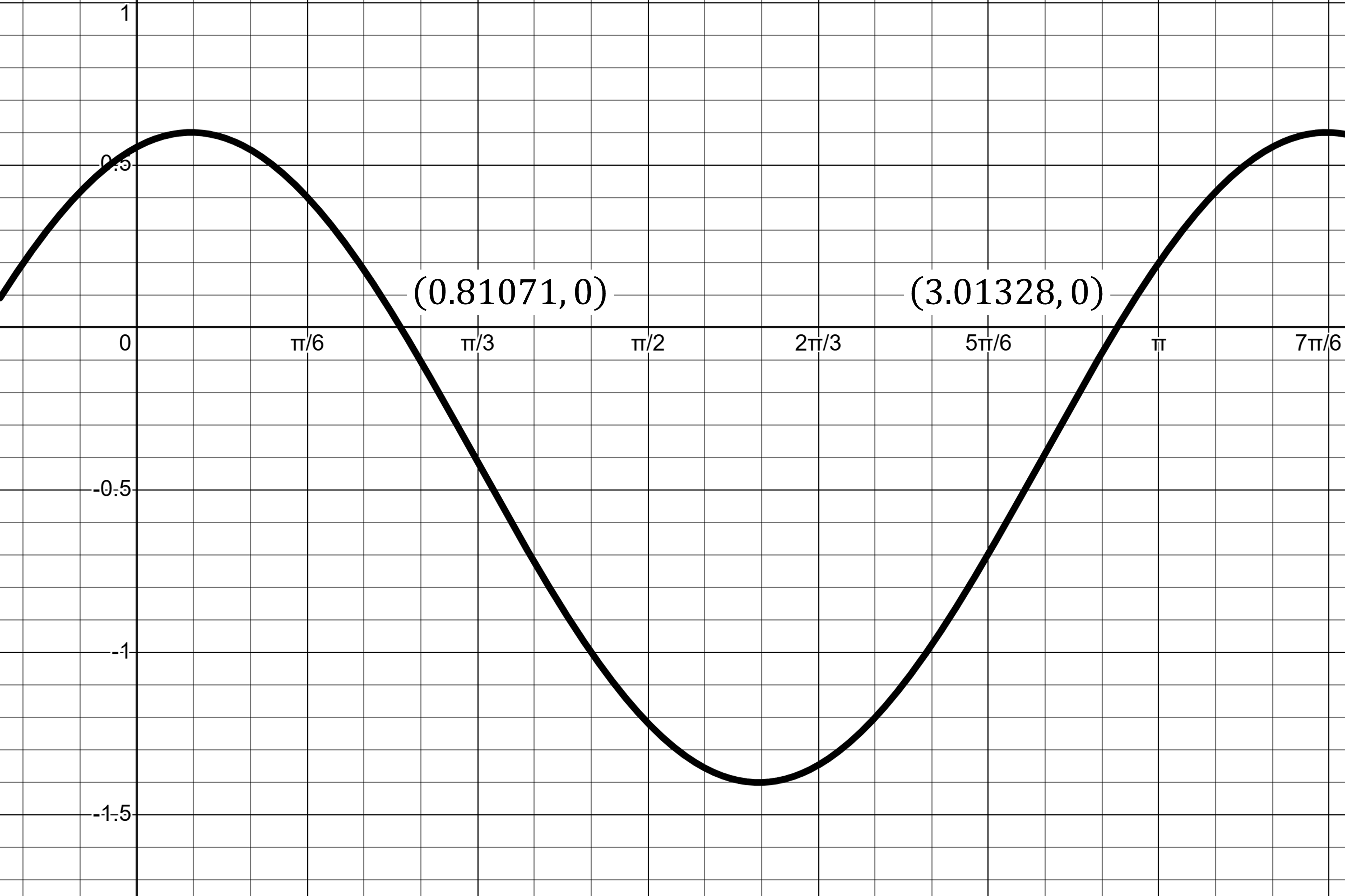
Round the answers to 3 decimal places
Worked Example
The function is given by . Find all input values in the domain of that yield an output value of .
Answer:
Set and rearrange to isolate the cosine function
Define the substitution
Let
So the equation becomes
Since no interval is specified, you need to find the general solution for
Find the initial solution
And by the symmetry of the cosine function, another solution is
Cosine has a period of
so adding integer multiples of to those two solutions gives all the other solutions
Finally,
So you can convert the solution back to by dividing each expression by
Worked Example
The function is given by . Find all input values in the domain of that yield an output value of .
Answer:
Set
Apply the sine function to both sides
Now solve for all real
has a domain of
But only outputs values in
So any real number is a valid input for
I.e. the domain for is all real numbers
Define the substitution
Let
So the equation becomes
The domain is all real numbers, so you need to find the general solution for
Find the initial solution
And by the symmetry of the cosine function, another solution is
Cosine has a period of
so adding integer multiples of to those two solutions gives all the other solutions
Finally,
So you can convert the solution back to by dividing each expression by

Unlock more, it's free!
Join the 100,000+ Students that ❤️ Save My Exams
the (exam) results speak for themselves:

Was this revision note helpful?
Build on this topic