Vertical & Horizontal Dilations (College Board AP® Precalculus): Study Guide

Vertical dilations
What are graph dilations?
When you alter a function in certain ways, the effects on the graph of the function can be described by geometrical transformations
With a dilation all the points on the graph are moved towards or away from either the x- or the y-axis by a constant scale factor

What is a vertical dilation?
If you start with a function and multiply the output by a constant (where )
the new function is called a multiplicative transformation of
The effect on the graph is a vertical dilation (stretch or compression)
every point on the graph is moved farther from or closer to the -axis
If , the graph is stretched vertically (pulled away from the -axis)
If , the graph is compressed vertically (pushed toward the -axis)
If , the graph is also reflected over the -axis (i.e. flipped upside down around the -axis), in addition to the stretch or compression
The dilation factor is
This tells you how much the graph is dilated (stretched or compressed)
Points on the graph after the dilation are times as far from the -axis as they were before the dilation
E.g. for a function
dilates the graph vertically by a factor of
this is a compression
the -coordinates of all points are multiplied by (while -coordinates stay the same)
dilates the graph by a factor of 2 and reflects it over the -axis
this is a stretch (along with the reflection)
the -coordinates of all points are multiplied by (while -coordinates stay the same)
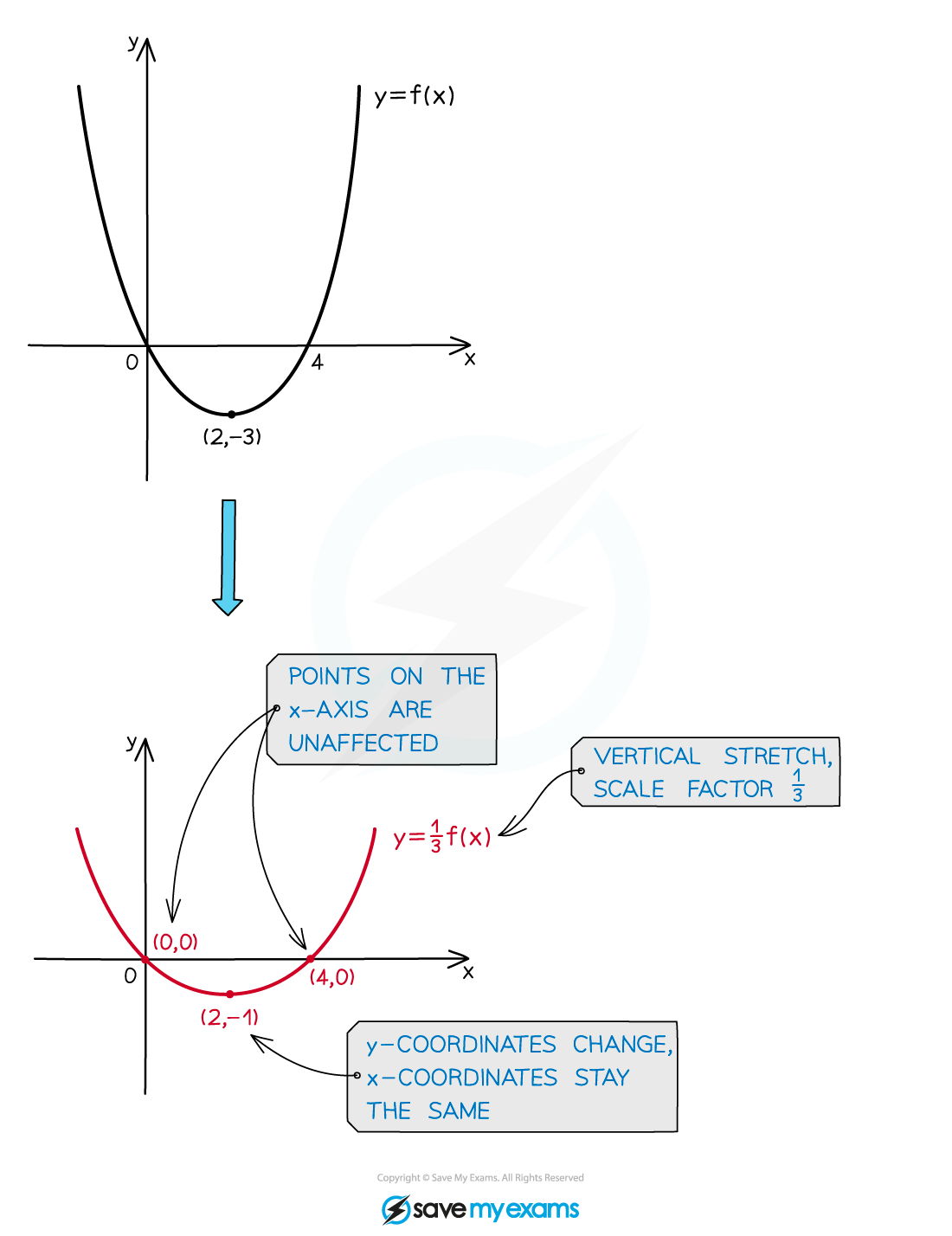
How does a vertical dilation affect key features?
Every output value is multiplied by , so
-intercept
multiplied by
Local maxima and minima
their -values are multiplied by
and if , maxima become minima and vice versa
Horizontal asymptotes
the -value defining the asymptote is multiplied by
Features that depend only on -values are not affected
Zeros (-intercepts) stay in the same place
since
Vertical asymptotes stay in the same place
Intervals of increase/decrease stay the same
unless , which reverses them
How do I find the analytical form of a vertical dilation?
means 'multiply the entire function by '
So if you have an expression for , simply multiply it by to get the analytical form of the transformed function
Simplify if necessary
E.g. if
Then to find
Horizontal dilations
What is a horizontal dilation?
If you start with a function and multiply the input by a constant (where ) before the function is applied
the new function is also called a multiplicative transformation of
i.e., vertical and horizontal dilations are both types of multiplicative transformation
The effect on the graph is a horizontal dilation (stretch or compression)
every point on the graph is moved farther from or closer to the -axis
If , the graph is compressed horizontally (pushed toward the -axis) by a factor of
If , the graph is stretched horizontally (pulled away from the -axis) by a factor of
If , the graph is also reflected over the -axis (i.e. flipped left-to-right around the -axis), in addition to the stretch or compression
The dilation factor is
This tells you how much the graph is dilated (stretched or compressed)
Points on the graph after the dilation are times as far from the -axis as they were before the dilation
Note the counterintuitive behavior
the dilation factor is , not
Multiplying the input by a number greater than 1 actually compresses the graph, rather than stretching it
E.g. for a function
dilates the graph horizontally by a factor of
this is a compression
the -coordinates of all points are multiplied by (while -coordinates stay the same)
dilates the graph horizontally by a factor of 3 and reflects it over the -axis
this is a stretch (along with the reflection)
the -coordinates of all points are multiplied by (while -coordinates stay the same)
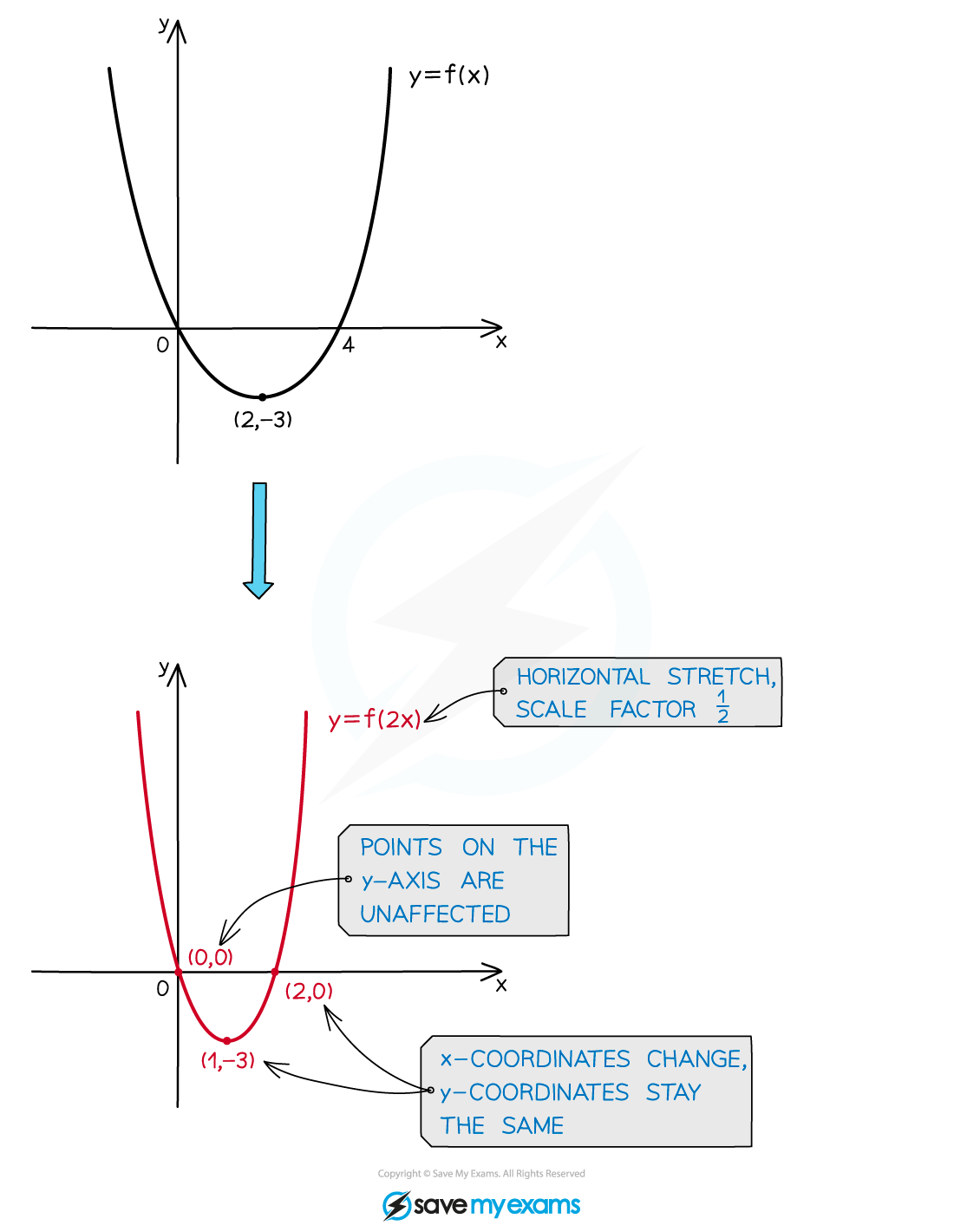
How does a horizontal dilation affect key features?
Every -value on the graph is multiplied by , so features that depend on -values are affected:
Zeros (-intercepts)
their -values are multiplied by
Local maxima and minima
their -values are multiplied by , but the -values stay the same
Vertical asymptotes
their -values are multiplied by
Features that depend only on -values are not affected
-intercept stays the same
since
Horizontal asymptotes stay at the same -value
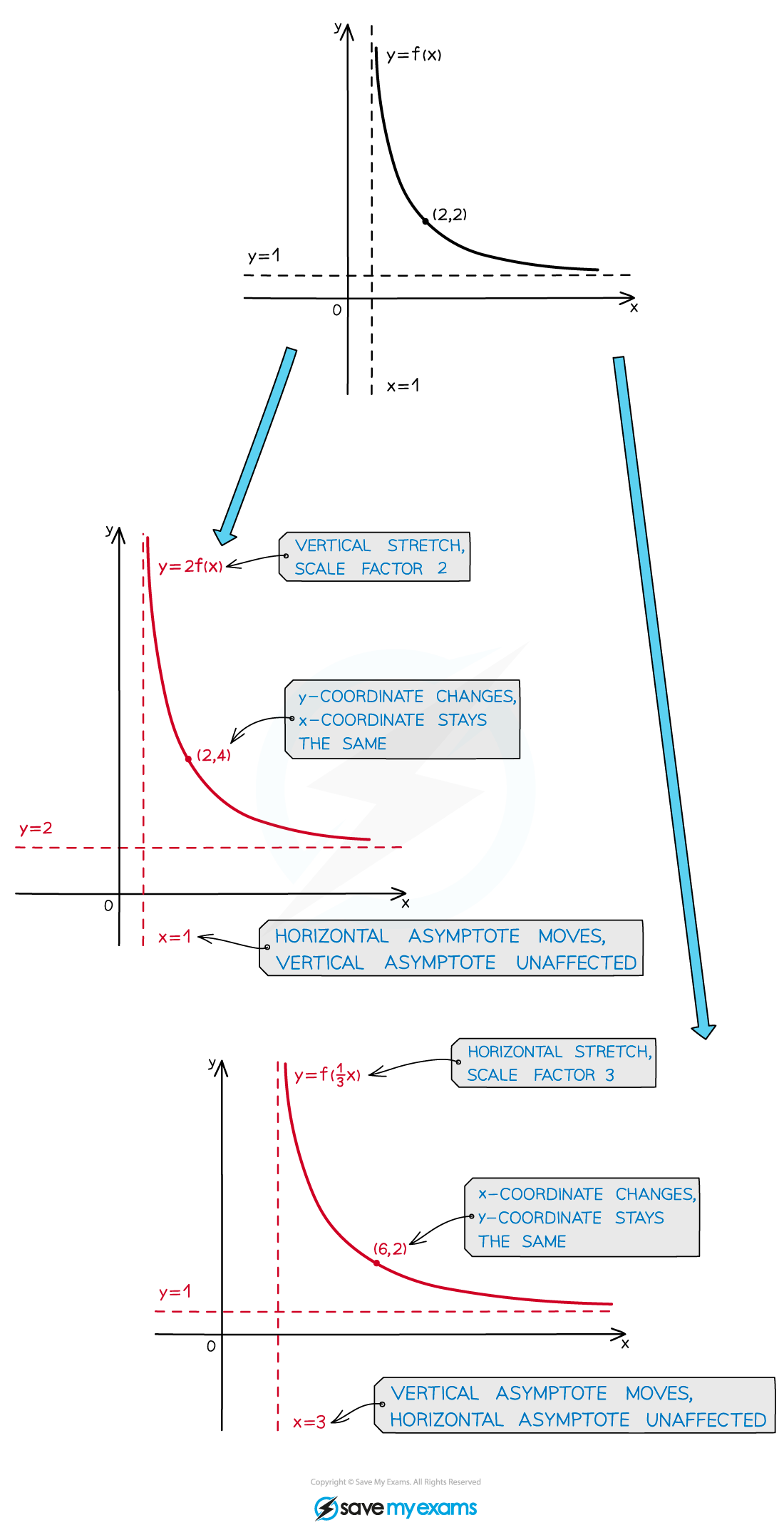
How do I find the analytical form of a horizontal dilation?
means 'replace everywhere in with '
So if you have an expression for , simply put everywhere that is to get the analytical form of the transformed function
Simplify if necessary
E.g. if
Then to find
How can you tell a vertical and horizontal dilation apart?
Vertical dilation
the constant multiplies the output
it appears outside the function
Horizontal dilation
the constant multiplies the input
it appears inside the function
A common mistake is to confuse the two
Just like with translations, the key question is:
Is the constant being applied to the input or the output?
Examiner Tips and Tricks
A common error on the exam is forgetting that horizontal dilation by compresses by a factor of (the reciprocal), not .
Another common error is forgetting that a negative value of or in a dilation also causes a reflection.
Examiner Tips and Tricks
You may find it useful to think about 'stretches' or 'compressions' to distinguish between cases where the graph gets bigger or smaller.
However, the mathematically correct term for both of those is 'dilation'.
If you are asked to describe a multiplicative transformation on the exam, be sure to use the term 'dilation' along with the correct dilation factor.
Worked Example
The function is given by . The graph of which of the following functions is the image of the graph of after a vertical dilation of the graph of by a factor of 3?
(A) , because this is an additive transformation of that results from adding 3 to .
(B) , because this is an additive transformation of that results from adding 3 to each input value .
(C) , because this is a multiplicative transformation of that results from multiplying by 3.
(D) , because this is a multiplicative transformation of that results from multiplying each input value by 3.
Answer:
Additive transformations cause translations, not dilations
So you can rule out (A), which is a vertical translation up by 3 units
and also (B), which is a horizontal translation to the left by 3 units
Multiplying each input value by 3 gives
That is function in option (D)
But multiplying the input value by 3 causes a horizontal dilation by a factor of
Multiplying by 3 gives
That is function in option (C)
And indeed multiplying the function by 3 causes a vertical dilation by a factor of 3
(C) , because this is a multiplicative transformation
of that results from multiplying by 3
Examiner Tips and Tricks
On the exam, incorrect answers in multiple choice questions often include an option that applies the constant to the wrong part of the function.
E.g. multiplying inputs when the question asks for a vertical dilation, or vice versa

Unlock more, it's free!
Join the 100,000+ Students that ❤️ Save My Exams
the (exam) results speak for themselves:

Was this revision note helpful?
Build on this topic