Transformations of Functions (College Board AP® Precalculus): Exam Questions

3 mins3 questions
1
Sme Calculator
1 mark

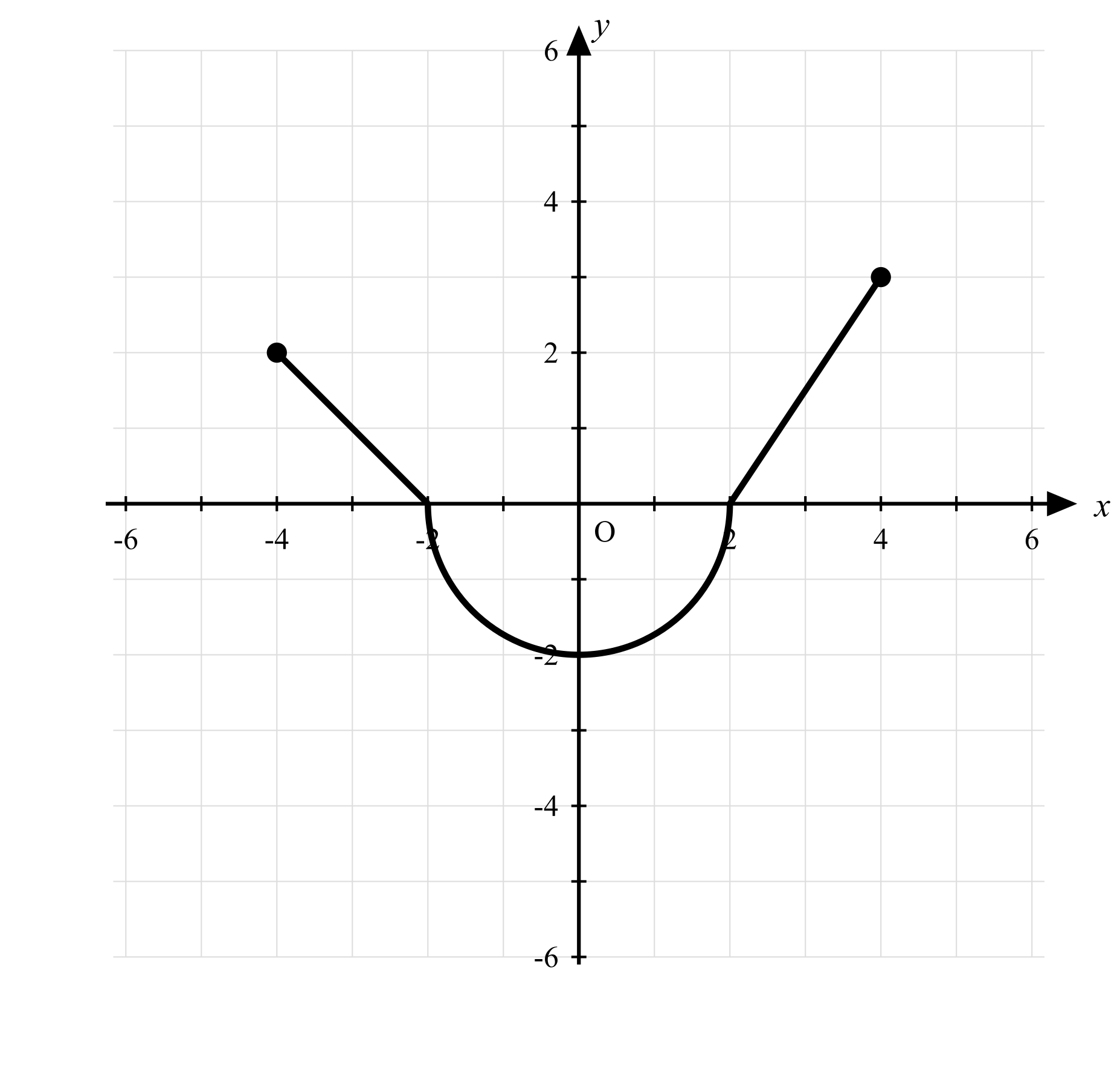
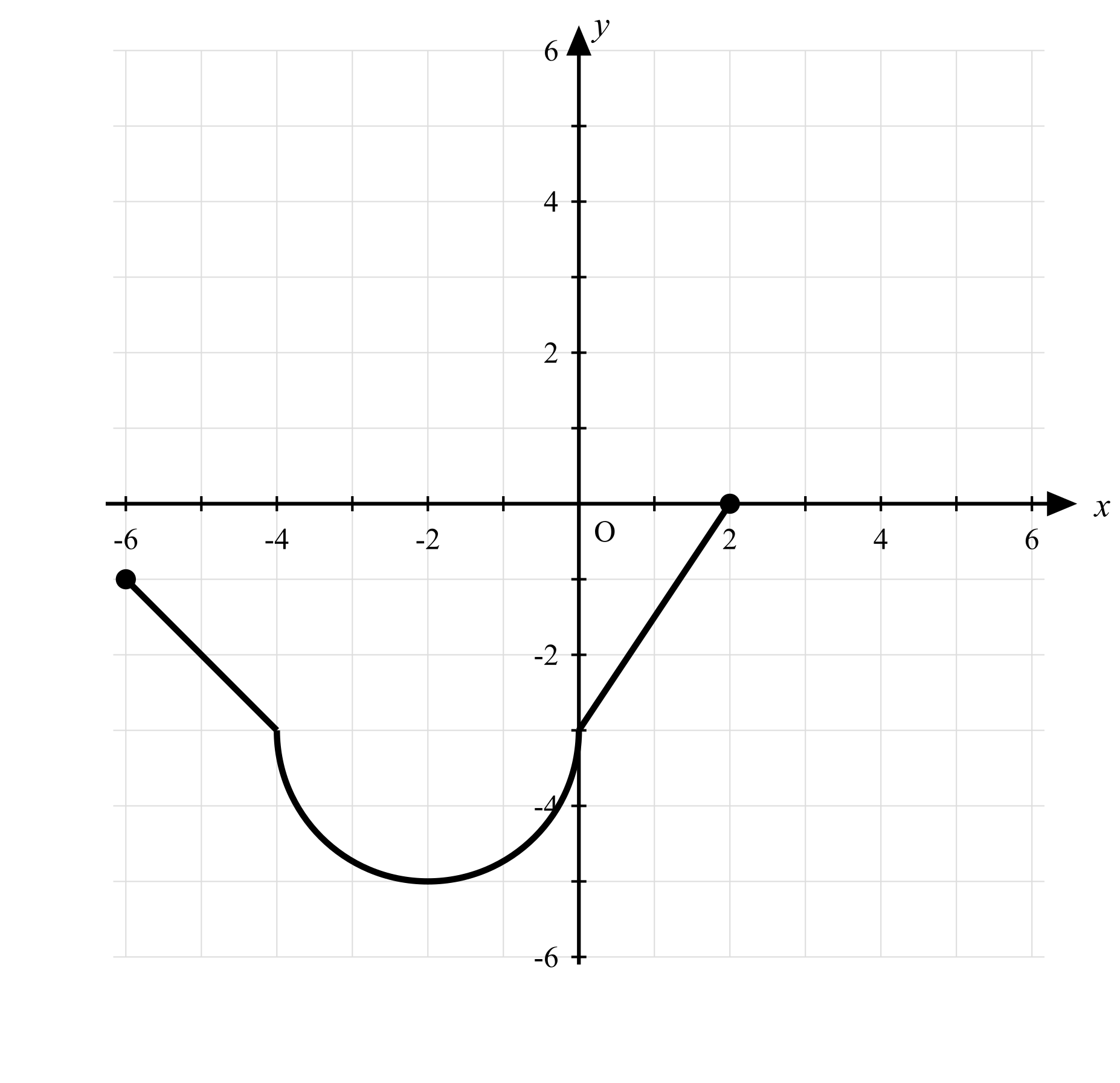
The graph of y = f \left(x\right), consisting of three line segments and a semicircle, is shown.

Graph of a piecewise function f on an axes from −6 ≤ x ≤ 6, consisting of a line segment from (−4, 2) to (−2, 0), a semicircle from (−2, 0) curving down to a minimum at (0, −2) and back up to (2, 0), and a line segment from (2, 0) to (4, 3). Closed dots at the endpoints (−4, 2) and (4, 3).
Graph of f

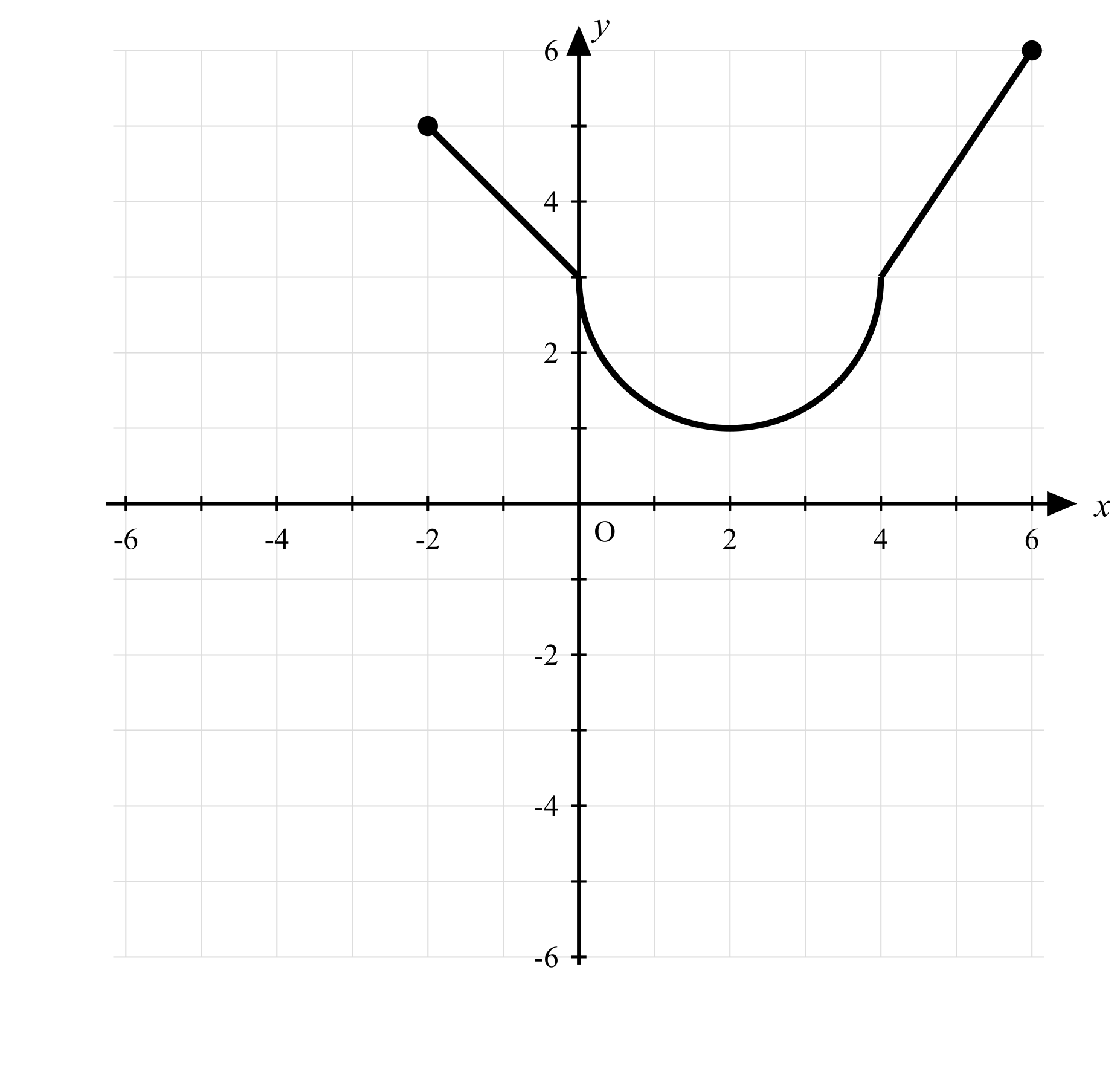
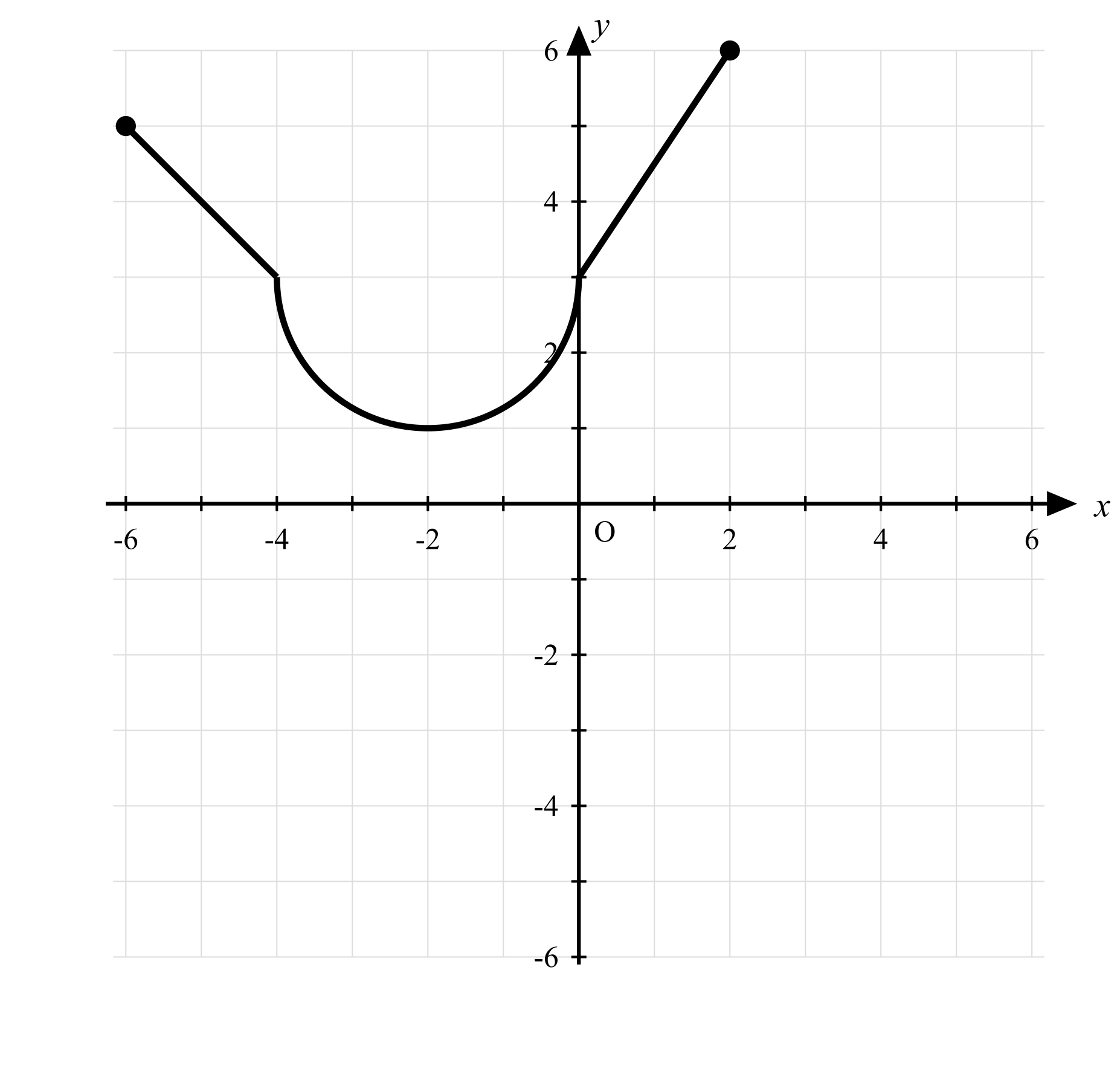
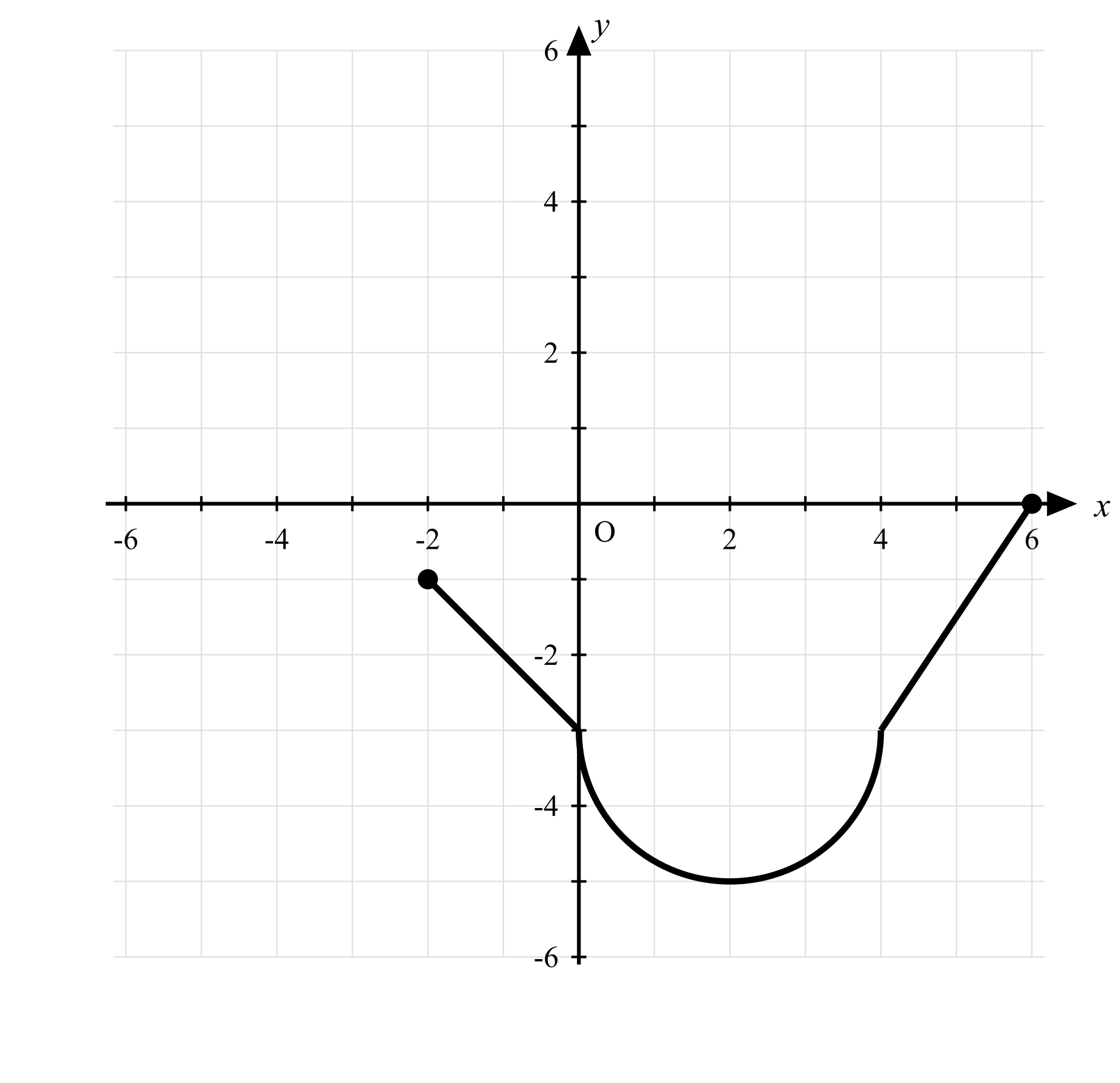
Which of the following is the transformed graph for y = f \left(x - 2\right) + 3 ?

  • Graph of a piecewise function on axes from −6 to 6 (x) and −6 to 6 (y). A line segment from (−2, 5) descends to (0, 3), a semicircle curves down from (0, 3) to a minimum at (2, 1) and back up to (4, 3), and a line segment rises steeply from (4, 3) upward. Closed dot at (−2, 5).
  • Graph of a piecewise function on axes from −6 to 6 (x) and −6 to 6 (y). A line segment descends from upper left to (−4, 3), a semicircle curves down from (−4, 3) to a minimum at (−2, 1) and back up to (0, 3), and a line segment rises steeply from (0, 3) upward.
  • Graph of a piecewise function on axes from −6 to 6 (x) and −6 to 6 (y). A line segment from (−2, −1) descends to (0, −3), a semicircle curves down from (0, −3) to a minimum at (2, −5) and back up to (4, −3), and a line segment rises from (4, −3) to (6, 0). Closed dots at (−2, −1) and (6, 0).
  • Graph of a piecewise function on axes from −6 to 6 (x) and −6 to 6 (y). A line segment descends from upper left to (−4, −3), a semicircle curves down from (−4, −3) to a minimum at (−2, −5) and back up to (0, −3), and a line segment rises from (0, −3) to (2, 0). Closed dot at (2, 0).
2
Sme Calculator
1 mark

The function f is given by f \left(x\right) = 2 x^{2} - x + 4. The graph of which of the following functions is the image of the graph of f after a vertical dilation of the graph of f by a factor of 3 ?

  • m \left(x\right) = 18 x^{2} - 3 x + 4, because this is a multiplicative transformation of f that results from multiplying each input value x by 3.

  • k \left(x\right) = 6 x^{2} - 3 x + 12, because this is a multiplicative transformation of f that results from multiplying f \left(x\right) by 3.

  • p \left(x\right) = 2 \left(x + 3\right)^{2} - \left(x + 3\right) + 4, because this is an additive transformation of f that results from adding 3 to each input value x.

  • n \left(x\right) = 2 x^{2} - x + 7, because this is an additive transformation of f that results from adding 3 to f \left(x\right).

3
Sme Calculator
1 mark

The functions f and g are defined for all real numbers such that g \left(x\right) = f \left(3 \left(x + 2\right)\right). Which of the following sequences of transformations maps the graph of f to the graph of g in the same x y-plane?

  • A horizontal dilation of the graph of f by a factor of 3, followed by a horizontal translation of the graph of f by - 2 units

  • A horizontal dilation of the graph of f by a factor of 3, followed by a horizontal translation of the graph of f by 2 units

  • A horizontal dilation of the graph of f by a factor of \frac{1}{3}, followed by a horizontal translation of the graph of f by - 2 units

  • A horizontal dilation of the graph of f by a factor of \frac{1}{3}, followed by a horizontal translation of the graph of f by 2 units