Composite & Inverse Functions (College Board AP® Precalculus): Free Response Questions

46 mins34 questions
1
2 points

The function  f is decreasing and is defined for all real numbers. The table gives values for  f(x) at selected values of x.

 x

-2

-1

0

1

2

 f(x)

14

7

3.5

1.75

0.875

The function g is given by g(x)=−0.167x3+x2−1.834.

(i) The function h is defined by h(x)=(g∘f)(x)=g(f(x)). Find the value of h(1) as a decimal approximation, or indicate that it is not defined. Show the work that leads to your answer.

(ii) Find the value of  f−1(3.5), or indicate that it is not defined.

2a
2 points
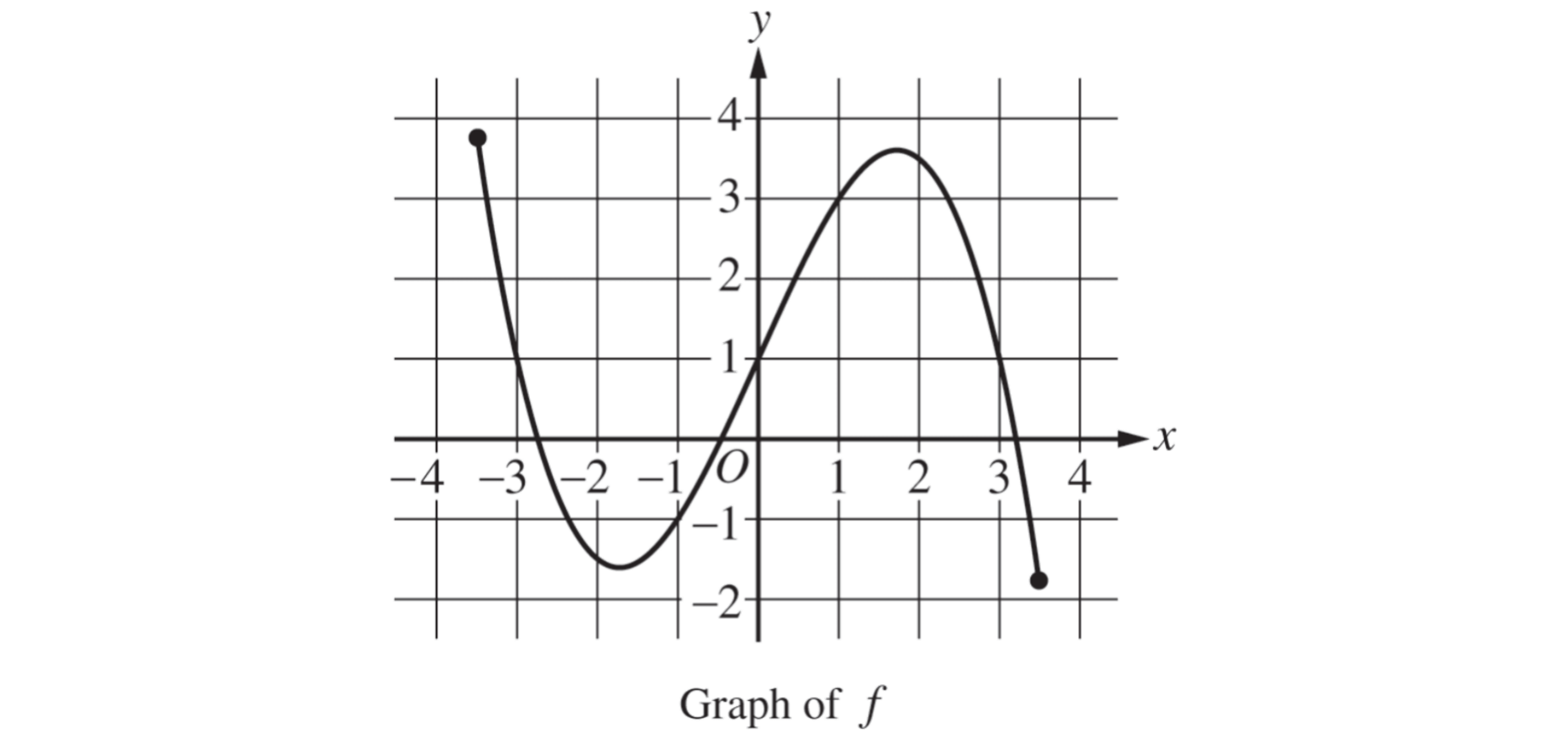
Graph of a function on a grid, with a curve starting at x=-3.5 and ending at x=3.5. From the start, it dips down, then turns back up, and then dips down again before getting to x=3.5. The points (-3, 1), (0, 1) and (3, 1) are on the curve.

The figure shows the graph of the function  f on its domain of −3.5≤x≤3.5. The points (−3, 1), (0, 1), and (3, 1) are on the graph of  f. The function g is given by g(x)=2.916·(0.7)x.

(i) The function h is defined by h(x)=(g∘f)(x)=g(f(x)). Find the value of h(3) as a decimal approximation, or indicate that it is not defined.

(ii) Find all values of x for which  f(x)=1, or indicate that there are no such values.

2b
2 points

(i) Determine if  f has an inverse function.

(ii) Give a reason for your answer based on the definition of a function and the graph of y=f(x).

3
1 point

The function h is given by h(x)=(2x−5)3.

Express h(x) as a composition  f(g(x)), where  f and g are functions and neither  f nor g is the identity function. Give explicit expressions for  f(x) and g(x).

4
1 point

The function  f is given by  f(x)=x3+2. Let  f−1 be the inverse function of  f.

Find the exact value of  f(f−1(11)).

5
1 point

The function  f is increasing and is defined for 0≤x≤5. The range of  f is −2≤y≤18. Let  f−1 be the inverse function of  f.

State the domain and range of  f−1.

6
2 points

The graph of a function  f in the xy-plane passes through the points (−1,0) and (2,5). Let  f−1 be the inverse function of  f.

State the coordinates of two points that must lie on the graph of  f−1. Then describe how the graph of  f−1 relates geometrically to the graph of  f.

7
2 points

The function  f is increasing and is defined for x>0. The table gives values of  f(x) at selected values of x.

x

1

2

4

8

16

 f(x)

3

5

7

9

11

The function g is given by g(x)=−0.1371x4+x3−1.2x2.

(i) The function h is defined by h(x)=(g∘f)(x)=g(f(x)). Find the value of h(2) as a decimal approximation, or indicate that it is not defined. Show the work that leads to your answer.

(ii) Find the value of  f−1(7), or indicate that it is not defined.

8
2 points

The function  f is increasing and is defined for x≥0. The table gives values of  f(x) at selected values of x.

x

0

1

2

3

4

 f(x)

3

5

9

15

23

The function g is given by g(x)=2x3−5x+1x−3.

(i) The function h is defined by h(x)=(g∘f)(x)=g(f(x)). Find the value of h(2) as a decimal approximation, or indicate that it is not defined. Show the work that leads to your answer.

(ii) Find the value of  f−1(5), or indicate that it is not defined.

9
2 points

The function  f is given by  f(x)=3x+1x−2 for  x≠2.

Find an expression for  f−1(x). Show the work that leads to your answer.

10
2 points

The number of mugs a small company sells per week depends on the amount spent on advertising, x dollars, according to the function N given by N(x)=30+0.05x.

The weekly revenue, in dollars, depends on the number of mugs sold, N, according to the function R given by R(N)=7.50·N−80.

Find the value of (R∘N)(400). Interpret the meaning of your answer in the context of the problem.

11
2 points

The function  f is given by  f(x)=x−5 for x≥5. The function g is given by g(x)=x2+1 for all real numbers x.

(i) Find a simplified expression for (f∘g)(x)=f(g(x)).

(ii) State the domain of f∘g.

12
2 points

The function  f is given by  f(x)=2x+3x−1 for x≠1. The function g is given by g(x)=x2+4 for x≥0.

(i) Find an expression for  f−1(x).

(ii) Find the value of  f−1(g(2)) as a decimal approximation. Show the work that leads to your answer.

13
2 points

The function  f is an increasing function defined for all real numbers. The table gives values of  f at selected values of x.

x

−2

0

1

3

5

 f(x)

2

6

8

10

12

The function g is given by g(x)=x2−2x+5 for x≥1.

(i) Find the value of  f−1(2).

(ii) Find the value of g−1(f(0)) as a decimal approximation. Show the work that leads to your answer.