Logarithmic Functions as Inverses of Exponential Functions (College Board AP® Precalculus): Study Guide

Roger B

Written by: Roger B

Reviewed by: Mark Curtis

Updated on

Logarithmic functions as inverses of exponential functions

  • The logarithmic function space f left parenthesis x right parenthesis equals log subscript b x

    • and the exponential function g left parenthesis x right parenthesis equals b to the power of x

      • where b greater than 0 and b not equal to 1

    • are inverse functions of each other

  • This means they "undo" each other:

    • bold log subscript bold italic b bold left parenthesis bold italic b to the power of bold italic x bold right parenthesis bold equals bold italic x

      • taking the log of an exponential with the same base returns the exponent

    • bold italic b to the power of bold l bold o bold g subscript bold italic b bold italic x end exponent bold equals bold italic x

      • raising a base to a logarithm with the same base returns the original value inside the logarithm

  • More formally, if space f left parenthesis x right parenthesis equals log subscript b x and g left parenthesis x right parenthesis equals b to the power of x

    • then space f left parenthesis g left parenthesis x right parenthesis right parenthesis equals g left parenthesis f left parenthesis x right parenthesis right parenthesis equals x

How do the input-output behaviors of logarithmic and exponential functions compare?

  • Exponential and logarithmic functions handle change in opposite ways

  • In an exponential function

    • when input values increase by equal amounts (additively)

    • the output values change by equal ratios (multiplicatively)

  • In a logarithmic function, the relationship is reversed

    • when input values change by equal ratios (multiplicatively)

    • the output values increase by equal amounts (additively)

  • E.g. for g left parenthesis x right parenthesis equals 2 to the power of x

    • increasing x by 1 (additive change)

    • always doubles the output (multiplicative change)

  • For space f left parenthesis x right parenthesis equals log subscript 2 x

    • doubling x (multiplicative change)

    • always increases the output by 1 (additive change)

x

g left parenthesis x right parenthesis equals 2 to the power of x

x

space f left parenthesis x right parenthesis equals log subscript 2 x

0

1

1

0

1

2

2

1

2

4

4

2

3

8

8

3

4

16

16

4

  • Notice that the tables are mirrors of each other

    • The inputs and outputs are swapped

    • This is exactly the inverse relationship at work

How do ordered pairs relate between the two functions?

  • If bold left parenthesis bold italic s bold comma bold italic t bold right parenthesis is a point on the graph of the exponential function g left parenthesis x right parenthesis equals b to the power of x

    • then bold left parenthesis bold italic t bold comma bold italic s bold right parenthesis is a point on the graph of the logarithmic function space f left parenthesis x right parenthesis equals log subscript b x

  • This follows directly from the inverse relationship

    • if b to the power of s equals t, then log subscript b t equals s

  • E.g. since 2 cubed equals 8

    • the point left parenthesis 3 comma 8 right parenthesis is on the graph of g left parenthesis x right parenthesis equals 2 to the power of x

    • and the point left parenthesis 8 comma 3 right parenthesis is on the graph of space f left parenthesis x right parenthesis equals log subscript 2 x

Graphs of logarithmic functions

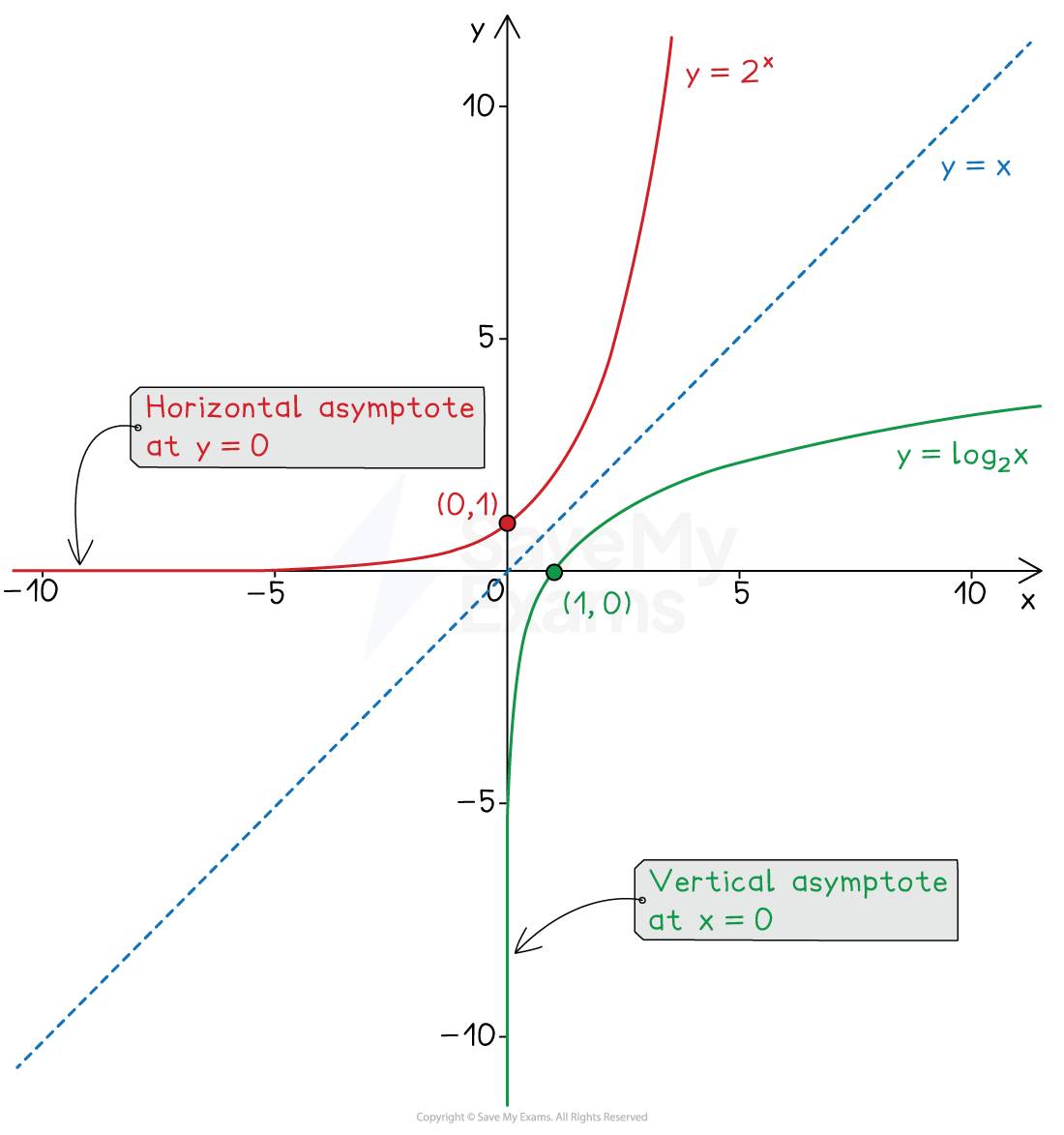
  • The graph of space f left parenthesis x right parenthesis equals log subscript b x is the reflection of the graph of g(x) = b^x over the line space bold italic y bold equals bold italic x

    • This is true for any base b (with b greater than 0 and b not equal to 1)

    • It follows from the general principle that the graph of any function and its inverse are reflections of each other over space y equals x

  • Note how features of the graphs swap under reflection:

    • The exponential function has a horizontal asymptote (space y equals 0)

      • the logarithmic function has a vertical asymptote (x = 0)

    • The exponential function passes through bold left parenthesis bold 0 bold comma bold 1 bold right parenthesis

      • the logarithmic function passes through bold left parenthesis bold 1 bold comma bold 0 bold right parenthesis

    • The exponential function has domain all real numbers and range y > 0

      • the logarithmic function has domain x > 0 and range all real numbers

    • These graph features are true for any base b (with b greater than 0 and b not equal to 1)

Graph showing lines y=x, y=2^x, and y=log_2(x). Asymptotes at y=0 and x=0, points at (0,1) and (1,0).
Graphs of exponential and logarithmic functions

Worked Example

The exponential function g left parenthesis x right parenthesis equals 3 to the power of x and the logarithmic function space f left parenthesis x right parenthesis equals log subscript 3 x are inverse functions.

(a) Without using a calculator, complete the tables of values for g(x) = 3^xand space f left parenthesis x right parenthesis equals log subscript 3 x.

x

-2

-1

0

1

2

3

g(x) = 3^x

x

\frac{1}{9}

\frac{1}{3}

1

3

9

27

f left parenthesis x right parenthesis equals log subscript 3 x

Answer:

You can use rules of exponents to complete the table for g

3 to the power of negative 2 end exponent equals 1 over 3 squared equals 1 over 9 space space space space space space space space space space space space space 3 to the power of negative 1 end exponent equals 1 over 3 to the power of 1 equals 1 third space space space space space space space space space space space space space 3 to the power of 0 equals 1

3 to the power of 1 equals 3 space space space space space space space space space space space space space 3 squared equals 9 space space space space space space space space space space space space space 3 cubed equals 27

x

-2

-1

0

1

2

3

g left parenthesis x right parenthesis equals 3 to the power of x

\frac{1}{9}

\frac{1}{3}

1

3

9

27

To find the table for space f left parenthesis x right parenthesis equals log subscript 3 x, swap the inputs and outputs in the table for g

  • This works because the functions are inverses

x

\frac{1}{9}

\frac{1}{3}

1

3

9

27

space f left parenthesis x right parenthesis equals log subscript 3 x

-2

-1

0

1

2

3

 
(b) Show that space f left parenthesis g left parenthesis x right parenthesis right parenthesis equals x by evaluating space f left parenthesis g left parenthesis 2 right parenthesis right parenthesis.

Answer:

Start with the value of g open parentheses 2 close parentheses

g left parenthesis 2 right parenthesis equals 3 squared equals 9

Substitute that into space f open parentheses x close parentheses, and find the value

space f left parenthesis g left parenthesis 2 right parenthesis right parenthesis equals f left parenthesis 9 right parenthesis equals log subscript 3 9 equals 2

So the output is equal to the input

The value of space f open parentheses g open parentheses 2 close parentheses close parentheses equals the original input (2), illustrating the fact that space f left parenthesis g left parenthesis x right parenthesis right parenthesis equals x

Rewriting exponential functions using logarithms

How can logarithms be used to rewrite exponential expressions?

  • Logarithms provide a way to change the base of an exponential expression

    • This can be useful for comparing or simplifying expressions

  • The key identity is b to the power of x equals c to the power of left parenthesis log subscript c b right parenthesis open parentheses x close parentheses end exponent

    • This works because b equals c to the power of log subscript c b end exponent

      • I.e., by the inverse properties of logarithms and exponentials

      • c to the power of square 'cancels' log subscript c

    • Therefore b to the power of x equals open parentheses c to the power of log subscript c b end exponent close parentheses to the power of x equals c to the power of left parenthesis log subscript c b right parenthesis open parentheses x close parentheses end exponent

Examiner Tips and Tricks

The identity b to the power of x equals c to the power of left parenthesis log subscript c b right parenthesis open parentheses x close parentheses end exponent may look complicated

  • But it follows directly from the fact that b can be written as c to the power of log subscript c b end exponent

  • If you can remember that one fact, you can derive the rest

Also be careful with the notation here!

  • left parenthesis log subscript c b right parenthesis open parentheses x close parentheses means

    • the number log subscript c b

    • times the input variable x

  • It does not mean log subscript c open parentheses b x close parentheses

    • which is the logarithm to base c of b x

  • This means any exponential function can be rewritten using any base you choose

    • With the notation used above, you can use the identity to rewrite an exponential with base b as an exponential with base c

  • E.g. rewrite 3 to the power of x using the base e

    • Use the identity

      • 3 to the power of x equals e to the power of left parenthesis ln 3 right parenthesis open parentheses x close parentheses end exponent

        • since ln 3 equals log subscript e 3

    • Or with the brackets expanded

      • 3^x = e^{x \ln 3}

  • E.g. rewrite 5 to the power of x using base 10

    • Using the identity

      • 5 to the power of x equals 10 to the power of left parenthesis log subscript 10 5 right parenthesis open parentheses x close parentheses end exponent

    • Or with the brackets expanded

      • 5 to the power of x equals 10 to the power of x log 5 end exponent

Examiner Tips and Tricks

A very common application is converting any exponential to base e.

  • For this the formula can be written more simply as b to the power of x equals e to the power of x ln b end exponent

When rewriting exponential expressions in a free response question on the exam, always show the intermediate steps clearly.

Worked Example

Rewrite each of the following exponential expressions in the specified form.

(a) Rewrite 7 to the power of x in the form e^{kx}, where k is a constant. Express k as a decimal approximation to three decimal places.

Answer:

Use the identity b to the power of x equals e to the power of left parenthesis ln b right parenthesis open parentheses x close parentheses end exponent with b equals 7

7 to the power of x equals e to the power of left parenthesis ln 7 right parenthesis open parentheses x close parentheses end exponent

Use a calculator to find the value of ln 7

k equals ln 7 equals 1.945910...

Round k to 3 decimal places

7 to the power of x equals e to the power of 1.946 x end exponent

(b) Rewrite 4^x in the form 2 to the power of m x end exponent, where m is a constant.

Answer:

The easiest way to do this is to substitute2 squared in place of 4

  • and then use rules of exponents

4 to the power of x equals left parenthesis 2 squared right parenthesis to the power of x equals 2 to the power of 2 x end exponent

That is in the form you are looking for, with m equals 2

You could also work this out using the identity b to the power of x equals c to the power of left parenthesis log subscript c b right parenthesis open parentheses x close parentheses end exponent

  • with b equals 4 and c equals 2

4 to the power of x equals 2 to the power of left parenthesis log subscript 2 4 right parenthesis open parentheses x close parentheses end exponent equals 2 to the power of left parenthesis 2 right parenthesis open parentheses x close parentheses end exponent equals 2 to the power of 2 x end exponent

  • That follows since log subscript 2 4 equals 2

4 to the power of x equals 2 to the power of 2 x end exponent

Unlock more, it's free!

Join the 100,000+ Students that ❤️ Save My Exams

the (exam) results speak for themselves:

Roger B

Author: Roger B

Expertise: Maths Content Creator

Roger's teaching experience stretches all the way back to 1992, and in that time he has taught students at all levels between Year 7 and university undergraduate. Having conducted and published postgraduate research into the mathematical theory behind quantum computing, he is more than confident in dealing with mathematics at any level the exam boards might throw at you.

Mark Curtis

Reviewer: Mark Curtis

Expertise: Maths Content Creator

Mark graduated twice from the University of Oxford: once in 2009 with a First in Mathematics, then again in 2013 with a PhD (DPhil) in Mathematics. He has had nine successful years as a secondary school teacher, specialising in A-Level Further Maths and running extension classes for Oxbridge Maths applicants. Alongside his teaching, he has written five internal textbooks, introduced new spiralling school curriculums and trained other Maths teachers through outreach programmes.