The Complex Plane (College Board AP® Precalculus): Study Guide

Roger B

Written by: Roger B

Reviewed by: Mark Curtis

Updated on

Complex numbers & rectangular coordinates

What is a complex number?

  • A complex number is a number of the form a plus b i, where

    • a and b are real numbers

    • i is the imaginary unit, defined by i squared equals negative 1

      • or equivalently, i equals square root of negative 1 end root

  • The real number a is called the real part of the complex number

  • The real number b is called the imaginary part of the complex number

    • E.g. the complex number 3 minus 5 i has real part 3 and imaginary part negative 5

  • Every real number is also a complex number

    • A real number a can be written as a plus 0 i

      • i.e. with real part a and imaginary part 0

Examiner Tips and Tricks

Familiarity with complex numbers is a prerequisite for the AP® Precalculus course.

How are complex numbers represented using rectangular coordinates?

  • A complex number can be represented as a point in a plane, called the complex plane

    • The horizontal axis is the real axis (Re)

    • The vertical axis is the imaginary axis (Im)

  • The complex number a plus b i is represented by the point with rectangular coordinates left parenthesis a comma   b right parenthesis

    • The real part a gives the horizontal coordinate

    • The imaginary part b gives the vertical coordinate

  • E.g. the complex number 4 plus 2 i corresponds to the point left parenthesis 4 comma   2 right parenthesis in the complex plane

    • or going the other way, the point with rectangular coordinates left parenthesis negative 3 comma   minus 3 right parenthesis in the complex plane corresponds to the complex number negative 3 minus 3 i

  • Note that a real number like 2 equals 2 plus 0 i is located on the real axis

    • and a purely imaginary number like i equals 0 plus i is located on the imaginary axis

Graph with complex numbers plotted as points: 4+2i at (4,2), -3-3i at (-3,-3), 2 at (2,0), and i at (0,1), with labels for each.
Representing complex numbers using rectangular coordinates in the complex plane

Complex numbers & polar coordinates

How are complex numbers represented using polar coordinates?

  • Since a complex number corresponds to a point in the complex plane, it can also be described using polar coordinates left parenthesis r comma   theta right parenthesis

    • r is the signed radius value

    • theta is the angle in standard position whose terminal ray includes the point

  • If a complex number has polar coordinates left parenthesis r comma   theta right parenthesis

    • then its rectangular coordinates are left parenthesis r cos theta comma   r sin theta right parenthesis

      • This follows directly from the standard conversion formulas

        • x equals r cos theta and y equals r sin theta

    • Substituting into the a + bi form gives the polar form of the complex number:

      • (r\cos\theta) + i(r\sin\theta)

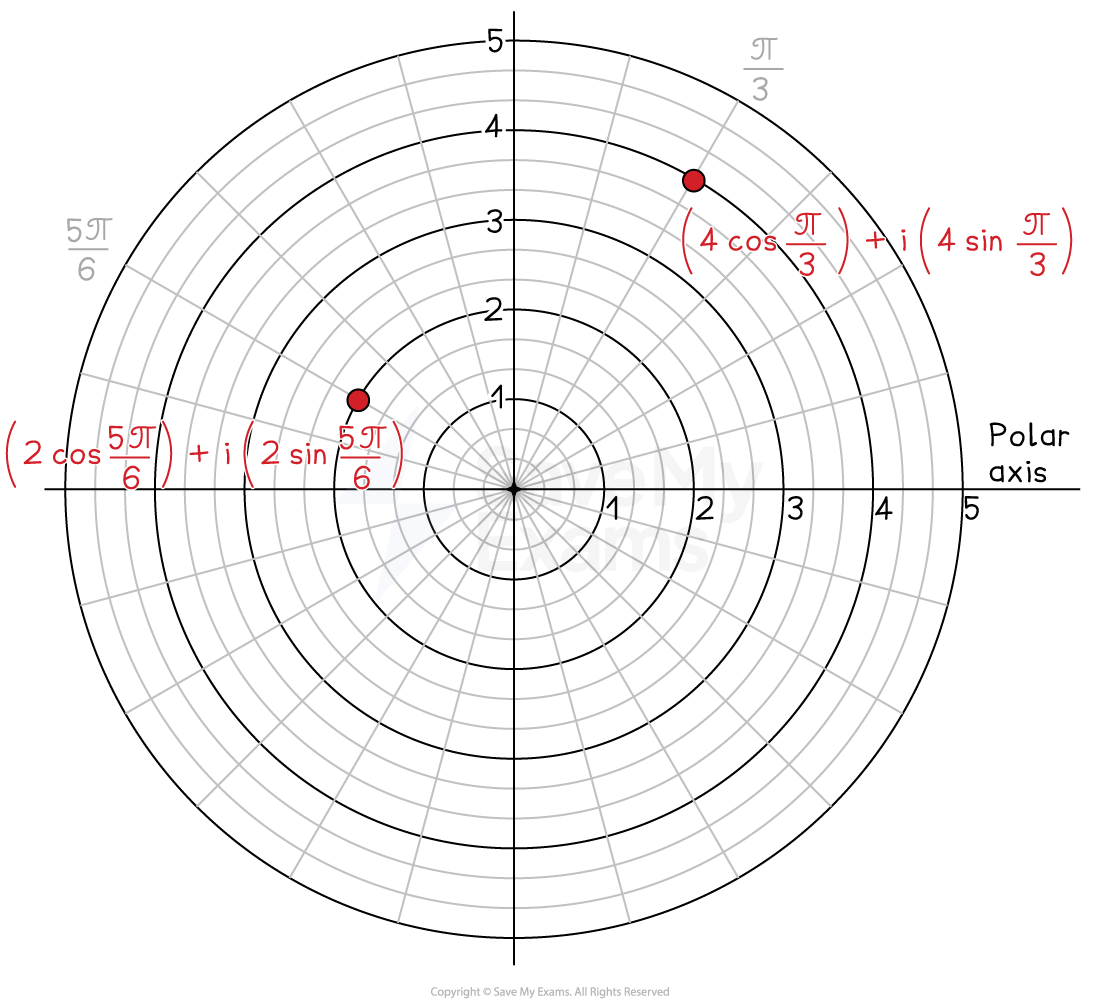
  • E.g. the complex number with polar coordinates open parentheses 4 comma   pi over 3 close parentheses can be written as open parentheses 4 cos pi over 3 close parentheses plus i open parentheses 4 sin pi over 3 close parentheses

    • which simplifies to 2 plus 2 square root of 3   i in the a plus b i form

      • i.e. because cos pi over 3 equals 1 half and sin pi over 3 equals fraction numerator square root of 3 over denominator 2 end fraction

  • Going the other way, to convert a complex number a plus b i to polar form

    • use the same rectangular-to-polar conversion formulas from the polar coordinate system

      • r equals square root of a squared plus b squared end root

      • theta equals arctan open parentheses b over a close parentheses space for space a greater than 0

      • theta equals arctan open parentheses b over a close parentheses plus pi space for space a less than 0

  • E.g. to convert negative square root of 3 plus   i to polar form

    • r equals square root of left parenthesis negative square root of 3 right parenthesis squared plus 1 squared end root equals square root of 4 equals 2

    • Since a equals negative square root of 3 less than 0

      • theta equals arctan open parentheses fraction numerator 1 over denominator negative square root of 3 end fraction close parentheses plus pi equals negative pi over 6 plus pi equals fraction numerator 5 pi over denominator 6 end fraction

    • So the polar form is open parentheses 2 cos fraction numerator 5 pi over denominator 6 end fraction close parentheses plus i open parentheses 2 sin fraction numerator 5 pi over denominator 6 end fraction close parentheses

      • with polar coordinates open parentheses 2 comma space fraction numerator 5 pi over denominator 6 end fraction close parentheses

Polar grid with two marked complex points. The first is at radius 2, angle 5π/6; the second at radius 4, angle π/3. Both are annotated with equivalent expressions in (rcosθ)+i(rsinθ) form.
Representing complex numbers using polar coordinates

Examiner Tips and Tricks

The polar form of a complex number is written with two factors of r, one multiplying the cosine and one multiplying the sine.

  • A common error is to leave the r out and write cos theta plus i sin theta, which only works when r equals 1

When converting from a plus b i to polar form, treat it exactly like converting the rectangular coordinates left parenthesis a comma   b right parenthesis to polar coordinates.

  • The only difference is in how the final answer is written

Worked Example

A complex number is represented by a point in the complex plane. The complex number has the rectangular coordinates left parenthesis negative 1 comma   square root of 3 right parenthesis. Which of the following is one way to express the complex number using its polar coordinates left parenthesis r comma   theta right parenthesis?

(A) open parentheses 2 cos fraction numerator 2 pi over denominator 3 end fraction close parentheses plus i open parentheses 2 sin fraction numerator 2 pi over denominator 3 end fraction close parentheses

(B) open parentheses cos fraction numerator 2 pi over denominator 3 end fraction close parentheses plus i open parentheses sin fraction numerator 2 pi over denominator 3 end fraction close parentheses

(C) open parentheses 2 cos open parentheses negative pi over 3 close parentheses close parentheses plus i open parentheses 2 sin open parentheses negative pi over 3 close parentheses close parentheses

(D) open parentheses cos open parentheses negative pi over 3 close parentheses close parentheses plus i open parentheses sin open parentheses negative pi over 3 close parentheses close parentheses

Answer:

Start by finding r from the rectangular coordinates

r equals square root of left parenthesis negative 1 right parenthesis squared plus left parenthesis square root of 3 right parenthesis squared end root equals square root of 1 plus 3 end root equals square root of 4 equals 2

  • Since the polar form of a complex number is (r\cos\theta) + i(r\sin\theta), this rules out options (B) and (C)

The point left parenthesis negative 1 comma   square root of 3 right parenthesis lies in Quadrant II (negative real part, positive imaginary part)

  • so use the a less than 0 version of the angle formula:

theta equals arctan open parentheses fraction numerator square root of 3 over denominator negative 1 end fraction close parentheses plus pi equals negative pi over 3 plus pi equals fraction numerator 2 pi over denominator 3 end fraction

  • The polar form is therefore

open parentheses 2 cos fraction numerator 2 pi over denominator 3 end fraction close parentheses plus i open parentheses 2 sin fraction numerator 2 pi over denominator 3 end fraction close parentheses

  • which is option (A)

Note that option (C) is what you would get if you forgot to use the version of the angle formula for a less than 0

  • I.e. if you used arctan open parentheses b over a close parentheses directly without adjusting by plus pi because the real part is negative

  • open parentheses 2 cos open parentheses negative pi over 3 close parentheses close parentheses plus i open parentheses 2 sin open parentheses negative pi over 3 close parentheses close parentheses is a number in Quadrant IV (positive real part, negative imaginary part) instead of Quadrant II

(A) open parentheses 2 cos fraction numerator 2 pi over denominator 3 end fraction close parentheses plus i open parentheses 2 sin fraction numerator 2 pi over denominator 3 end fraction close parentheses

Examiner Tips and Tricks

Note that the worked example question says "Which of the following is one way to express the complex number...".

That is because, as with regular polar coordinates, there are an infinite number of ways to represent a complex number in polar form, i.e. by adding or subtracting an integer multiple of 2 pi to the angle theta.

  • E.g. fraction numerator 2 pi over denominator 3 end fraction plus 2 pi equals fraction numerator 8 pi over denominator 3 end fraction, and fraction numerator 2 pi over denominator 3 end fraction minus 2 pi equals negative fraction numerator 4 pi over denominator 3 end fraction

  • So the complex number open parentheses 2 cos fraction numerator 2 pi over denominator 3 end fraction close parentheses plus i open parentheses 2 sin fraction numerator 2 pi over denominator 3 end fraction close parentheses could equivalently be written as open parentheses 2 cos fraction numerator 8 pi over denominator 3 end fraction close parentheses plus i open parentheses 2 sin fraction numerator 8 pi over denominator 3 end fraction close parentheses or open parentheses 2 cos open parentheses negative fraction numerator 4 pi over denominator 3 end fraction close parentheses close parentheses plus i open parentheses 2 sin open parentheses negative fraction numerator 4 pi over denominator 3 end fraction close parentheses close parentheses

Unlock more, it's free!

Join the 100,000+ Students that ❤️ Save My Exams

the (exam) results speak for themselves:

Roger B

Author: Roger B

Expertise: Maths Content Creator

Roger's teaching experience stretches all the way back to 1992, and in that time he has taught students at all levels between Year 7 and university undergraduate. Having conducted and published postgraduate research into the mathematical theory behind quantum computing, he is more than confident in dealing with mathematics at any level the exam boards might throw at you.

Mark Curtis

Reviewer: Mark Curtis

Expertise: Maths Content Creator

Mark graduated twice from the University of Oxford: once in 2009 with a First in Mathematics, then again in 2013 with a PhD (DPhil) in Mathematics. He has had nine successful years as a secondary school teacher, specialising in A-Level Further Maths and running extension classes for Oxbridge Maths applicants. Alongside his teaching, he has written five internal textbooks, introduced new spiralling school curriculums and trained other Maths teachers through outreach programmes.