The Tangent Function (College Board AP® Precalculus): Study Guide

The tangent function & the unit circle
How is the tangent function defined using the unit circle?
Given an angle in standard position and a unit circle centered at the origin
the terminal ray intersects the circle at a point
The value of the tangent function,
is given by the slope of the terminal ray
This connects directly to the unit circle coordinates of point
has coordinates
So the slope of a line through the origin and the point is
Therefore
This slope interpretation means
When the terminal ray is steep and rising
is a large positive number
When the terminal ray is horizontal (along the -axis)
When the terminal ray is steep and falling
is a large negative number
When the terminal ray is vertical
the slope is undefined
so is undefined
What are the exact values of tangent for key angles?
Since , the exact values can be calculated from the sine and cosine values
undefined | |||
undefined |
Because tangent has a period of , the values repeat every radians
E.g.
Key characteristics of the tangent function
What is the period of the tangent function?
The slope values of the terminal ray repeat every half revolution of the unit circle
For example, the terminal rays at and point in opposite directions
but they lie on the same line
and therefore have the same slope
Therefore the tangent function has a period of :
This is different from sine and cosine
which both have a period of
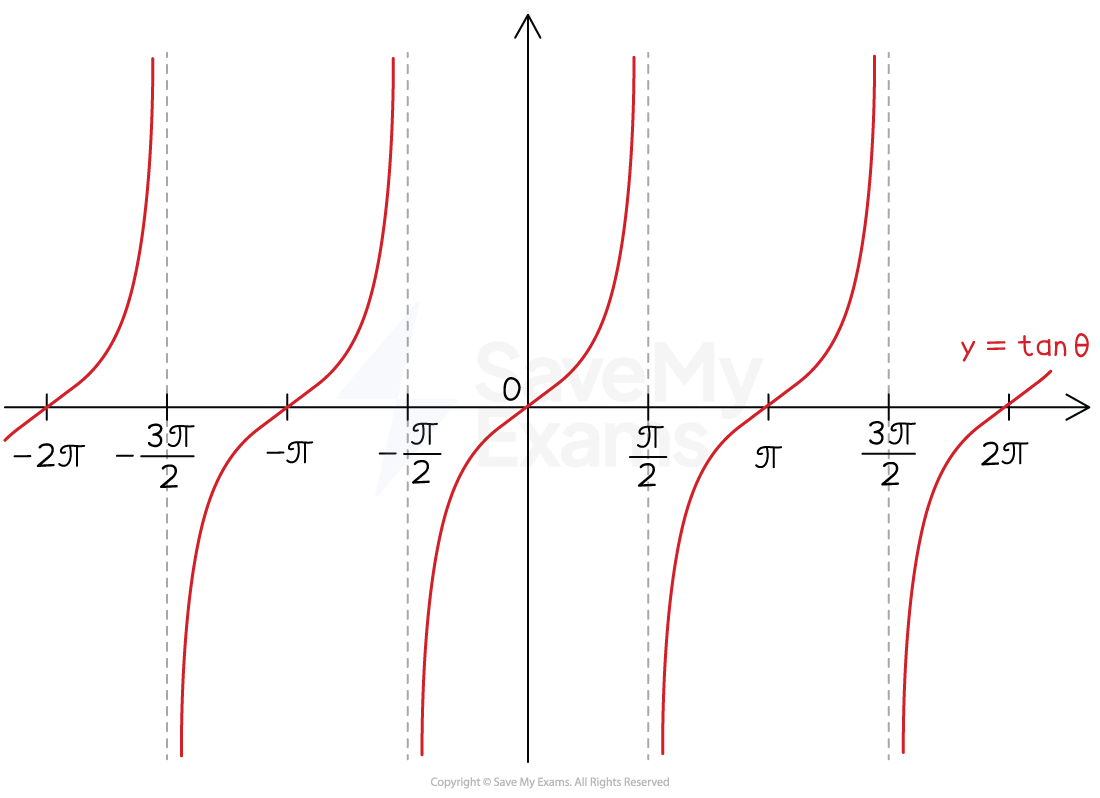
Where does the tangent function have asymptotes?
The tangent function is undefined when , which occurs at
At these input values, the terminal ray is vertical (pointing straight up or straight down)
so its slope does not exist
The graph of the tangent function has vertical asymptotes at each of these values
E.g. as approaches from the left, increases without bound
and as approaches from the right, decreases without bound
The tangent function therefore demonstrates periodic asymptotic behavior
the pattern of asymptotes repeats with the same period as the function
What is the behavior of the tangent function between consecutive asymptotes?
Between any two consecutive asymptotes
the tangent function is always increasing
The graph changes from concave down to concave up between consecutive asymptotes
Specifically, the graph is
concave down on the first half of the interval
and concave up on the second half
The changeover occurs at the point of inflection
which is where
i.e. at integer multiples of
Between consecutive asymptotes, the tangent function takes all real number output values, from to
Transformations of the tangent function
How do additive transformations affect the tangent function?
A vertical translation of the tangent function is given by
This shifts the graph vertically by units
The line containing the points of inflection is also shifted up by units
from to
The asymptotes are not affected by a vertical translation
A horizontal translation (phase shift) is given by
This shifts the graph horizontally by units
to the left if , to the right if
The asymptotes shift by units as well
How do multiplicative transformations affect the tangent function?
A vertical dilation is given by
This stretches the graph vertically by a factor of
If , the graph is also reflected over the -axis
this causes the function to be decreasing (instead of increasing) between consecutive asymptotes
and reverses the concavity pattern
The asymptotes and period are not affected
A horizontal dilation is given by
This changes the period of the function by a factor of
The new period is
If , the graph is also reflected over the -axis
this causes the function to be decreasing (instead of increasing) between consecutive asymptotes
and reverses the concavity pattern
The asymptotes are compressed or stretched accordingly
How are all transformations combined?
The general form combining all transformations is
The parameters have the following effects
: vertical dilation factor (with reflection over the -axis if )
: the period of the function
: the phase shift (horizontal translation)
: the vertical shift (the new midline of the points of inflection is )
For example, has:
Vertical dilation factor
Period
Phase shift of to the right (since )
Vertical shift of unit up
Examiner Tips and Tricks
When identifying the period of a transformed tangent function, remember that the base period is , not . A common mistake is to use the sine/cosine period formula instead of the correct tangent period formula .
Worked Example
The function is defined by .
(a) Find the period of .
(b) Find the equations of two consecutive vertical asymptotes of the graph of .
(c) Find the coordinates of the point of inflection of the graph of that lies between the two asymptotes found in part (b).
Answer:
(a)
The function has the form where
So the period of the tangent function is
(b)
The asymptotes of occur at
For , asymptotes occur when
i.e. when
So a possible set of two consecutive asymptotes (using and ) is
(c)
The point of inflection lies midway between the two consecutive asymptotes
At a point of inflection of a transformed tangent function, the tangent part equals zero, so
Therefore
The point of inflection is

Unlock more, it's free!
Join the 100,000+ Students that ❤️ Save My Exams
the (exam) results speak for themselves:

Was this revision note helpful?
Build on this topic