End Behavior of Polynomial Functions (College Board AP® Precalculus): Study Guide

End behavior of polynomial functions
What is end behavior?
The end behavior of a function describes
what happens to the output values
as the input values become very large (in the positive or negative direction)
For a polynomial function this describes what happens to
as increases without bound ()
or decreases without bound ()
For a nonconstant polynomial function, the output values will always
either increase without bound (go to )
or decrease without bound (go to )
in each direction
Polynomial functions never "level off" to a horizontal asymptote
they always increase or decrease without limit
How is end behavior expressed in limit notation?
End behavior is described using limit notation:
means "as increases without bound, increases without bound"
means "as increases without bound, decreases without bound"
means "as decreases without bound, increases without bound"
means "as decreases without bound, decreases without bound"
A complete description of a polynomial's end behavior includes both limits
i.e. what happens as and as
Examiner Tips and Tricks
In limit notation, the '' stands for 'limit'. So, e.g., may be read as 'the limit of as goes to infinity'.
How do I determine the end behavior of a polynomial?
First, identify the leading term
i.e. the term with the highest power of
Remember that the leading term might not be the first term written in the expression (see the Polynomial Functions study guide)
Then use the degree of the polynomial (odd or even) and the sign of the leading coefficient (positive or negative) to determine the end behavior
degree of polynomial | sign of leading coefficient | description of graph | ||
|---|---|---|---|---|
odd | positive | Left end goes down, right end goes up | ||
odd | negative | Left end goes up, right end goes down | ||
even | positive | Both ends go up | ||
even | negative | Both ends go down |
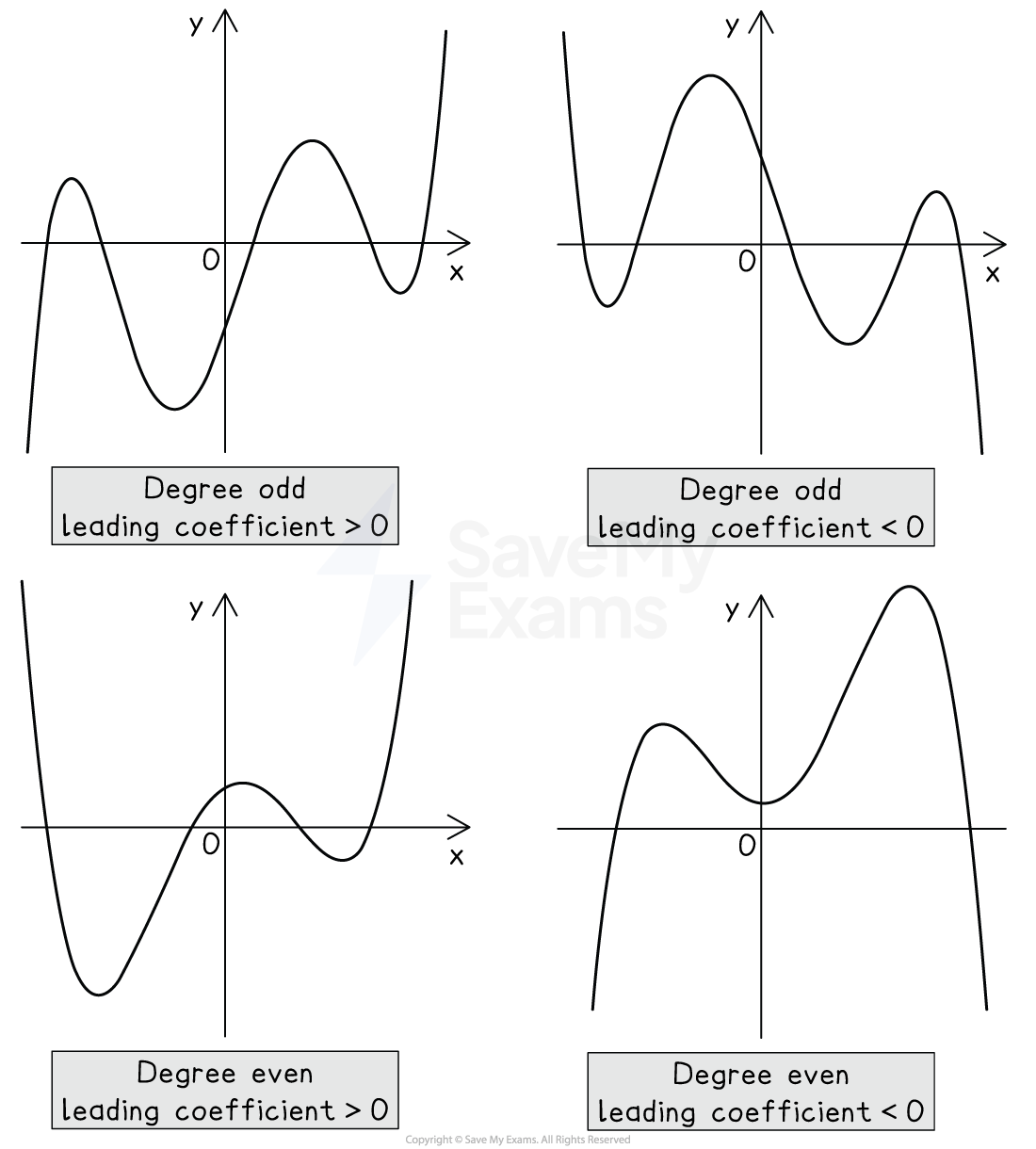
Examiner Tips and Tricks
Always check that you have identified the degree and sign of the leading coefficient correctly.
The leading term may not be the first term written in the expression
Why does the leading term determine end behavior?
As the input values increase or decrease without bound
the values of the leading term dominate the values of all lower-degree terms
This is because higher powers of grow much faster than lower powers
E.g. for
when is very large, the term is far larger in magnitude than the and terms
Therefore, the degree of the polynomial and the sign of the leading coefficient are all you need to determine the end behavior
How can I remember the four cases?
For odd degree polynomials, the two ends behave in opposite ways:
Positive leading coefficient → falls left, rises right (think of )
Negative leading coefficient → rises left, falls right (think of )
For even degree polynomials, both ends behave the same way
Positive leading coefficient → both ends go up (think of )
Negative leading coefficient → both ends go down (think of )
For the negative coefficient cases
note that multiplying by a negative number flips the end behavior compared to the positive coefficient case
Examiner Tips and Tricks
When an exam question asks you to describe the end behavior of a polynomial, always express your answer using limit notation (e.g. ). To earn all the points in a free-response question, you need to include all four components of a correct limit statement:
the "" symbol
the direction ( or )
the function, e.g.
and the result ( or )
Worked Example
The function is given by . Which of the following describes the end behavior of ?
(A) and
(B) and
(C) and
(D) and
Answer:
Consider the leading term (i.e. the term with the highest power of )
This is
The leading term will determine the end behavior of the function
First consider , which is an odd power of
When is positive, is positive
and as increases in the positive direction, increases in the positive direction
When is negative, is negative
and as decreases in the negative direction (i.e. becomes more and more negative), decreases in the negative direction
Then consider the effect of the coefficient, -3
This will make negative whenever is positive
and will make positive whenever is negative
Combining these means that
as increases in the positive direction, decreases in the negative direction (i.e. becomes more and more negative)
and as decreases in the negative direction, increases in the positive direction
In limit notation, this end behavior is written as
(D) and

Unlock more, it's free!
Join the 100,000+ Students that ❤️ Save My Exams
the (exam) results speak for themselves:

Was this revision note helpful?
Build on this topic