Zeros and Successive Differences of Polynomial Functions (College Board AP® Precalculus): Study Guide

Zeros of polynomial functions
What is a zero of a polynomial function?
If is a number and
then is called a zero of the polynomial function
Equivalently, is a root of the equation
Zeros of polynomial functions can be real or complex (non-real) numbers
How are zeros related to factors?
If is a real number, then is a linear factor of if and only if is a zero of
I.e. if is a linear factor of , then
Or if , then is a linear factor of
E.g. if , then the zeros of are , , and
This lets you write down the solutions to if you have in fully factorised form
Conversely, if you know that is a zero of a polynomial, then must be a factor
What is the multiplicity of a zero?
If a linear factor is repeated times in the factorisation of a polynomial
the corresponding zero has multiplicity
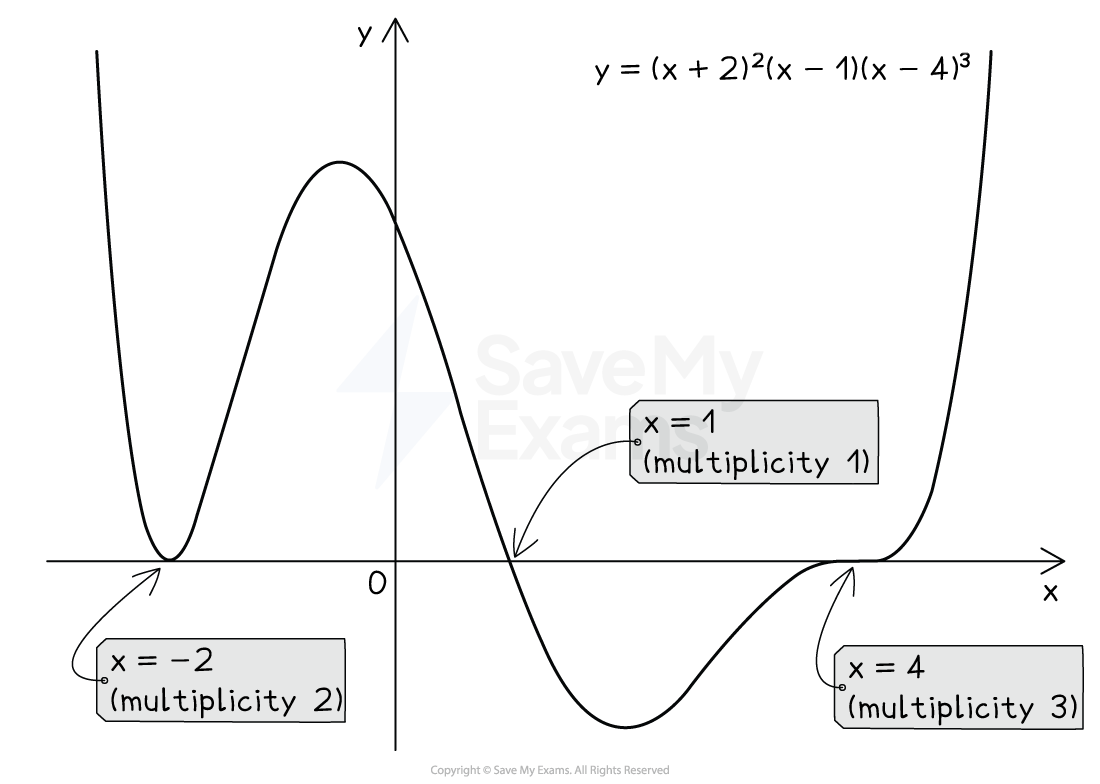
E.g. has
a zero at with multiplicity 2
a zero at with multiplicity 3
and a zero at with multiplicity 1
A polynomial function of degree has exactly complex zeros when counting multiplicities
A 'complex zero' here means a zero of the function that is either a real or a (non-real) complex number
E.g. a degree 5 polynomial always has exactly 5 zeros (counting multiplicities)
though some may be repeated (i.e. have a multiplicity greater than 1)
and some may be complex (i.e. non-real)
How do zeros appear on a graph?
If is a real zero of a polynomial function , then the graph of has an -intercept at the point
The graph crosses or touches the -axis at that point
The multiplicity of a zero determines the behaviour of the graph at that -intercept:
If the zero has odd multiplicity (e.g. 1, 3, 5, ...), the graph crosses the -axis at that point
The sign of the output values changes on either side of the zero
If the multiplicity is 1, the graph 'cuts straight across' the -axis
If the multiplicity is 3, 5 or more, then the curve 'levels out' as it crosses the -axis
If the zero has even multiplicity (e.g. 2, 4, 6, ...), the graph is tangent to (touches but does not cross) the -axis at that point
The sign of the output values is the same on both sides of the zero
The graph touches the axis then 'turns back'
Graph behavior at zeros with different multiplicities can be seen here:
How can zeros help solve polynomial inequalities?
The real zeros of a polynomial are the points where the output value is zero
Therefore they divide the -axis into intervals
On each interval between consecutive zeros, the polynomial is either entirely positive or entirely negative
This means the real zeros act as endpoints for intervals satisfying polynomial inequalities
E.g. to solve
find the zeros first
then determine the sign of on each interval between zeros
How can I find the zeros of a polynomial?
If the polynomial is given in factored form, set each factor equal to zero and solve
E.g. for
The zeros are , , and
If the polynomial is a quadratic, you can factor it (if possible) or use the quadratic formula
For higher-degree polynomials that are not easily factored, you can use a graphing calculator to find the real zeros
Enter the polynomial into the calculator and find where the graph crosses the -axis
Or use the calculator's "zero" or "solve" function
E.g. to find the zeros of
you would enter the function into your calculator
and find that the zeros are approximately , , and
Examiner Tips and Tricks
The zeros found on your calculator may be decimal approximations.
On your exam, report these accurate to three decimal places
What about complex (non-real) zeros?
Some zeros of a polynomial may be complex numbers
I.e. numbers involving
These do not correspond to -intercepts on the graph
since only real zeros appear on the real number line (i.e. on the -axis)
Complex zeros always come in conjugate pairs
I.e. if is a zero of a polynomial (where )
then is also a zero of
E.g. if is a zero, then must also be a zero
This means non-real zeros always account for an even number (0, 2, 4, 6...) of the total zeros
Examiner Tips and Tricks
When a question gives you a polynomial with a non-real complex zero, immediately write down its conjugate.
That gives you a second zero for free!
This is particularly useful for determining how many real zeros (and therefore -intercepts) a polynomial has
For example, a degree 4 polynomial with a given non-real zero must also have the conjugate as a zero
That leaves only 2 remaining zeros, which may be real or another non-real conjugate pair
Worked Example
The polynomial function is given by .
(a) Find all zeros of and state the multiplicity of each zero.
(b) For each zero, state whether the graph of crosses the -axis or is tangent to the -axis at that point.
(c) Find all values of for which .
Answer:
(a)
Set each factor equal to zero:
The 'squared' (power of 2) on tells you that has a multiplicity of 2
The other two zeros are both multiplicity 1
(b)
Use the multiplicity to determine the behavior of the graph at each zero
At :
multiplicity is (odd), so the graph crosses the -axis
At :
multiplicity is (even), so the graph is tangent to the -axis
(touches but does not cross)
At :
multiplicity is (odd), so the graph crosses the -axis
(c)
The zeros divide the -axis into four intervals: , , , and
Test a value in each interval to determine the sign of
:
:
:
:
The polynomial is only positive on one of those intervals
on
Worked Example
The polynomial function is given by , where and are nonzero real constants. Each of the zeros of has multiplicity 1. In the -plane, an -intercept of the graph of is . A zero of is . Which of the following statements must be true?
(A) The graph of has three -intercepts.
(B) is a zero of .
(C) The equation has four real solutions.
(D) The graph of is tangent to the -axis at .
Answer:
Because complex zeros come in conjugate pairs, if is a zero of , then must also be a zero of
That already tells you that (B) is the correct answer
but it's worth considering why the other answers are not correct
has degree 4, so it has exactly 4 zeros (counting multiplicities)
Each zero corresponds to a solution to
and are both non-real zeros
So the equation cannot have four real solutions
That rules out option (C)
Two of the zeros are non-real
So the remaining 2 zeros must either both be real
or both be non-real
because non-real zeros always occur in conjugate pairs
So can have at most 2 real zeros
which means at most 2 -intercepts
So option (A) cannot be true
Finally, you are told that each zero has multiplicity 1
1 is odd so the graph crosses the -axis at each real zero, rather than being tangent
This rules out option (D)
(B) is a zero of
Degree and successive differences
How can successive differences reveal the degree of a polynomial?
The degree of a polynomial function can be found by examining the successive differences of the output values over equally spaced input values
To do this:
Start with output values at equally spaced inputs
Calculate the 1st differences (differences between consecutive outputs)
If the 1st differences are constant, the polynomial has degree 1 (linear)
If not, calculate the 2nd differences (differences between consecutive 1st differences)
If the 2nd differences are constant, the polynomial has degree 2 (quadratic)
If not, continue taking successive differences until you reach a constant set of differences
The degree of the polynomial is equal to the least value for which the th differences are constant
E.g. consider these values at equally spaced inputs for a polynomial function :
0 | 1 | 2 | 3 | 4 | |
|---|---|---|---|---|---|
2 | 5 | 14 | 35 | 74 |
Calculate the differences
1st differences: — not constant
2nd differences: — not constant
3rd differences: — constant
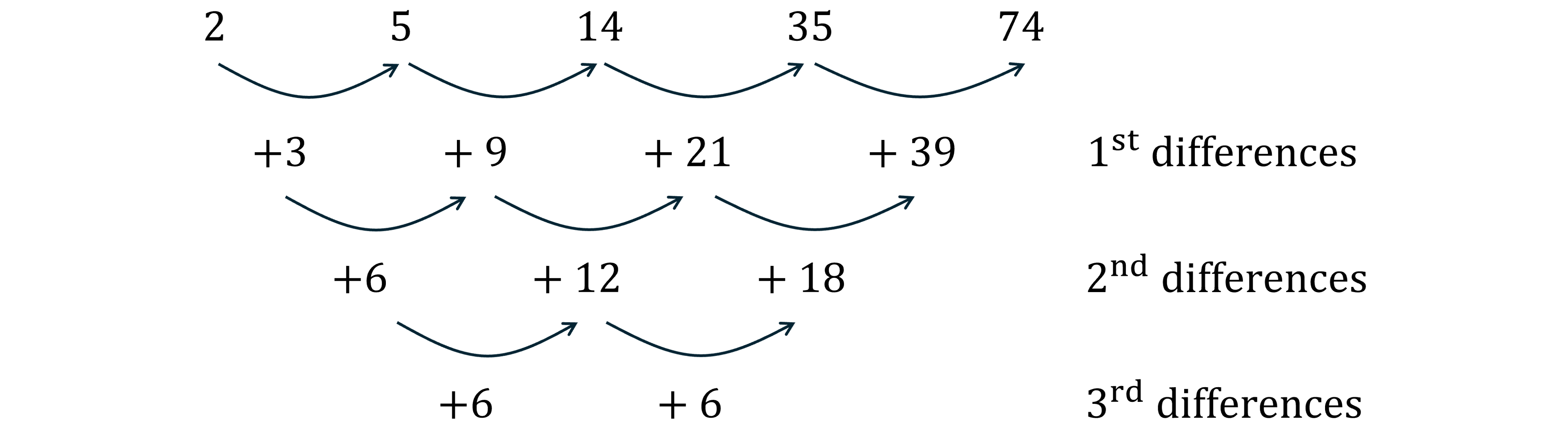
The 3rd differences are constant, so is a degree 3 (cubic) polynomial

Unlock more, it's free!
Join the 100,000+ Students that ❤️ Save My Exams
the (exam) results speak for themselves:

Was this revision note helpful?
Build on this topic